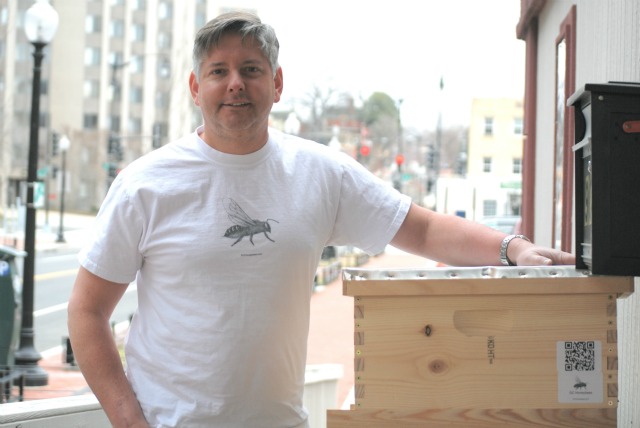
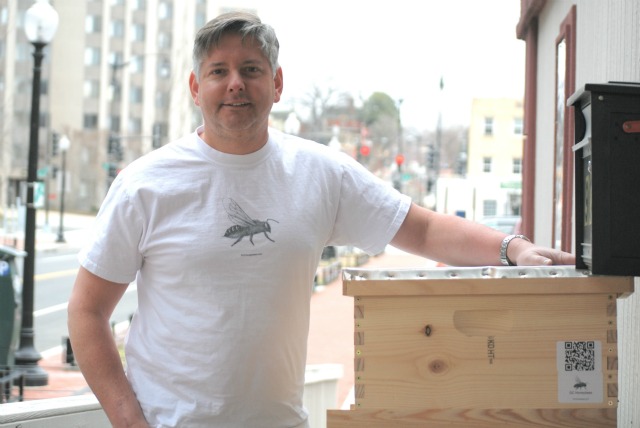
 D.C. bee guru Jeff Miller.
Jeff Miller is a Georgetown resident and Washington’s unofficial beekeeping guru. He founded the non-profit D.C. Honeybees and has installed dozens of hives across D.C., as well as several on the roof of his own townhouse. He’s even something of a smalltime celebrity — a new documentary, The Capital Buzz, features Miller and other D.C.-based beekeepers. We chatted with him about why the District is such a great place to be a honeybee — or a beekeeper. (Yes, urban beekeeping is a thing, so much so that even President Obama has a First Hive.)
How did you get into beekeeping?
I’m a real estate developer by trade. When the market took a nosedive in 2009, I, like many others found myself with a lot less to do. I needed something to fill that void. I’ve always been a foodie, and that took me from eating and making food to growing my own food in my plot in Georgetown. I did some research and found out about the importance of pollinators, and on a whim I got myself a beehive and put it on the roof of my townhouse. I thought it was fun, so I got another, and I became addicted. Like any good addict, I didn’t wanna be the only guy I knew [who was in to bee keeping], so I started a non-profit around my kitchen table. We hope to propagate more bees in the urban context and educate people about the importance of pollinators.
How are urban honeybees different than rural honeybees?
The behavior and life cycle are identical, but the foraging material in urban context seems to be a lot more plentiful and diverse than it is in the rural areas. In the District specifically we have a very green canopy that includes a lot of trees, on the streets and in parks. Trees are great for bees. As the season wanes, a lot of non-native species are here that extend the nectar flow — the nectar availability season. Plus there’s a lack of competition in the urban environment. We don’t have a lot of other competing pollinators, so it makes for a smorgasbord for the bees.
Approximately how many beekeepers are there in D.C.?
We helped 45 people become beekeepers last year in D.C., and there are probably about 50 more out there, including hives sponsored by the federal government and USDA.
How much does it cost to become a beekeeper?
For a basic hive with bees, it would be about $320 to $350, plus accessories it would be about $425.
What are honeybees doing in mid-February in D.C.?
What happens in the winter is they create a cluster in the hive, a ball of bees, and they basically buzz to produce heat. That heat keeps them warm, and keeps their larvae and the queen warm during these months.
They move through the hive to consume the honey that they’ve collected over the season as a carbohydrate source. They create honey to survive their own winters, but they create much more than they need and we harvest the surplus.
When do you harvest the honey?
Nectar flow starts in first part of March and goes through late May/early June, so we’ll probably start harvesting in June. We get about 60 to 100 pounds of honey per hive.
Do you get stung all the time?
Countless times. It ain’t that big of deal, unless you’re allergic. You shouldn’t be afraid of honeybees, because unlike wasps or yellow jackets, they are non-aggressive — they only sting when they are defending their hive.
What’s the best thing about beekeeping?
I think there’s something fascinating about the busy little workers, and understanding how the colony functions. The colony itself is the organism, not the bees. Plus having a small and time-relaxed hobby that produces a crop that’s as cool as honey.
Since it’s almost Valentine’s Day I have to ask: Do you get attached to your bees?
Oh, no. They only live for about five to six weeks. I look at them as urban livestock, they provide me a crop and some pleasure, but at the end of the day they are just a stinging insect.