“The people are the city!” That line appears just once in Shakespeare’s play detailing the rise and fall of fifth-century B.C. Roman war hero and politician Caius Martius Coriolanus (Ralph Fiennes), just as public opinion is turning ugly towards him and his anti-populist attitudes. Ralph Fiennes makes his debut as a director in an adaptation of that play, and in his and screenwriter John Logan’s version, set in modern times, that line becomes a repeated rallying cry for the people who oppose Coriolanus in his bid to follow military success with a run at becoming a Roman consul.
While filming on the project began in early 2010, the images of those people seem remarkably timely: as protesters decry Coriolanus’ open distaste for the will of the unwashed majority, it’s impossible not to think of Occupy activists angrily denouncing the 1 percent.
Coriolanus, a play not quite as well known or as often performed as some of Shakespeare’s other Roman tragedies, works remarkably well as a contemporary piece in Fiennes’ hands. The factions at work in the original play remain the same: the Romans on one side, the upstart Volsci on the other. The film simply relocates the Roman Empire in time, so that instead of swords and sandals we get assault rifles and combat boots. Instead of public forums on marble steps, we get broadcasts from television studios.
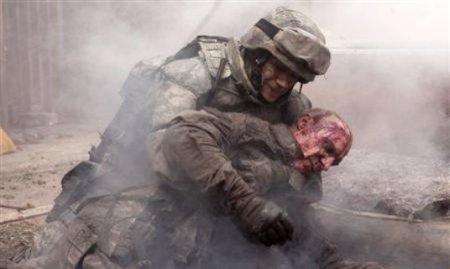 Military conflict is constantly at the center of the story, first with Coriolanus’ instrumental role in beating back an uprising of Volsci soldiers in the city of Corioli — the battle that gives him his name and the power necessary for the political run — and then later, after he has been exiled, and joins up with the Volsci and his mortal enemy Tullus Aufidius (Gerard Butler) and uses their army in an attempt to exact revenge on Rome. Fiennes adopts a gritty, handheld style for the warfare footage that far removes the piece from its roots on the stage. Think The Hurt Locker as imagined by the Bard. Logan’s script also excises vast amounts of text from the original play, often opting for a show rather than tell approach that furthers the cinematic effect.
Make no mistake, though: the film still feels Shakespearean through and through, and it’s easy to get lost in the unfamiliarities of the language, particularly in a work where the plot isn’t quite as familiar as a Hamlet or a Romeo and Juliet. Best to let the words merge with the images as one whole, and don’t be concerned with parsing every word as it’s spoken.
Fiennes helps us out by filling the film with actors more than capable of handling those words. Vanessa Redgrave takes on the role of Coriolanus’ icy mother Volumnia, a stern matriarch who pushes her son to the quest for public office that is eventually his downfall, and does it as much for her own glory as his. Jessica Chastain appears as his wife, Virgilia, while Paul Jesson and James Nesbitt are excellent as Brutus and Sicinius, two tribunes who act as the voices of the people and help to initiate the general’s eventual tumble. Gerard Butler may be the biggest surprise here, ditching action flicks and romantic comedies for something meatier, and proving a worthy adversary for the title character. Best among the supporters is Brian Cox as Menenius, a patrician advisor to Coriolanus.
But this is really a show for the man of the title, and in that role, Fiennes proves to not be distracted at all by directorial duties, infusing Coriolanus with the rage and vengeance that make him one of the least sympathetic of Shakesepearean protagonists. This is a character reminiscent of Jack Nicholson’s Colonel Jessup in A Few Good Men, a career soldier without the time or the inclination to answer to anyone about how he does his job. Imagine how disastrous a Jessup for Senate campaign would be, and you have a sense of how quickly Coriolanus’ contempt for those he views as ungrateful and unworthy of his efforts becomes his undoing.
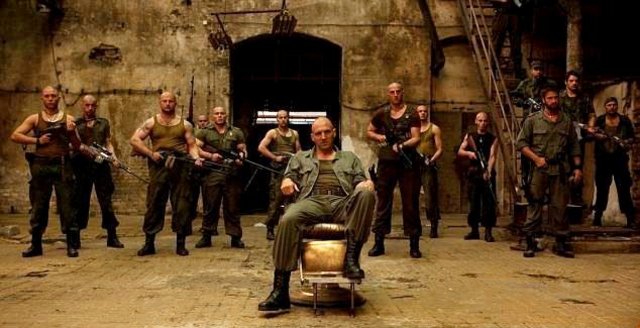
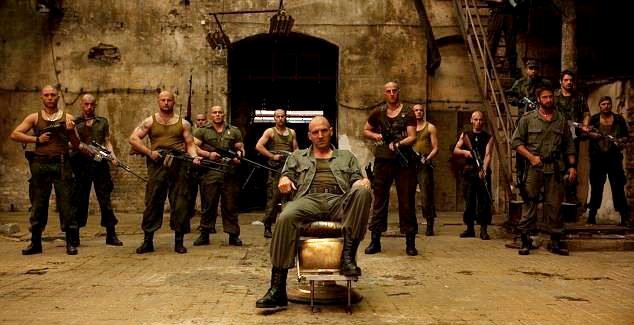
Men like this have magnetic charisma, so when he joins up with the Volscians, they quickly become acolytes, much to the annoyance of their erstwhile leader, Aufidius. The men take to shaving their heads just like Coriolanus does his, as a rite of passage. When he grants anyone an audience, he sits in a chair as if a guerrilla king, backed by burly armed soldiers looking as intense as he does.
This is the portrait of the birth of a fascist leader, and Shakespeare’s play sets his will to power in direct opposition to the people of Rome and their right to rule themselves. In modernizing the setting, Fiennes only makes the comparison more relevant. Once set down the path against the, it’s difficult to turn back. As with most Shakespearean tragedies, even when acts of contrition are offered, the cost of taking the wrong path is high, and the currency is blood. Fiennes latches onto the violent heart of this play and this character, and never shies away.
—
Coriolanus
Directed by Ralph Fiennes
Screenplay by John Logan, from the play by William Shakespeare
Starring Ralph Fiennes, Gerard Butler, Brian Cox, Vanesa Redgrave, Jessica Chastain
Running time: 122 minutes
Rated R for some bloody violence.
Opens today at West End Cinema.