Many of us spend a lot of time learning about what we’re putting in our mouths. We ask our servers about items in dishes with unfamiliar names. We consult sommeliers, cicerones, and bartenders on which wines, beers, and cocktails would go with our meal or suit our preferences. And there are fishmongers and cheesemongers in this city that serve similar edifying functions.
So why is it that meat, often the centerpiece of a meal, garners so little consultation of experts during the procurement process? Why are there no “meat sommeliers”? Now that it’s popular for food to be environmentally friendly and humane, so many of us are concerned about how close the farm is to our plate, what the animal is fed, and how much space the animal has to roam. But we don’t take the time to consider how efficiently an animal is processed and utilized or what cuts might best suit our dish.
A good butcher will take all of these details in to consideration. That’s where the expertise of Society Fair’s charcutier Julien Shapiro comes in. He can help you navigate the over 30 different cuts of dry-aged Virginia and Randall Lineback beef, as well as Shenandoah lamb, Virginia pork, poultry, sausages, and cooked charcuterie that are butchered or prepared in-house.
Shapiro, whose most recent stint was at Palena, draws deeply from French butchery and charcuterie. Working in Paris, he learned basic butchery and cooked charcuterie preparation at Gilles Verot (charcutier for highly decorated chef Daniel Boulud) and whole animal butchery and dressing at Hugo Desnoyer (butcher).
Shapiro elaborates on the difference in American and French butchering philosophies – American butchery uses saws, rather than knives, to break down cows in to ribs, steaks and ground beef. French butchery breaks down pieces that would usually be made in to ground beef in to economical, but delicious cuts. For instance, the round (leg) yields pear, spider, and whiting cuts make for tender, flavorful minute steaks at a sensible price. And nothing goes to waste.
As an example he recounts one of his experiences in France, “The dedication to the standard of quality was bordering on reverence. I vividly remember the lead beef butcher furious, calling the person responsible for the slaughter of the cows and ordering him to immediately stop slaughtering because the aging time was not consistent with the aging on the beef and that one of the loins showed signs of the cow being “feverish” -burgundy colored meat that did not spring back when pressed, indicative of a cow that was either stressed before slaughter (which affects the pH [and flavor] in the meat) or killed in a room that was too hot.”
For him meat is a pursuit of not just dogma, but art. His pâté en croûte are beautiful handworks in pastry that tell a story of the ingredients within — the fruit outlines in pastry hint at the ingredients inside. (He notes about cracks in the pastry, “You just spackle it with duck fat, and then torch it until the hole seals.”)
And Shapiro studies further outside of work — watching French butchery videos, researching recipes, and then meticulously documenting the results of home experiments on his blog Kitsch & Classics.
He notes, “Properly executed cooked charcuterie has savory qualities, unctuousness, balance, flavors, textures, spice, aesthetics and complexity (from different meats, different grinds, fat, pastry, fillings and such). The true worth of cooked charcuterie (for me) is being able to manipulate and transform what are otherwise austere scraps into something fanciful and exquisite.”
And when it comes to forcemeat, Shapiro is no slouch. He pays close attention to the requirements/standards for charcuterie appellations from ‘Le Livre du Campagnon Charcutier-Traiteur. “It specifies length, weight, diameter and minimum compositions necessary to be called such a style or to bear a title such as truffle or foie gras or other luxury ingredient (to prevent fraud). The book also has tables showing animal yields, water and fat content for both land and sea animals, brine solutions, smoking charts and so forth.”
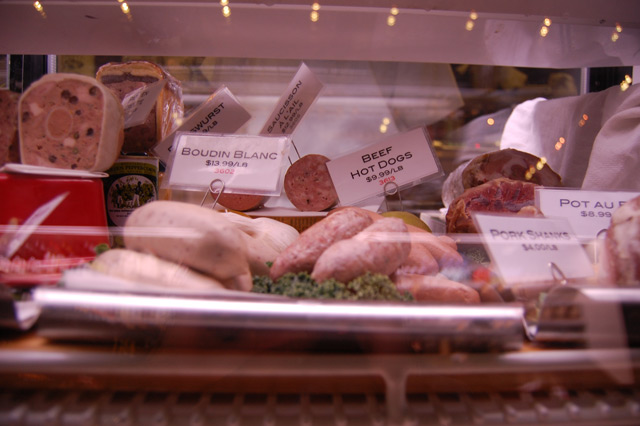
And from this he has developed a repertoire of excellent sausages (as well as charcuterie) that includes chorizo, Rindswurst, Murçon, breakfast bangers, mortadella, merguez, and much more. Though not all of it is available for immediate sale. In some cases there is a lack of demand for certain products, such as merguez, the delicious Middle-Eastern spicy harissa-accented lamb and beef sausage. However, if customers wish to purchase five pounds or more of a sausage in Shapiro’s repertoire, they can place a custom order for them.
Tube Meat Week was meant to be stories about sausage. But the real story is the dedication behind the people who make them. “I’d need at least a week to adequately answer [why it matters to me] in a thesis that would justify the extent of my pursuits, but in the immediate: Traditional resourcefulness, French atavism and disciplined technique.” And the story of Julien Shapiro is his dedication to a philosophy that seeks to make the best and most out of the least with attention to purpose and artistry, and the desire to show others the delicious way.