DCist’s highly subjective and hardly comprehensive guide to the most interesting movies playing around town in the coming week.
—
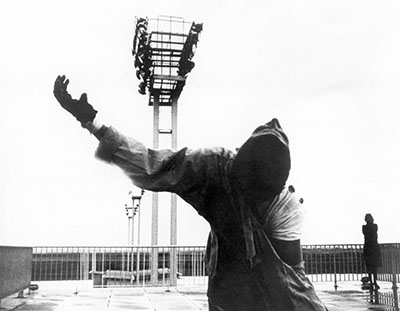 © New Yorker Films/Photo Fest
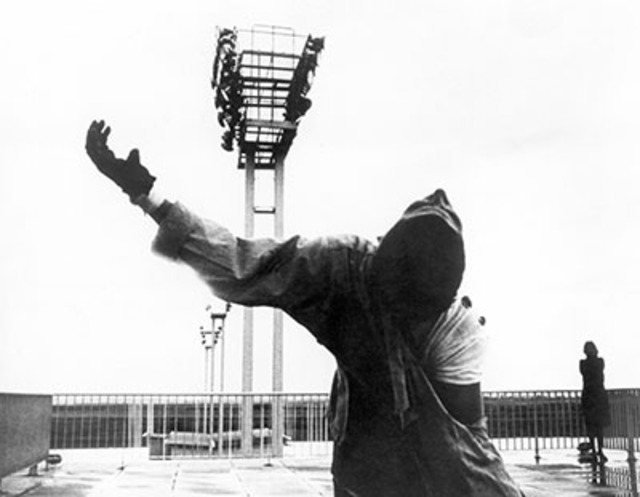
 What it is: One of the best science-fiction movies ever made consists almost entirely of still photos.
Why you want to see it: They’re called motion pictures, but what happens when moviemakers use still photos? On Saturday the National Gallery’s Photofilm! series opens with a look at still photos and the movies in the program How Much Movement Does the Image Need. The centerpiece is Chris Marker’s 22-minute La Jetée, a time-travel story that’s at once a meditation on the movies (with allusions to Vertigo), photography, the nature of time, and the best Twilight Zone episode never made. Marker’s career since has mostly been at the service of dense, complex documentaries, but he also took time out to reference his masterpiece in a music video for Electronic. The program also includes short films by Sergei Eisenstein, Leonore Mau and Hubert Fichte, and Katja Pratschke and Gusztáv Hámos. (For a hilarious and irreverent use of still photos, keep an eye out for Robert Downey Sr.’s Chafed Elbows, due to appear in a Criterion set this spring). Sunday’s program Recall and Memory features short work by Thierry Knauff, Agnès Varda, Jerzy Ziarnik, Franz Winzentsen, Helke Misselwitzand Janet Riedel, Katja Pratschke, and Gusztáv Hámos.
View part one of La Jetée.
Saturday at the National Gallery of Art at 2:30 pm. Free.
—
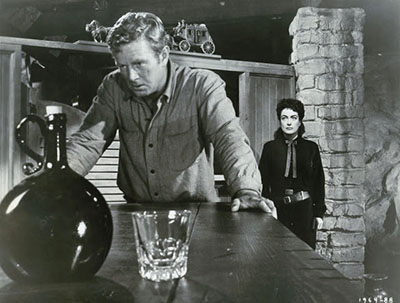 No more wire hangers, Sterling!
What it is: A camp classic western for people who hate camp and westerns.
Why you want to see it: ‘She makes me feel somehow less of a man.” That’s Sterling Hayden as the titular guitar-wielding cowboy in the strange gender-bending Johnny Guitar. It’s not his fault that the manliest presence in the film is star Joan Crawford. Who would not be emasculated by her statuesque frame, and those giant eyes that threaten to devour you in chunks? I’m np fan of self-conscious camp but it’s impossible not to howl at the sexual politics of this film, hilarious and fascinating in ways that you can’t imagine the filmmakers had in mind. It’s a case study in how mores change over time; from the Wild West to the 1950s, from mid-century America to now. Thanks to the AFI for including this in their Nicholas Ray series – how can this not be on DVD?
View a manly clip from Johnny Guitar.
Sunday, Feb 26 and Tuesday, Feb 28, at the AFI.
—
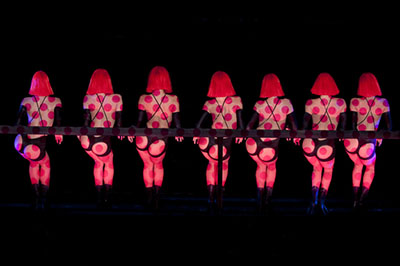 Crazy Horse
What it is: A documentary about the legendary Paris cabaret.
Why you want to see it: Documentary filmmaker Frederick Wiseman has made a career out of looking at troubled social institutions: his landmark Titicut Follies (1967) exposed the harrowing conditions inside a hospital for the criminally insane. The titles of his films are pretty self-explanatory: High School (1968), Hospital (1970), The Store (1983). Wiseman’s latest film offers exposure of a different kind. Crazy Horse opened its doors in 1951, and has played host to all sorts of entertainers, including iconic ventriloquist Senor Wences. But the club is best known for beautiful nude women and light shows that play like a live-action R-rated James Bond opening title sequence. So why is Crazy Horse kind of boring? Wiseman takes you behind the scenes, to watch the performers get ready for a show, and this means choreography as well as tedious board meetings. And the uniformity of the dancers figures makes for neat lines but not much in the way of human variation. Polka dotted lights turn a row of derrieres into the body abstract. It’s institutional conformity in an unlikely place. Go figure: Senor Wences appeared in the 1977 film Crazy Horse de Paris, which had no pretenses to documentary filmaking; and that was kind of boring too.
View the trailer.
Opens tomorrow at E Street.
—
What it is: One of the inspirations for The Artist’s George Valentin.
Why you want to see it: So you thought The Artist was pretty cute, and you’re wondering if an Actual Silent Movie would be any good? Guess what: they’re better! This year’s Oscar front-runner is, in typical Academy fashion, charming but bland, a watered-down simulacrum of its ancestral betters. Just ask David Denby. The moustachioed Valentin played by Jean Dujardin may get his name from screen idol Rudolph Valentino, but his look and persona is closer to that of ur-swashbuckler Douglas Fairbanks, Jr. Saturday afternoon the AFI screens a new 35mm print of the rare two-strip Technicolor silent The Black Pirate, starring Fairbanks as the titular hero out to avenge his father’s death. With live musical accompaniment by the Alloy Orchestra, who will also be on hand for Friday night’s sold-out screening of the futuristic silent classic Metropolis.
View a clip.
Saturday, February 25 at 2:30 at the AFI.
—
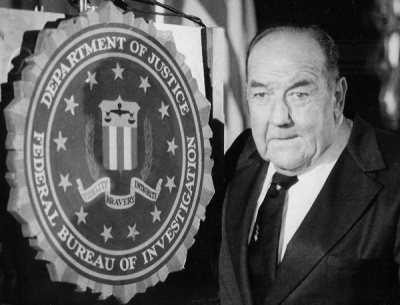 Broderick Crawford knows where you’ve been sleeping.
The Private Files of J Edgar Hoover
What it is: The b-movie precursor to Clint Eastwood’s biopic.
Why you want to see it: The days are long gone when the AFI would screen this on a double bill this with Beyond the Valley of The Dolls. But what other repertory theater would give viewers a chance to compare the acting skills of Leo DiCaprio and Broderick Crawford? The Highway Patrol star is a different kind of FBI kingpin in this picture directed by schlockmeister Larry Cohen. Film Comment‘s Geoffrey O’Brien called it “tabloid satori … a B-movie aura of moral exhaustion and scurvy duplicitousness rendered all the more believable by the veteran actors who incarnate them.” But whom are you going to believe, me or Film Comment? An all-star cast including Michael Parks, José Ferrer, Celeste Holm, Rip Torn, and even George Plimpton can’t muster the class needed to push Private Files above it’s pay-grade.
View the trailer.
Monday February 27 and Thursday March 1 at the AFI.
—
Also opening this week: two Oscar nominees for Best Foreign Film: the Belgian crime drama Bullhead and the Polish Holocaust drama In Darkness. We’ll have full reviews tomorrow.