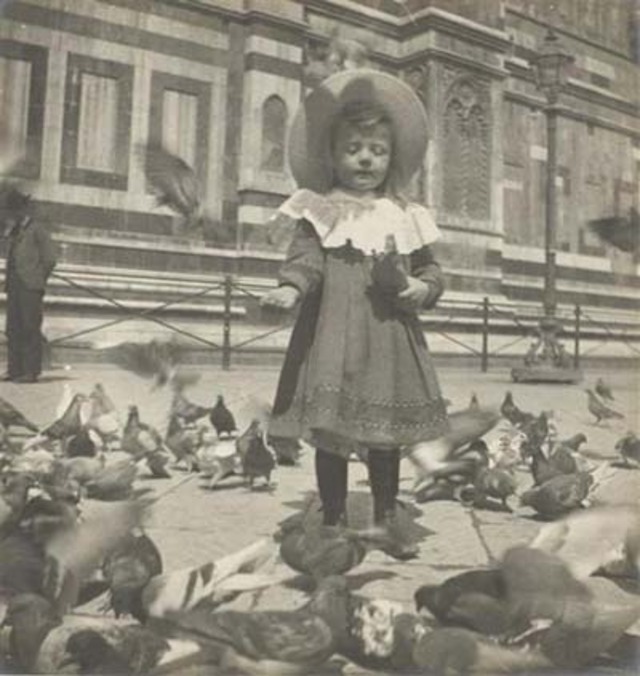
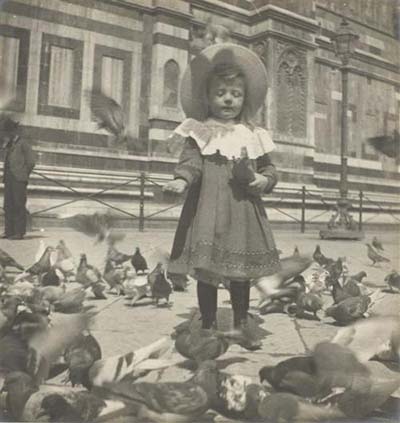
 Maurice Denis, Bernadette feeding pigeons in front of the Duomo., Florence, 1904. Gelatin silver print, 4 ¾ in. x 6 ¼ in . Musee de Orsay, Paris. Gift of Mme Claire Denis, through the Societe des Amis du Musee d’Orsay, 2006. © 2012 Artists Rights Society (ARS), New York / ADAGP, Paris.
The Phillips Collection’s excellent new exhibit Snapshot: Painters and Photography, Bonnard to Vuillard, is ostensibly about how a handful of post-impressionist artists cottoned to the dawn of hand-held photography at the end of the nineteenth century. None of these artists, from Pierre Bonnard and Eduard Vuillard to lesser known’s like George Hendrik Breitner and Henri Riviere, quit their fine art calling to chase the photo muse in more than a casual way. There are some outstanding post-impressionist canvasses on display, but Snapshot succeeds most as a photography show, one that is in some ways more impressive than the Phillips Pictorialism survey or even the Museum of Modern Art’s recent Cartier-Bresson retrospective. It’s the thrill of discovery as opposed to revisiting the canon.
Snapshot may even change the way you think about the history of photography. After previewing the show, friend of DCist Chris Chen, aka furcafe, tweeted that it was “funny how painters’, even avant garde, reluctant embrace of new photo technology set back photos as art.” The photos on exhibit here were never made public during the artists’ lifetimes, yet look forward to photographic trends that would appear years later.
Snapshot focuses on the camera work of a handful of artists who were members of the avant-garde Nabis group: Bonnard, Vuillard, Maurice Denis and Felix Valloton. The work of three other artists of the time, Breitner, Evenpoel and Henri Riviere, are also featured. These men all experimented with Kodak’s handheld cameras, introduced in 1888. This was a time when photography was no longer the exclusive domain of studios and cumbersome view cameras. Roll film (or portable glass plates) and lightweight machines, several of which are on display at the Phillips, made picture taking a household endeavor. The title of the exhibit reminds us that these are the kind of informal images that we take today with our smart phones, but that is not to suggest for a minute that they are a lesser art.
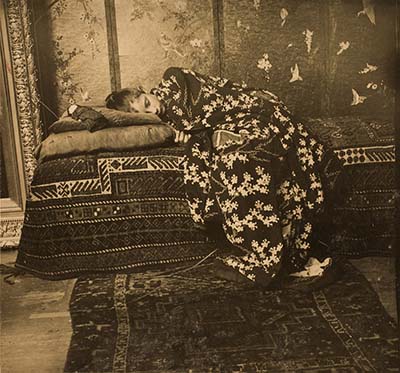 George Hendrik Breitner, Girl in a kimono (Geesje Kwak) in Breitner’s studio on Lauriersgracht, Amsterdam, n.d. Gelatin silver print, framed: 12 1/4 x 15 1/4 in. Collection RKD (Netherlands Institute for Art History) The Hague.
The exhibit starts with a ringer whose camera and easel work were both at a high level, although only one of these arts was meant for public consumption. Pierre Bonnard found a painterly equivalent to the photographic approximation of shadow and light, and his post-impressionist brush strokes can be seen as a soft and textured substitute for film grain. His photos are dynamic. He worked with shutter speeds fast enough and machines portable enough to capture water in mid splash as children play, recalling boyhood photographs made by Jacques Henri Lartigue in the early 20th century.
The limited palette of Bonnard’s cyanotypes may bring to mind the limitations of today’s ubiquitous snapshot makers, the smart phone. But these limitations can result in evocative images. In fact the shallow tonal range and low contrast of some photos in the exhibit can be seen as the artists’ experimentation with the limitations of the medium. It’s not a bug but a feature.
Henri Riviere’s photos of the construction of the Eiffel Tower in 1889 document two emerging technologies in photography and architecture. Riviere’s lithographs of the same subject reveal the influence of Japanese printmaking, complete with the artist’s red stamp in each frame, but as technically brilliant as these are, they lack the deep mystery and bold tones of the photographs.
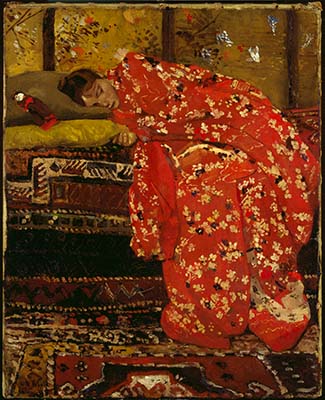 George Hendrik Breitner, Girl in Red Kimono, Geesje Kwak, 1893-95. Oil on canvas, 24 x 19 1/2 in. Noortman Master Paintings, Amsterdam. On behalf of private collection, Netherlands.
Maurice Denis is one of the more remarkable photographers in the group, and his camera work benefits from some of the larger prints on display. His composition and lighting has the freshness of 20th century street photography. But his Symbolist paintings, inspired by Gaugin but more decorative, less wild, seem naive and kitschy. The paintings of his wife and daughter are specific and sentimental, but his photographs, which often suffer from his holding the camera too close for his subjects to be in focus, have a mystery lacking in his canvasses.
Breitner’s stark nudes recall the prostitute portraits of E. J. Bellocq, with many of the models gazing boldly into the lens. His images are tack-sharp, but on canvas he worked to soften detail, and it’s hard to choose between the textures of his painting Girl in Red Kimono and the photographs he worked from, one of which includes a calico cat that didn’t make it into the final composition.
Research has shown that Breitner would go shooting with more than one camera. The shooting habits of the artist-photographers in Snapshot may be familiar to modern photographers. The men often took pictures of each other, and the camera was a tool of documentation and experimentation but also a focus of camraderie. In that spirit, Snapshot is destined to start discussions among photographers and painters alike.
Snapshot: Painters and Photography, Bonnard to Vuilard is on display at The Phillips Collection through May 6. The Phillips Collection is located at 1600 21st St NW and is open Tuesday through Saturday from 10 a.m. to 5 p.m., Thursday from 10 a.m. to 8:30 pm., and Sunday 11 a.m. to 6 p.m. Admission is $12.