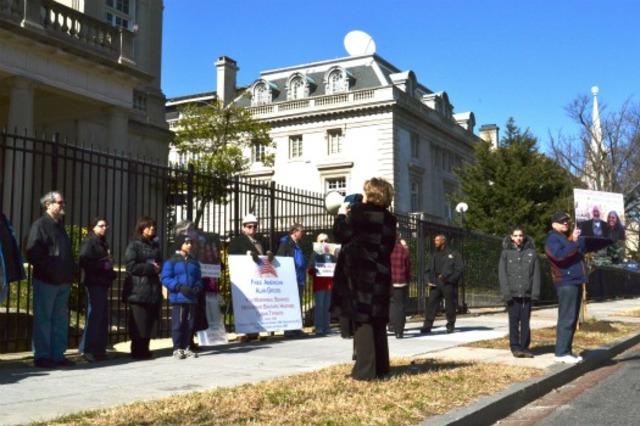
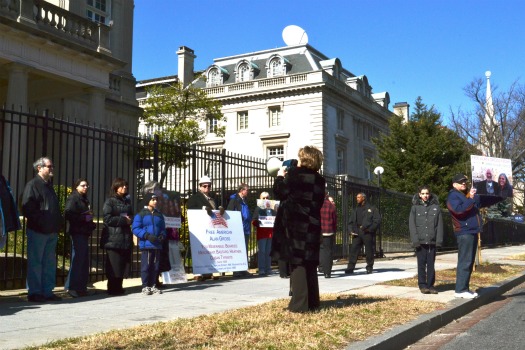
 People gathered in front of the Cuban Interests Section last Monday hoping to influence the Cuban government to release Alan Gross, an American jailed in Cuba for two years, based on humanitarian grounds. (Kat Lucero)
Despite a recent AP report questioning the innocence of a D.C.-area resident who was detained while working as a U.S. government subcontractor in Cuba, support remains strong for Alan Gross’ release after two years in jail on the communist island.
The Jewish Community Relations Council (JCRC) of Greater Washington’s weekly vigils demanding Gross’ release based on humanitarian grounds continue to take place every Monday at noon outside the Cuban Interests Section. The organization also launched a new nationwide online petition Wednesday appealing Pope Benedict XVI to convince the Cuban government to release the 62-year-old Maryland native.
“We are going to be here every Monday!” declared JCRC Executive Director Ron Halber at this week’s gathering outside the diplomatic mission on 16th Street in Northwest D.C. Addressing the Cuban government with a megaphone, Halber went on to say, “Our will for Alan to come home is stronger than your divided people.”
JCRC launched the petition in anticipation for the pope’s upcoming trip to Cuba from March 26-28. News reports state that his first visit to the island is to support its Catholic Church leaders who have been influential in changing President Raúl Castro’s government.
The visit will be an “opportunity of a goodwill gesture,” said Rev. Clark Lobenstine, executive director of the InterFaith Conference of Metropolitan Washington, an organization that co-sponsors vigils with JCRC.
Gross, a USAID subcontractor, was arrested in Havana in December 2009. A few months later, he was sentenced to 15 years in prison for espionage crimes against the state for operating under a pro-democracy project illegal under Cuban law.
People championing Gross’ release maintain that he never meant any harm to Castro’s government. They continue to demand for his release for humanitarian reasons not only because of his ailing health, but because his family also needs him — his wife had to sell their home, and his mother and one of his daughters were recently diagnosed with cancer.
The AP investigation, however, reveals that Gross’ attempt to help the small Jewish community in Cuba did appear to be a covert operation. One of his activities included bringing a specialized chip often used by the Pentagon and the CIA to make satellite phone signals undetectable. Another was identifying himself “as a member of a Jewish humanitarian group, not a representative of the U.S. government.”
U.S.-Cuban policy experts also said that the Jews on the island have excellent communication with the rest of the world. The synagogues are even connected to the Internet, so it’s questionable why USAID would reach out to them.
Some of the Jewish leaders in Cuba were “upset that the U.S. government was trying to involve” their community, said Wayne Smith, director of the Center for International Policy’s Cuba Project and former chief of mission at the U.S. Interests Section in Havana.
Experts, however, don’t think the report changes the humanitarian campaign surrounding Gross. He is still caught in the middle of the tense relations between the two countries. Although he broke Cuban law and knew the risks, they also believe he never meant to subvert the government.
“Everyone wants Alan Gross to come home,” said Anya Landau French, director of New America Foundation’s U.S.-Cuba Policy Initiative.
Landau French said that USAID is “blurring the lines of aid and intelligence” and the organization was not smart to send subcontractors like Gross to countries that are hostile to the United States. “The real threat to Cuba is not from this one man, it is the government that sent him there,” she wrote in The Havana Note responding to the AP story.