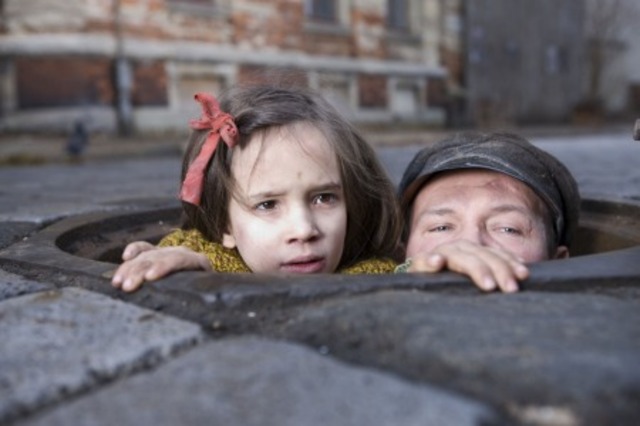
 There’s an textual epilogue at the end of Agnieszka Holland’s new Oscar-nominated World War II drama that confirms something that I suspected throughout the film: the director was angry. Like most movies that involve the Holocaust, this is a story of struggle against adversity and the triumph of the human spirit in the face of unspeakable actions. But most of those films look at the atrocities with a sad resignation — what’s done is done, so better to mourn than to rage — that balances whatever triumphal notes there are in the story.
But with a few words put on the screen just before the credits roll, Holland reveals a deeply bitter attitude towards human nature. She argues that the attitudes that inspired the Holocaust weren’t an anomalous and defeated evil, and didn’t die with the Third Reich; they’re simply an innate part of our nature that must be constantly battled. It’s this attitude that makes the film a vital addition to Holocaust movies, because it makes the case that vigilance against such evil must be constant, enduring, and is never easy.
The movie is based on In the Sewers of Lvov, Robert Marshall’s 1990 non-fiction account of a group of Jewish residents of the Polish (now Ukrainian) city of Lvov who avoided being taken from the city’s Jewish ghetto to a concentration camp by hiding out in the sewers for nearly a year. Their survival was assisted by Leopold Socha (Robert Więckiewicz), a Catholic sewer worker who initially agrees to help them only because he is extorting money in exchange for not turning them in.
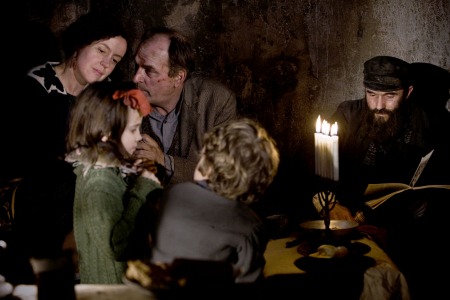 Holland is relentless in driving home how awful the experience of living in the sewers was for these refugees. Rats constantly skitter along the edge of the frame, and everything from the walls to the foul water to the faces of anyone who decends into these catacombs looks so grimy you’d swear there was filth smeared on the camera lens. Children brought into the sewer vomit from the stench. Feeling the need to shower after watching is an entirely natural reaction. And “In Darkness” isn’t an idle description of the conditions: cinematographer Jolanta Dylewska keeps the underground footage dim and grainy, lit only by candles and flashlights. As if the tunnels don’t feel claustrophobic enough already, the darkness closes things in even more tightly.
Things above ground aren’t very bright either. The winter in Lvov seems never-ending, and even when the snows disappear, the city almost always seems grey, damp, and chilly, with a few notable exceptions that Holland uses very carefully for symbolic impact.
On the surface, In Darkness hits all the standard notes of Holocaust cinema. Scenes of daring escapes from ghettos while jackbooted Nazis casually fire bullets into the heads of anyone not falling into line, of concentration camp lineups, of breathless hiding in dark spaces while searching soldiers are mere feet away are all de rigueur for the genre by now. What sets it apart, though, is that subtle but unmistakeable undercurrent of anger, the sense that Holland is frustrated by the hate we all have inside of us.
Even the refugees aren’t exempt from criticism into this basic nature. One man, caught by his wife cheating just before they are forced to escape, callously chooses his mistress over his wife and children, and then has the gall to have sex with her in full view of his wife and the rest of the refugees. Later, when it becomes clear that only a portion of the initial number of those who have fled into the sewer will be able to occupy the best hiding place that Socha can arrange, bitter bickering and the pulling of rank based on class and money starts breaking out among them to decide who gets the prime sewer real estate. Even the victims of atrocity can be atrocious to one another, Holland points out.
It’s a shame that the Academy so rarely considers foreign language films for anything other than the single foreign language Oscar, because Więckiewicz’s performance as Socha is one of the most complex and riveting of the year. He starts the film as a petty thief, supplementing his city-funded income with stolen items he and his partner hide in the sewers. His attitude towards the refugees in his care is one of openly anti-semitic contempt, and it’s a credit to the actor’s skill that when he slowly begins to legitimately care for them — bringing them matzo for Passover, and eventually putting is own life at great risk to save them — it feels utterly genuine.
His humanism and transformation is the foil to Holland’s own pessimism. It’s not enough to triumph over adversity and those who have already given in to evil; the most important victories are the ones in battles waged against our worst internal impulses and beliefs. But there is nothing artificially uplifting about that message; that internalized battle is as grim a slog as living a year in the darkness underground. Holland’s uncompromising honesty in the presentation of those struggles makes its inspirational component, the bright light that it inevitably leads towards, entirely earned.
—
In Darkness
Directed by Agnieszka Holland
Written by Robert Marshall and David F. Shamoon, based on Marshall’s book, In the Sewers of Lvov.
Starring Robert Więckiewicz, Benno Fürmann, Agnieszka Grochowska, Maria Schrader
Running time: 145 minutes
Rated R for violence, disturbing images, sexuality, nudity and language
Opens today at Bethesda Row and Shirlington.