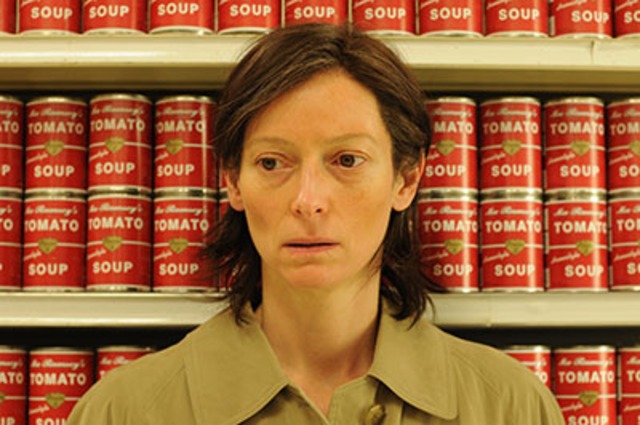
 Tilda Swinton in WE NEED TO TALK ABOUT KEVIN. Courtesy of Oscilloscope Laboratories
 Midway through director Lynne Ramsay’s powerful film We Need to Talk about Kevin, Eva (Tilda Swinton) tells her six-year old son Kevin (Jasper Newell) a bedtime story about Robin Hood. The boy’s relationship with his mother had up to that point been one of mutual frustration and frequent contempt. As Kevin listens to his mother tell him the satisfying tale of another foe smote by an arrow, he at last finds something which they can share as a family: violence.
The events of We Need to Talk about Kevin, based on the novel by Lionel Shriver, are inspired by the mass shooting at Columbine High School in 1999. Gus Van Sant looked at similar themes with his stylish Elephant, which cast vapid Gap-model kids in a beautifully filmed study of high school culture. But instead of focusing on high school life, Ramsay takes a different approach, which has an experimental look and feel but makes what is perhaps a conventional argument: it’s mommy’s fault.
Kevin is filled with blood but also tomato sauce and strawberry jam. Ramsay makes frequent connections between food and violence, as if hunger – for affection and attention – can be fueled by both. The film opens with what seems like a nightmare: an ecstatic Tilda Swinton crowd surfs on a swarm of revelers drenched in what looks like blood. But the red sea pours not from open veins but tomatoes, at a festival. Eva wakes up to find her white house splattered with red paint. The mother is an outcast at the start, and in a curious reversal of the Biblical saw, the sins of the son are visited upon her.
Even more gaunt than usual, Swinton is thus introduced as a mother who is depressed and shunned, and who has difficulty finding work. She is haunted by her past, and we are introduced to this past in non-linear fits and starts the way that we might revisit our own failings and triumphs in no particular order. She drives through a crowd at night towards what we sense is the tragedy for which she is being punished. But we only see this through beams of light that go in and out of focus, through desperate crowds looking in horror at something we do not yet see. The director repeatedly withholds information, in much the way that Eva withholds affection from her son.
 Ezra Miller and Tilda Swinton in WE NEED TO TALK ABOUT KEVIN. Courtesy of Oscilloscope Laboratories
 About her son. We see Kevin at three different ages, and the young actors who play him at these ages all drip with malevolence. Even Rock Duer, who plays the toddler Kevin, gives a pretty but evil eye to his mother as she rolls a ball to her son in the vain hope that he’ll return the interaction. At 6-8 yrs, Jasper Newell plays a Kevin who is not yet potty trained and walks around the house in a diaper, the inability to read his inner workings taken as both a lack of control and a manipulative tactic. The developing menace is shown to its creepiest in Ezra Miller as the teenage Kevin, a brooding charismatic figure. Miller’s agent should get him ready to play Joker in Batman 2025.
This is Ramsay’s third feature, and the fragmented narrative and diverse soundtrack recalls her last film, Morvern Callar. The score by Radiohead’s Jonny Greenwood is relatively restrained for the composer, and the jarring percussion that punctuates certain scenes appropriately adds to the unease. This is played against songs like Buddy Holly’s “Every day” and Lonnie Donegan’s version of “Muleskinner blues,” songs of gentleness and confidence that provide an uncomfortable contrast to the tension on screen. John C. Reilly, who plays Eva’s husband Franklin, is the human equivalent of this musical counterpoint. He’s easygoing and doesn’t seem to have real chemistry with Eva, but their mismatched personalities feed the domestic tension: Kevin is fully aware that his every word of feigned camaraderie with dad is a needle in Eva’s maternal eye.
Nobody really talks about Kevin in We Need to Talk about Kevin: no character attempts to explain his behavior. But the suggestions are clear, from Eva’s indifference to motherhood, to growing impatience, and finally to physical confrontation. The Oedipal tension becomes perhaps too obvious. But even if there is such thing as a good reason for what happened, how does one possibly deal with the aftermath? Swinton walks a fine line here, and makes us feel both sympathy and distaste for her character. Her frail body seems at times vulnerable, at times a weapon. With her unusual frame and features, is there any contemporary actress better at expressing alienation? We Need to Talk about Kevin tells a fragmented tale about the fractured psyche. It poses difficult questions, and perhaps has too easy answers. But it’s a grueling and fascinating interview process.
We Need To Talk About Kevin
Directed by Lynne Ramsay
Written by Lynne Ramsay and Rory Kinnear, based on the novel by Lionel Shriver
Starring Tilda Swinton, John C. Reilly, Ezra Miller
Running time: 112 minutes
Rated R for disturbing violence and behavior, some sexuality and language
Opens today at West End Cinema, AMC Georgetown, and AMC Shirlington.