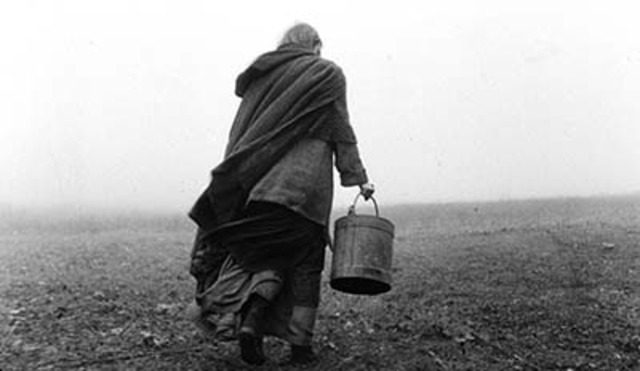
 Erika Bók in The Turin Horse. Courtesy of Cinema Guild.
An old man and his daughter peer into the depths of a well that has suddenly run dry. “Fuck!” the old man declares. There is occasion for dry levity in Béla Tarr’s swan song The Turin Horse, but the film is a hard slog by design. The Hungarian director is known for long takes and punishing running times. Ask anyone who’s made it through his seven hour Satantango and they may tell you Tarr is one of the most powerful artists working in film. But the more casual cinephile may look at the comparatively brief 2 ½ hour duration of his latest punishment and ask, “Why the long movie?”
The film starts with with a black screen as a narrator tells of the mental breakdown of philosopher Frederich Nietzsche in Turin in 1889. Legend has it that Nietzsche watched in horror as a cab driver whipped a horse that refused to move. The philosopher intervened, hugging the animal and sobbing before returning home, where he passed out for two days and awoke to utter a few brief words that would be the last he ever spoke for the remaining ten years of his life. Nobody knows what became of the horse, the narrator continues, but Tarr’s film takes up the narrative as a study in hardship on a Biblical level.
A tired old workhorse struggles on a country road in a windstorm, driven by a tired old man with a face out of the Old Testament. The workhorse and the old man struggle to get home in what seems like real time, and then the true drudgery really begins, for the old man and his daughter and perhaps for the viewer as well. The Turin Horse is divided into six days, and the first days have a dreary similarity, as the man and his daughter get dressed, cook and eat their daily meal (a single potato), fetch water from the well, and repeat the process to the strains of a repetitive, brooding score by frequent Tarr collaborator Mihály Vig.
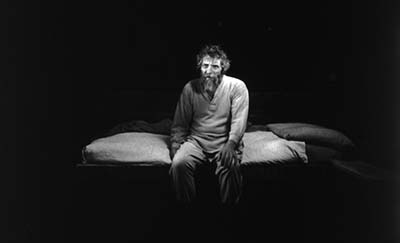 János Derzsi in The Turin Horse. Courtesy of Cinema Guild.
The black and white cinematography by Fred Kelemen bathes painterly compositions in a rich tonal range that you don’t often see in today’s black and white movies. Chiaroscuro still lifes of an old wooden table and steel dishes are the work of a photographic master. The film’s sound design is effective from howling winds to quiet interiors. But this mastery holds up the most uninviting narrative.
There’s nothing wrong with making hard work and dismal lives your subject. The film means to convey the stark tedium of farm life in what may be the last days before the end of the world. But the aesthetic is so extreme it becomes almost humorous as another round of the oppressive musical theme begins again and another day opens with the old man’s bare feet sticking out from a threadbare blanket and the old man and his daughter mash another hot potato.
This ascetic aesthetic will be familiar to fans of Tarkovsky, Bergman, and Bresson, whose Au Hasard, Balthazar, which resonates throughout Tarr’s film, screens at the National Gallery on Sunday. But the work of those directors are a cakewalk compared to a Béla Tarr joint.
The Hungarian director is only 56 but claims that this will be his last film. The Turin Horse’s overbearing descent into darkness is an obvious metaphor for a filmmaker’s twilight. There is no doubt that the man has a strong vision and the chops to put it on celluloid. But even those predisposed to the filmmakers who resonate with him may find this rough going. Brave moviegoers who manage to stay awake through such cinematic hardship will be rewarded with a gorgeous monochrome palette. In the end, however, the film’s characters as well as the viewer may welcome the apocalypse.
The Turin Horse (A Torinói ló)
Directed by Béla Tarr and Ágnes Hranitzky.
Written by László Krasznahorkai and Béla Tarr.
Starring János Derzsi and Erika Bók.
Running time: 146 minutes.
Not rated; contains graphic ennui and despair.