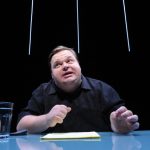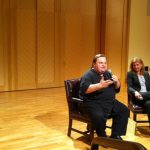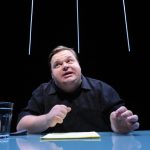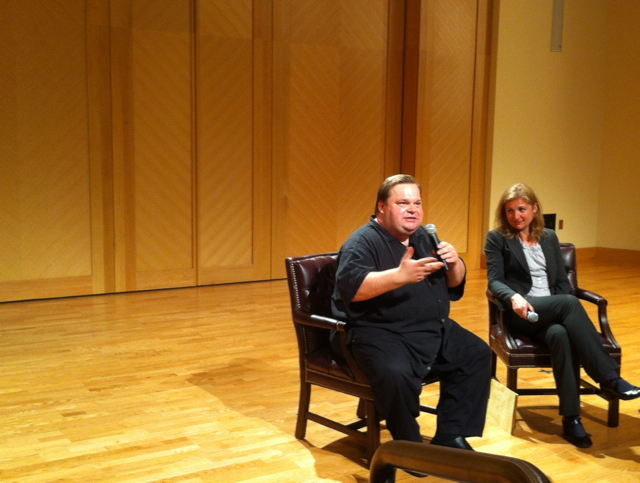
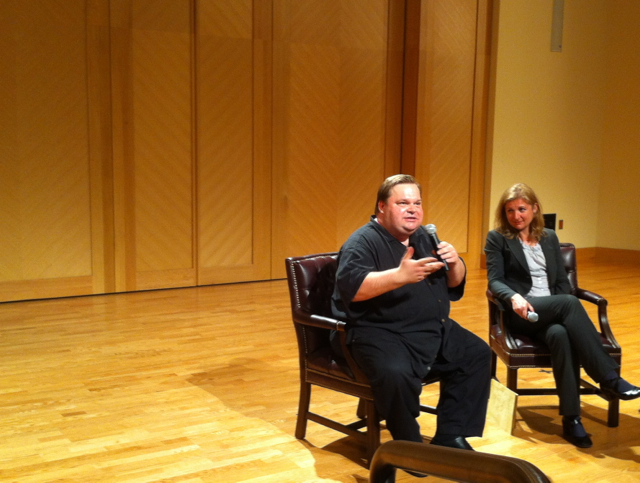
 Daisey, with Georgetown University labor researcher Jennifer Luff.
“I remember seeing guns at the gates of Foxconn,” Mike Daisey said last night.
Yeah, Daisey remembered a lot of things. Unfortunately, he also misremembered things, misremembered the order of events and, when all else failed, covered up holes in his narrative with outright lies.
Daisey was at Georgetown University last night where he had been scheduled to address a crowd on labor issues. Guess what he ended up talking about.
The appearance was Daisey’s first since his one-man show, The Agony and the Ecstasy of Steve Jobs, closed its run Sunday at the Public Theater in New York. Of course, the real story here is that just days earlier, the rhapsodic storyteller became the center of a controversy that has embroiled equally the essence of journalism and the meaning of theater.
When This American Life announced last Friday it was retracting an episode it had aired in January that presented Daisey’s show as narrative journalism, it was an ugly blotch on the program’s otherwise sparkling reputation as a fount of truthful—albeit whimsical—storytelling. For all his deadpan delivery and hipster street cred, Ira Glass has always held This American Life to the same burden of veracity one expects of any other newsgathering program.
Daisey opened his Georgetown remarks meekly.
“I thought about canceling,” he said. “I never fully imagined I would become James Frey. And James Frey is an asshole.”
But the handwringing was a tease. Daisey acted—yes, it was essentially a new monologue—the remorseful one, but there were few actual apologies. Certainly not for his approach. “I don’t take notes,” he said repeatedly throughout the evening, insisting his style of constructing narratives is the same one used every day by teachers, lawyers and preachers. Maybe that was the case for some of Daisey’s previous shows like If You See Something Say Something, his 2008 riff on the war against terrorism.
But The Agony and the Ecstasy of Steve Jobs was never supposed to be a fish tale. From the outset, it has always been presented as a raw piece of nonfiction. Not “based on a true story,” but a verifiably true story. That’s what the programs read for its “birth” run at Woolly Mammoth Theatre Company in summer 2010. Theatergoers have been promised by Daisey—and the theaters that have hosted him—that the Steve Jobs piece would be an eye-opening dose of brutal truth about the company that produces all those shiny gadgets we love so much.
“I have a good reputation in the American theater,” Daisey said at one point last night. “It didn’t do well because it was about Chinese labor. It did well because it was about Steve Jobs. It tries to make you care where your shit comes from.”
That might have been Daisey’s aim, but when alleging to speak truth to power, journalistic training informs us, the execution is as important as the purpose.
And yet, on Monday night, sitting in a Georgetown amphitheater, Daisey tried to meander on back, saying the “journalist” appellation was forced upon him by actual journalists who caught his monologue and started interviewing him about his trip to China in spring 2010. The interviews he conducted outside the gates of Foxconn’s plant in Shenzhen became factory-floor tours; the number of underage employees jumped from a rare exception to a significant percentage of the workforce; his translator and two other sources were blended into a single character—these alterations happened, Daisey said last night, because of insinuations put to him by journalists interviewing him.
It was a serious charge to level against reporters and, sitting a couple dozen rows back with a group of colleagues who were restricted from asking questions at the end, quite insulting. Daisey tried to soft-pedal it with some more self-deprecation: “I’m a moron and people ask me things sometimes and I just fucking tell them.”
Trust, but verify. It was one of Ronald Reagan’s catchphrases, and it works pretty well for reporters, too. One hopes anyone who interviewed Daisey while The Agony and Ecstasy of Steve Jobs was swelling in critical acclaim and water-cooler chatter did that much, yet here he was insinuating he was nudged into a web of embellishments and half-truths. Giving interviews, Daisy said, was “another kind of storytelling.”
At some point, Daisey said, the details of the argument succumbed to the urgency of the broad strokes. Fine. Let’s run them down: Does Apple contract with Foxconn to manufacture its products? Are the labor conditions at Foxconn grueling, unsafe and otherwise deplorable? Was Steve Jobs practically unmatched in creating public adoration for his company and its inventions?
The answer to any of these questions, as evinced by reporting that predates Daisey’s first performances of the show in July 2010, is unequivocally yes. Before making his own trip to China, Daisey immersed himself in newspaper articles and human-rights reports compiled by groups like Sacom, which has long advocated against the conditions at Foxconn’s Shenzhen campus.
The Agony and Ecstasy of Steve Jobs caught fire. IPhone-clutching audiences walked away from Daisey’s performance thrilled by his witty delivery and stunned by the things he’d seen in China. About the time he appeared on This American Life in January, The New York Times revisited Foxconn to tell the detailed story of how explosions at iPad assembly plants killed four people and injured another 77.
But getting on the radio with Glass demanded a fastidious review. “As soon as he said ‘We have to check everything’,” Daisey recalled, “ooh.” He knew his “chronology was completely hosed” and his “facts were fucked,” but he knew putting the Apple monologue on a widely distributed radio program could reach far more people in one weekend than live recitations could in a year.
So Daisey patched some holes in his story with white lies and exaggerations, but the main threads remained accurate. It passed muster and became the most downloaded episode in This American Life’s history. He could have declined, a possibility he acknowledged last night. But the opportunity to spread his message so far and wide was too tempting to pass up. And he crossed over from performance artist to working journalist.
Except, there were no guns outside Foxconn, reporters from Marketplace and the Times told Glass in the retraction show last weekend. Nor were there hordes of teenage workers inside the factory, just the rare, random stowaways that sometimes manage to sneak their ways into manufacturing jobs. And Daisey—his interpreter, now tracked down and interviewed, said—talked to far fewer people than he originally claimed.
But Daisey’s defense last night was that it was all in the service of spreading word of Apple’s dark underbelly. “I honestly believe it was the right thing to do,” he said. “I didn’t do the right thing, but having that story on the air was right.”
To Daisey, his murky version was the closest thing out there to a truth no one else was bothering to expose.
“There are foreign correspondents, and where were they?” he exclaimed.
But lack of mainstream coverage of a problem spot in the world is no excuse to start trumping up an undercooked report. That’s what Daisey couldn’t seem to grasp. As much as he betrayed his journalist friends and sullied the reputations of This American Life and its bespectacled host, Daisey remained, on balance, unapologetic for what he did.
“I try to talk about the truth,” he said. “Not the facts necessarily, but the truth.” Again, it bears repeating: The truth is only so solid when there are facts to back it up, doubly so when passing off one’s work as journalistic output.
And whether he admits to it or not, that is precisely what Daisey did from the first showing of The Agony and the Ecstasy of Steve Jobs. Consider those playbills Woolly Mammoth distributed—“This is a work of nonfiction,” they read. And Daisey himself insisted that statement be placed inside the programs, according to Alli Houseworth, who was the communications director at Woolly Mammoth when Daisey’s show premiered.
The Agony and the Ecstasy of Steve Jobs wasn’t meant to be some trifling monologue, Houseworth recalled. From the start Daisey envisioned it as a piece that would galvanize the masses to realizing the ugly side of their shiny new devices:
For months and months four major non-profit organizations across the U.S. (Seattle Rep, Berkeley Rep, Woolly and the Public Theater) worked to put TATESJ on the stage, bringing the story we all felt was so enormously important—a story Mike told at least me time and time again was true. He insisted that “This is a work of non-fiction” be printed in playbills. This was to be a work of activist theatre. Staff at Woolly handed out sheets of paper to every audience member that left our theatres, per Mike’s insistence, that urged them to take action on this matter. (I and other staffers would get nasty emails from him the next day if even one audience member slipped by without collecting this call to action.) As the head of the marketing staff at Woolly, my staff and I worked hard to get butts in seats, and it worked. We sold out our houses. As in the other cities where Mike appeared, we got Mike in every major news outlet in D.C., and the buzz, hype and importance of the show only grew along the way.
Houseworth also advised a boycott of Daisey’s productions until he delivers a proper apology not just for bilking audiences expecting to hear the whole truth and nothing but it, but for allowing his blunderbuss narrative style that allowed him to stand in the way of his own worthy objective.
But sitting on that lecture-hall stage, Daisey put it on the backs of journalists. Report on his obfuscations and subsequent apology tour if they must, he said, “as long as they tell that fucking factory story.”
It’s crucial that news organizations stay focused on abuses by manufacturing concerns that produce goods for Apple and other popular brands. But it’s also vital to ensure that story, like all others, should be told with the utmost adherence to the truth. Our industry might be stretched, but I think we can do both. At times, Daisey’s mealy-mouthed regrets seemed like more of a “fuck-you tour” than an apology tour.
Daisey told his audience last night he felt “pulled by journalism” as time passed, but that “he played the role of a bad journalist.” The more Daisey opens his mouth, the more that seems like the truth.
And the more he tries to straddle the gap between journalism and an impassioned work of performance art, the more he seems like a bad theatermaker, too.