Martin Austermuhle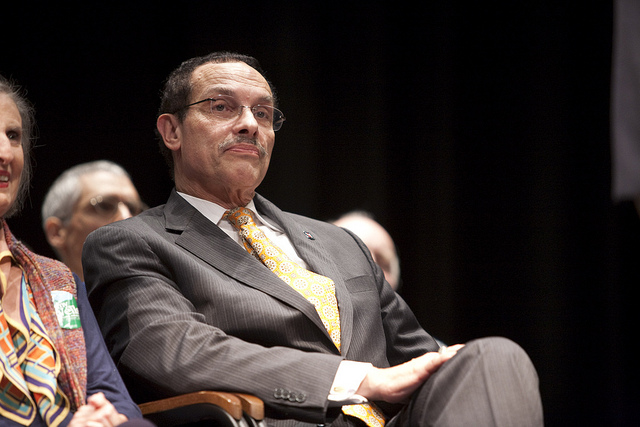
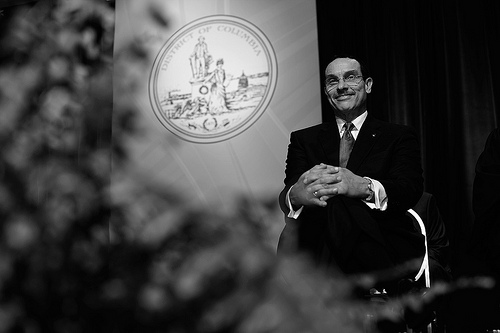 Photo by Matt Dunn
It was around this time last year that Sulaimon Brown’s claims against Mayor Vince Gray were dragging down his first year in office, and today we’ve got a whole new slate of allegations revolving around the 2010 mayoral campaign that could well derail Gray’s second year—if not the rest of his term.
Both the Post and the City Paper are reporting on claims that Gray’s campaign against Mayor Adrian Fenty was two-fold—the traditional above-board apparatus that collected and reported campaign contributions and expenditures and a shadow campaign that illicitly funneled money to off-the-books campaign operatives.
According to both papers, the shadow campaign revolved around Vernon Hawkins, a political operative and former D.C. government official. Writes the Post:
The former campaign staffers said the alleged activity ran outside the apparatus of the official election efforts, meaning that the spending was not reported, as would generally be required by campaign finance laws.
Several campaign aides and volunteers told The Washington Post that veteran field organizer Vernon E. Hawkins coordinated the alleged effort, sometimes working out of Gray’s downtown campaign headquarters. At the time, Gray (D) was considered an underdog, and his fundraising badly lagged behind that of the incumbent mayor, Adrian M. Fenty (D). The alleged shadow campaign would have added money and manpower.
The aides and volunteers spoke on the condition of anonymity to be candid about the matter. Some said they had talked with investigators looking into the Gray campaign.
Top campaign consultants said they believed that Hawkins — a former Human Services director who was forced out in 1996 after mismanagement claims — was a volunteer who advised them on campaign literature that would resonate with voters east of the Anacostia River. The campaign workers said they don’t know the origin of Hawkins’s effort, which included getting voters to the polls and distributing literature, but that it was well-organized.
Hawkins did not return calls seeking comment, and Gray said it was his understanding that Hawkins was a campaign volunteer. Gray declined to answer specific questions about the campaign allegations, citing the ongoing investigation.
None of the people identified by The Post as being involved in Hawkins’s alleged operation is listed on Gray campaign-finance records as receiving significant compensation. Under city law, political committees must publicly report their activities even if they are not coordinating with a campaign. The Post could not find any records filed with the D.C. Office of Campaign Finance that reflect the activity the aides described.
To add more the the shadiness of this, the Post reports that Hawkins coordinated with a consulting firm linked to Jeffrey Thompson, the businessman whose home and office were raided recently be federal officials. Thompson has donated hundreds of thousands of dollars to local candidates of all stripes over the years, and some of those have come in the form of money orders. Critics say that the money order donations are simply a means to get around individual contribution limits.
The claims of two campaigns have angered people who worked to get Gray elected legitimately. Mo Elleithee, a consultant who helped with messaging during the campaign, told the Post, “It’s increasingly clear that there was a shadow campaign that the legitimate campaign didn’t know anything about.” This morning on Twitter, Elleithee said he wasn’t abandoning Gray, but rather was “furious” about the new allegations that have surfaced:
@dc_voter No, not abandoning. Just furious with the idiots who ran a secret campaign that was against everything that we were all about.
— Mo Elleithee (@MoElleithee) March 22, 2012
A Gray campaign employee who asked to remain anonymous echoed Elleithee’s comments to us this morning: “From day one it felt like there were two campaigns: the east-of-the-river campaign and the west-of-the-river campaign. The professional campaign and the not-professional campaign. It was always frustrating, but no more so today than it was when it was happening.”
In related news, yesterday Gray said that he thought a broader look at campaign finance laws and enforcement mechanisms in the District is needed. Both the D.C. Council and a group of residents have introduced legislation and spurred an initiative that would crack down on money orders and corporate contributions. There is also a campaign to recall Gray from office that is collecting signatures to get on the ballot.