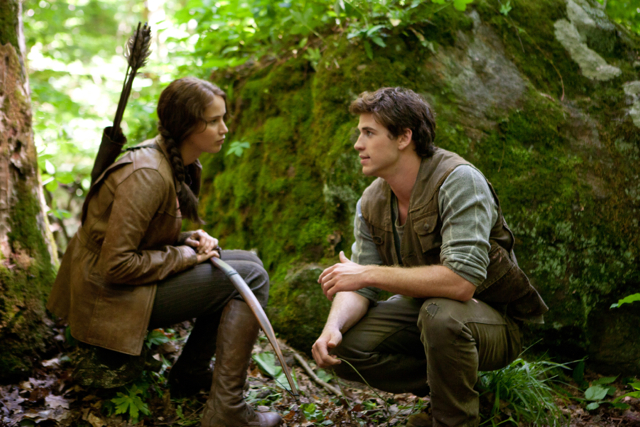
 Katniss Everdeen (Jennifer Lawrence) and Gale Hawthorne (Liam Hemsworth) in “The Hunger Games. (Lionsgate/Murray Close)
Dystopian satire and a young-adult franchise seem like mutually exclusive concepts, but author Suzanne Collins walked that fine line with her Hunger Games trilogy and made herself a worthy competitor to those angst-riddled wizards and lovelorn vampires. Collins’ book series raises all sorts of political and cultural issues one doesn’t expect to find on the tween bestseller list. And the first volume, The Hunger Games, is now this spring’s most hotly anticipated movie, all but guaranteed to make a killing at the box office. But how does it navigate the thornier aspects of the book?
Adolescence is a time of self-consciousness, when humans not yet fully formed begin to navigate the muddy waters of society, while at the same time coming to terms with their still developing minds and bodies. But what if youg adults were also required to kill?
The gist of The Hunger Games is a fight to the death among teens. A boy and a girl between the ages of 12 and 18 is selected by lottery from each of the twelve districts of Panem, a kind of post-apocalyptic North America. The 24 young people must fight until only a single combatant is left alive. It’s a spectacle like unto the ancient Romans (and for good measure there’s Claudius and Seneca presiding over it) and only a few steps up the rung from the reality television that currently inundates our culture. It’s violent stuff for the pre-teen crowd, and provocative for adults who can ferret out political resonance. Collins, also serving as screenwriter, manages to keep the cutthroat action exciting but not too gory. But translating her vision to film is a tricky balancing act. A movie that is truly faithful to the book’s violence would easily rate an R, but there goes most of the target audience at the multiplex. To tone down the violence would be to diminish the book’s message. Sadly, this is to what director Gary Ross’ adaptation of The Hunger Games falls prey.
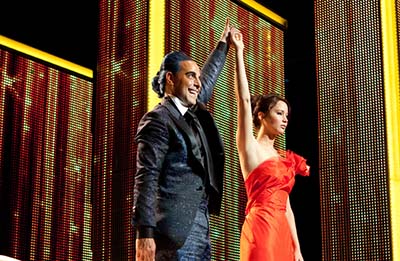 Caesar Flickerman (Stanley Tucci) and Katniss Everdeen (Jennifer Lawrence) in The Hunger Games. Photo credit: Murray Close. Courtesy of Lionsgate.
The film begins promisingly enough, framed by television host Stanley Tucci and games-maker Seneca (Wes Bentley) setting up the spectacle; this is contrasted to the world of Katniss (Jennifer Lawrence), who lives in eternally impoverished Appalachia. The script, co-written by Collins, is fairly faithful to the book, most changes being for the sake of efficiency. Fans of the book are bound to have issues with casting, but for the most part it works. Lawrence has a toughness and vulnerability that makes her a natural for Katniss, a role that has some similarities to her breakthrough in Winter’s Bone. As Peeta, Josh Hutcherson is suitably generic, and just sly enough to play off Katniss’ issues with trust. Notable supporting roles include Woody Harrellson’s Haymitch, which, seems, in a word I never expected to write next to this actor’s, classier than the book’s vision. The minor whitewashing of Haymitch does raise an overall problem with the movie: Does the film diminish the book’s scathing commentary on modern culture?
Boy, howdy. Collins’s vision of The Hunger Games‘ audience is clear: it’s you and me. It’s a horrific vision of the future but like so much science fiction it’s also an indictment of today. The filmmakers work against this basic point of the book in a couple of ways. First, they portray the future citizens of the Capitol, the bloodthirsty spectators who cheer on the kinder killing, as candy-colored fops out of a Fellini tale. In the book, these spectators are described in passing as having “bizarre hair” and “painted faces,” and fond of gaudy colors, but where much of that description could pass the kind of makeup we see commuters applying to themselves on the subway, the filmmakers run with it and come up with a completely foreign spectatorship. The spectators in the Capitol are hideous, and very much not us. And that lets audiences off the hook. It may have been heavy-handed to show that these audiences are today’s reality/sports audiences, but that would have been too subversive a critique, and after all there are bundles to be made.
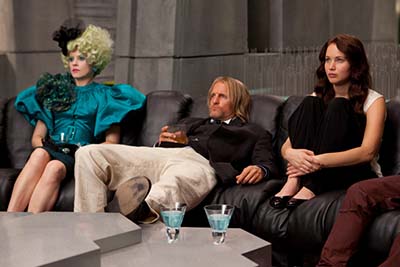 Effie Trinket (Elizabeth Banks, left), Haymitch Abernathy (Woody Harrelson, center) and Katniss Everdeen (Jennifer Lawrence, right) in THE HUNGER GAMES. Photo credit: Murray Close. Courtesy of Lionsgate.
Then there’s the book’s violence. I didn’t expect the filmmakers to go medieval with this, but The Hunger Games is about exploitation by violent spectacle, and by toning down the violence it pulls punches literally and metaphorically. And like most movie fight scenes, they’re poorly shot and edited, the camera too close and too fast to give you a good sense of what the combatants are up to. (For impeccably shot and choreographed fight scenes, see this week’s real fight-to-the-death spectacle, The Raid: Redemption. If only its director had made The Hunger Games.) The distracting, handheld camera work (Does Ross think this is a Lars Von Trier movie?) is unfortunately not limited to the fight scenes. Much of the camerawork throughout is sloppy, the compositions indifferent, as if the details of that dystopian vision aren’t important enough to see.
The movie makes one appreciate what Collins achieved with her book: an indictment of the very audiences who clamor for violent spectacle, not in the future, but in 2012. She does this in the form of a coming of age story turned extreme. Sure, we don’t *really* pit our children against each other in a fight to the death. But in concept, is it really that far from Toddlers and Tiaras? Is our culture too competitive? We root for Katniss and Peeta but, as they suggest at one crucial moment of self-awareness, can they live their lives without being tools of a state that wants to pit sister against brother? Can their find their voices without dancing for The Man? The book raises these questions and more, but the movie often glosses over these questions and becomes mere entertainment. The Hunger Games is an edible product, but it leaves the spectator in need of a more satisfying meal.
Hunger Games
Directed by Gary Ross
Written by Gary Ross, Suzanne Collins and Billy Ray.
Starring Jennifer Lawrence, Josh Hutcherson, Woody Harrelson and Stanley Tucci.
Opens today at the Avalon, the Uptown and your local multiplex.