It’s the most nightmarish scenario—a nuclear device being detonated in downtown Washington.
Kablammo and good night, right?
For most of us, actually, that wouldn’t be the case, according to a recent study by the Federal Emergency Management Agency. The 120-page report, “Key Response Planning Factors for the Aftermath of Nuclear Terrorism,” was released last November to little fanfare, but contains some promising (within reason) predictions that much of D.C. would survive a 10-kiloton nuclear strike.
The FEMA report posits a detonation a few blocks from the White House. Everything within a half-mile radius would be reduced to rubble and be so irradiated as to make any rescue operations unfeasible. Between half a mile and one mile out, there would still be significant damage and heavy injuries, but the area would be approachable by emergency responders. And further out, there would just be a lot of broken glass from windows shattered by the force of the explosion, but few, if any, injuries that would require medical attention. (Aside from those sustained by people running face first into their bursting windows when they try to look outside to see what is happening.)
Still, this outlook is from rosy. It’s still a nuclear explosion. The Associated Press reports:
The government study predicted 323,000 injuries, with more than 45,000 dead. A 10-kiloton nuclear explosion would be roughly 5,000 times more powerful than the truck bomb that destroyed the federal building in Oklahoma City in 1995.
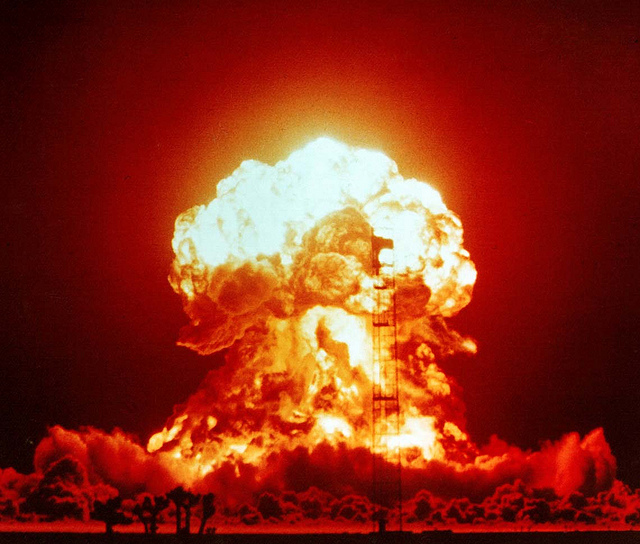
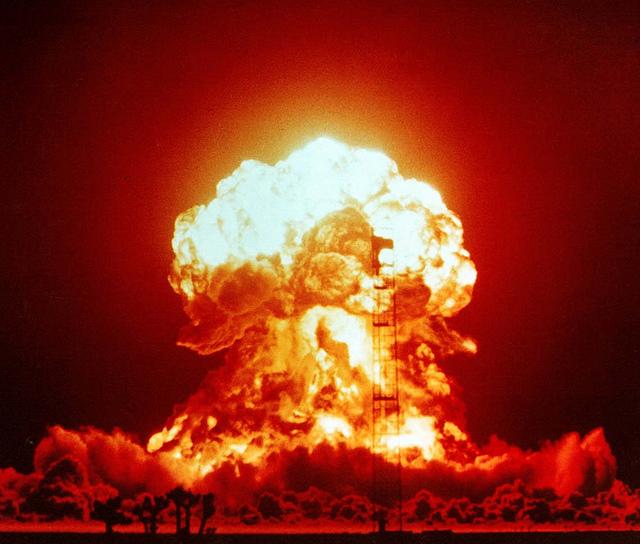
The flash from the explosion would be seen for hundreds of miles, but the mushroom cloud—up to five miles tall—would only keep its shape for a few minutes. The flash would be so bright it could temporarily blind people up to 12 miles away, including drivers on Washington’s Beltway. At least four area hospitals would be heavily damaged or couldn’t function, and four others would experience dangerous radiation fallout. The government said it expects to send warnings afterward by television, radio, email, text message and social media services like Twitter and Facebook.
It predicted the seriousness of radioactive fallout, which would drift with prevailing winds that vary depending on the season and expose victims closest to the explosion to 300 to 800 Roentgens in the first two hours, or enough to kill nearly all of them. In the spring, fallout would drift mostly to the north and west of downtown Washington. But in the summer, it would drift mostly southeast. After two hours, the radioactive cloud would move over Baltimore with far less exposure.
So, good chance of injury, temporary blindness, destroyed hospitals and a massive fallout cloud—but more likely than not, you’d live. At least until the radiation settles in.