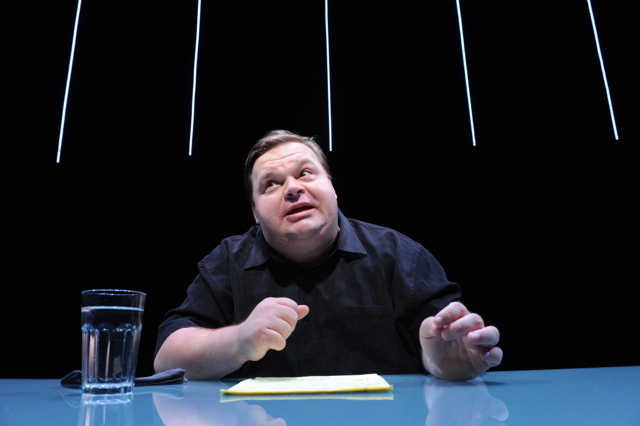
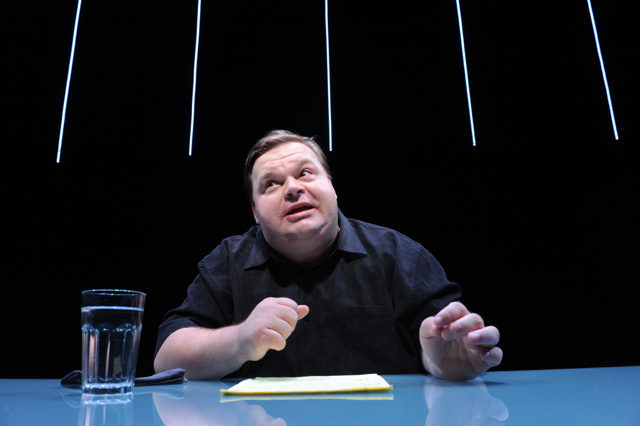
 Mike Daisey in “The Agony and Ecstasy of Steve Jobs” (Photo by Stan Barouh via Woolly Mammoth Theatre Company)
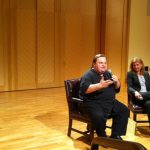
Eight days after an appearance at Georgetown University in which he couldn’t quite realize the severity of his errors, a humbled and emotional Mike Daisey sat before an audience at Woolly Mammoth Theatre Company last night in the latest round of handwringing over his monologue The Agony and the Ecstasy of Steve Jobs.
“I have my standards and I didn’t follow them,” Daisey said as he joined Artistic Director Howard Shalwitz and Managing Director Jeffrey Hermann on stage. It was just last week that Daisey had told a Georgetown lecture hall that his commitment was to “not the facts, necessarily, but the truth,” but at Woolly Mammoth it was evident Daisey had come to the notion that facts matter, too. Especially when presenting one’s show as a “work of non-fiction,” as the Steve Jobs show had been described in programs.
The Georgetown event, just days after it was revealed that Daisey had fudged many of his responses to fact-checkers at This American Life when the radio program ran an adapted version of his monologue in January, was originally designed to be a discussion about labor economics for a roomful of college students. Last night’s forum at Woolly Mammoth, though, put Daisey in front of his paying audience and gave the theater, which has largely stood by Daisey as it plans a remount of The Agony and the Ecstasy of Steve Jobs, to lay itself bare.
“We felt the need to open ourselves,” Hermann said. Shalwitz said of Daisey’s monologue that he “can’t think of a single show I’ve been involved in that has had more of an impact on the world.”
Daisey, echoing the apologetic note he took on his blog last weekend, acknowledged he never should have suggested his show about his witnessing of brutal practices that go on at Chinese factories where Apple devices are manufactured as non-fictional. It’s not something he had done in any of his previous shows, several of which also had runs at Woolly Mammoth.
But being exposed to conditions at at plant in the industrial city of Shenzhen, where employees of the manufacturing concern Foxconn assemble iPads and iPhones and MacBooks in grueling conditions, snapped something inside Daisey. Figuring audiences would assume any stage work was fictitious, Daisey said the playbills for The Agony and the Ecstasy of Steve Jobs included the “non-fiction” label because it was “me speaking live, narrating events of the things I have actually seen.” It was a bad choice, he admitted.
“This monologue was very different,” Daisey said. Unlike his previous works, which could be designated “theatrical memoirs,” the Apple piece combined personal experience with copious research that eventually merged into a single narrative. “I never felt so driven before. Felt really consumed. That drive is part of the story. I wanted so badly for people to look at this problem.”
And indeed, The Agony and the Ecstasy of Steve Jobs was a conversation-starter that unhinged the romanticized bubble that often surrounds Apple Inc., it’s marvelous products and its sometimes-beatified founder. Daisey’s show had its first performances at Woolly Mammoth in 2010, picked up steam last year including a long residence at the Public Theater in New York and eventually the This American Life program in January. Around that time, The New York Times published a series of investigative reports on Foxconn, thrusting Apple’s labor practices into full view, further dimming the rosy glow around the company.
Daisey had gotten people talking, and he was being heralded as a great investigative journalist himself. But there were gaps in his story, fabrications made to jazz up some details and a very murky narrative around the translator he hired on his trip to China. With This American Life having retracted its Daisey episode earlier this month, many of the questions from the Woolly Mammoth audience last night were an iteration of “How do we believe you?”
“At the end of the day, people make a trust decision,” Daisey said. The Agony and the Ecstasy of Steve Jobs will no longer be presented as a work of non-fiction—that much was already obvious. Daisey also said that he will excise the offending details of the show that were contested by This American Life, which he said would total about six minutes out of two hours.
But most of all, Daisey, seemingly near tears most of the evening, wants desperately to excise himself from what he sees as the actual story—that Foxconn is a hellish place to work and that the origins of Apple’s dream machines are not so idyllic themselves. “This movement needs to be separate from me,” he said.
Yet in the course of being interviewed so often as his show grew in popularity and buzz, Daisey said that he “forgot giving interviews was a kind of performance.” It was all in the service of an obsessive cause. “I’ve been really miserable for a long tome, which is what happens when you live for a cause.”
And some in the crowd were willing to excuse Daisey, especially Jenifer Deal, an actress who said she felt the reaction to the denuding of The Agony and the Ecstasy of Steve Jobs was enabling vicious corporate behavior. “The arduous path of true art is to remove oneself from one’s own time,” she said, paraphrasing an essay by the existentialist writer Albert Camus.
“[Daisey] manufactured his own destruction,” Deal said after the forum ended. “But if he had been going after a less sainted entity”—referring to the late Steve Jobs as “Saint Steve”—”I’m not sure the retribution would have been so vitriolic. He pinned the tail on the donkey and the donkey kicked back.”
But Sara Hope Franks was less forgiving.
“I think you are a great fabricator in the best sense of the word and in the worst sense of the word,” she said. After seeing The Agony and the Ecstasy of Steve Jobs and some of Daisey’s other work at Woolly Mammoth, Franks told him she could not in good conscience buy a ticket to another one of his shows. She said his remorse felt too manufactured, too drawn out, to be genuine.
“I’m sorry this seems too slick to you,” Daisey replied. “I’m either totally open or I’m very armored. Frankly, after the weeks I have had, I don’t fucking know the difference.”