
 Lily Collins stars as Snow White in “Mirror Mirror.” Photo Credit: Jan Thijs. © 2012 Relativity Media. All Rights Reserved. (Jan Thijs)
Fairy tales are not just about living happily ever after. They play upon our most acute childhood fears: abandonment, incompetence, powerlessness. Mirror Mirror adds two contemporary fears to this list in the form of Julia Roberts and Nathan Lane. Their smug star power threatens to derail the simple art of storytelling. With the help of a smart-alecky script they commit the gravest of cinematic sins: feeling superior to the material. Fortunately, the ship rights its course just enough to work for adults, and there’s no question kids will respond to it. But what exactly does this mirror reflect?
The classic Snow White tale is of inner beauty. In the Disney telling of the Grimm Brothers fairy tale the Evil Queen really is fairest of them all, more beautiful than the plain Jane with the little friends. But surface beauty hides ugliness inside. It’s a time-worn theme, but it’s not really the theme of Mirror Mirror, which subverts it source to an end that is not entirely encouraging.
The enchanted couple is well cast. Lily Collins, (Phil’s daughter), is the beautiful Snow White, who has just turned 18 and looks like a fairy tale version of PJ Harvey. Armie Hammer, best known as the Winklevoss twins in The Social Network, is a dashing Prince Charming. The two make an attractive couple whom you want to live happily ever after. The other lead is more problematic.
Julia Roberts is the wicked Queen, who took the throne from Snow White’s late father and rules the kingdom with cruelty and high taxes. Roberts’s voice opens the film with the magic words, “Once upon a time,” but screenwriters Melissa Wallack and Jason Keller add a modern knowingness that too often breaks the fairytale spell.
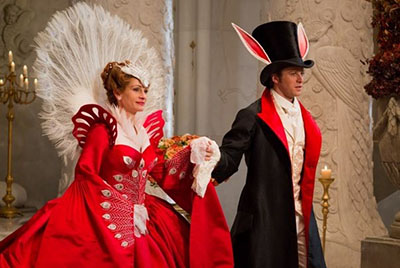 Armie Hammer and Julia Roberts star in “Mirror Mirror.” Photo Credit: Jan Thijs. © 2012 Relativity Media. All Rights Reserved. (Jan Thijs)
Another problem is the lack of aesthetic tension between the female leads. In the Disney classic, the Queen is indeed fair but wicked, and Snow White is plain but beautiful inside. There is no such contest in Mirror Mirror: Lily Collins is the fairest by far, while Roberts is all superstar arrogance and little allure. Her evil is simply ugly, not tempting. Roberts was director Tarsem Singh’s first casting coup for the film, and his take on the Queen is that “she’s not evil; she’s insecure.” But Roberts plays a Queen who seems to lack any inner wounds.
Nathan Lane plays the ineffectual Queen’s huntsman, who’s never a particular threat to anyone but his own dignity. He may as well be one of the dwarves, who are no longer miners, working the earth, but bandits with names have been updated to things like Grub, Half-pint, and Chuck (short for Chuckles). The staging of their woodland thievery recalls Chimes at Midnight, Orson Welles condensation of Shakespeare’s Henry IV plays, and the Elizabethan resonances don’t end there, but such plot interjections seem like pastiche more than part of a coherent theme.
Fans of Tarsem Singh’s work in The Fall will not be disappointed in the vibrant colors, epic woodland settings and grotesque CGI creatures that fill this magical kingdom. Costumes by the late Eiko Ishioka are a brilliant marriage of Elizabethan and animal, and suggest a fairy tale Alexander McQueen, with a touch of George Franju’s film Judex. The Queen’s beauty regime is a fascinating study of Mother Nature as sadist. We watch Roberts smeared with dark brown guano, bitten by bees, snakes, and a scorpion. Her attempts to stay young and defeat nature become a literal battle with nature.
For a couple of reels in the middle, the film sustains a compelling world without winking its way out of it. In these alternately idyllic and nightmarish passages, the fairy tale comes alive. But the spell breaks again in the final reel. Mirror Mirror would like to subvert the fairytale cliché of the damsel in distress and give us a strong young woman who can take care of herself. More power to them. But before a climactic scene, Snow White actually announces what she’s doing. Would it have been any less inspiring to audiences for her to just do it? Mirror Mirror works best when it shows, not tells. It’s an intermittently enjoyable trifle that could have been something more if it had resisted the self-conscious urge to look at its own reflection.
Mirror Mirror
Written by Melissa Wallack and Jason Keller, based on the story by Jacob and Wilhelm Grimm.
Starring Julia Roberts, Lily Collins, Armie Hammer, and Nathan Lane.
Running time 95 minutes
Rated PG for some fantasy action and mild rude humor
Opens today at AMC Loews Georgetown, Regal Gallery Place, AMC Mazza Gallerie, Regal Majestic, AMC Courthouse, and more.