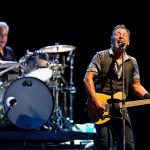
For Bruce Springsteen, every day is like Sunday. The 62-year-old lifer came to the Verizon Center during the Lenten season with a familiar righteousness, looking to save souls and take names. Though the Springsteen-as-preacher schtick is not as prominent as years past, the Boss and his E Street Band charged through another marathon evening of hopeful enlightenment (“a whoop ass session on the recession!”) with enough peaks and valleys to fill both the Old and New Testaments.
Bruce was in town promoting Wrecking Ball, his 17th studio album. Over the past decade, the Boss has drifted into a late-era phase that’s more famine than feast, characterized by Big Ideas and the promise of salvation that has yet to come. To say Wrecking Ball is better than 2009’s Working on a Dream but not quite as interesting as 2007’s little-liked Magic is besides the point; these are albums made to generate excitement then quickly fade from memory, not reference points but rather excuses to put on a show.
On Wrecking Ball, Springsteen continues along a neo-traditionalist path, carrying on the proud tradition of his heroes Woody Guthrie and Pete Seeger. Whether he’s railing against the fat cats on banker’s hill (“Shackled and Drawn”) or defending those residing in shotgun shacks (“We Take Care of Our Own”), Bruce has doubled down on the struggles of the working man. It works occasionally (“Easy Money”) but often veers toward distraction like on “Jack of All Trades,” where Bruce kindly offers to harvest the crop and clean the leaves from your drain. It’s an over-the-top choice, but I suppose the alternatives aren’t quite as visceral. Bemoaning the shift away from blue collar labor in the face of a knowledge economy is hardly poetic. Woody Guthrie and Pete Seeger it is, then.
The three-hour, 26-song evening kicked off with “We Take Care of Our Own,” a bouncy slab of machismo that opens Wrecking Ball. The song—a stone’s throw away from a Ford Truck jingle—fit nicely within the arena setting, inspiring an impressive level of fist pumping right out of the gate. Of the eight songs played from the new album, it was surely the band’s most effective, one of the few they will likely trot out on future tours. “Death to my Hometown”—a spritely Celtic stomp on record—was muddled live, its clunkiness exacerbated by Bruce’s ham-fisted high-stepping. When “Jack of All Trades” began, it rang out like a universal bathroom break.
The Boss pulled out more than enough surprises to placate the faithful, however. “Seaside Bar Song” and “Does this Bus Stop at 82nd Street?” have both been dusted off this tour along with “Trapped,” a highly effective Jimmy Cliff cover that transforms a mid-tempo reggae jam into a gut-busting anthem. Renditions of “Adam Raised a Cain” and “Because the Night” were both highlights, invigorating the already rapturous crowd with a driving, palpable urgency. Springsteen die-hards were treated to a true rarity in a full-band rendition of “The Promise,” a song played live just three times thus far in the past 35 years. There was also a haunting rendition of “American Skin (41 Shots),” initially penned in response to the tragic death of Amadou Diallo back in 2000, now re-purposed—not explicitly—as a response to the recent death of Florida teenagerTrayvon Martin.
Of course, lingered throughout the evening was the absence of saxophonist Clarence Clemons, who passed away last June following complications from a stroke. Early in the evening, Springsteen made a passing mention about new friends joining them on stage, one of which happened to be Clemons’s nephew Jake, who recently took up sax duty in the E Street horns. While the Big Man is irreplaceable, Jake nicely upheld his uncle’s legacy of glorious solos during electrifying turns on “Thunder Road,” “Night” and “She’s the One.”
Springsteen finally summoned Clemons directly on “10th Avenue Freeze-Out,” pausing at the reference to the Big Man in the third verse. Holding the music to solicit applause, the crowd responded with deafening cheers. You can keep the hokey, pseudo-spirituality of songs like “Rocky Ground;” it was here that Bruce, with a preacher’s deft touch, demonstrated how a resurrection really feels. And it was good.