Martin Austermuhle
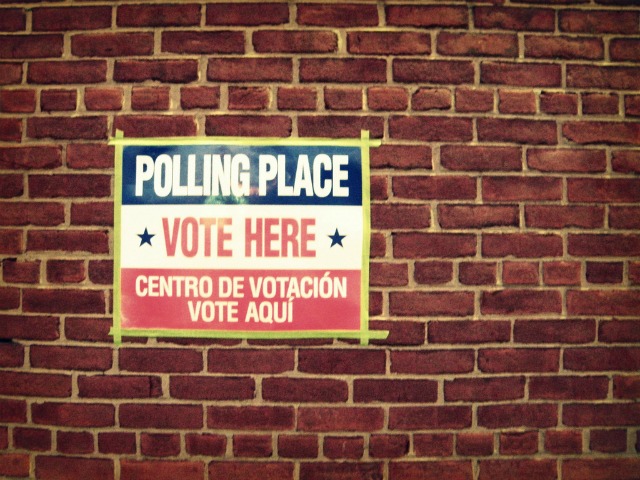 Photo by jagosaurus
Wait, a D.C. primary in April? Aren’t these things supposed to happen in September? Yep, until federal law forced D.C. to move up the date of its primary to tomorrow, April 3. (Think that’s a joke? The 2014 primary could well fall on April Fool’s Day.) You know what this means—you put on your Tuesday best and you join your fellow citizens in the time-tested civic tradition of engaging in representative democracy. Here are the basics.
IMPORTANT INFO: The D.C. Board of Elections and Ethics is putting on the election, and it’s got all the info you could possible want here. The official D.C. Voter Guide is here, in .PDF format. The Post’s voter guide is here.
WHAT: Primary time. Since the District’s staggers its elections for the ward-based seats on the D.C. Council, only residents living in wards 2, 4, 7 and 8 will be voting for their councilmember tomorrow. But don’t feel left out—there’s an At-Large seat up for grabs, as well as elections for D.C. delegate to the House of Representatives, Shadow Senator and Shadow Representative. Even the city’s oft-overlooked 30,000 Republicans get to participate, casting ballots for their Republican nominee for president, national committeeman and national committeewoman. (Statehood Greens only have one presidential contender on the ballot, but another is waging a fierce write-in battle.) Don’t forget, though—this is just a primary. There’s the general election in November, where things really get decided. (Voters will also have a chance to decide who gets one of the other At-Large seats in November.)
WHO: You! Well, provided you’re a registered Democrat, Republican or Statehood Green Party member. This is a closed primary after all, and it’s limited to party members, much to the chagrin of the 80,000 D.C. voters who chose to remain unaffiliated.
WHERE: If you can’t find your voter registration card, just enter your address here to find your polling site. Polls will be open from 7 a.m. to 8 p.m., though you won’t get locked out if you’re standing in line as polls are set to close. If you can’t make it to your assigned polling place, you can cast a special ballot at any polling place in the city. If you were like your fellow 6,000 early voters, you don’t even have to worry about casting a ballot tomorrow.
WHY: If it were up to us, voting would be as inevitable, required and expected as are death and taxes. But it’s not. Still, it’s the lifeblood of democracy—and complaining about D.C. politics really is more fun if you can say that you didn’t vote for the person you’re complaining about. We know that all the scandals can make even the hardiest of souls cynical and jaded, but things can only get worse if you don’t do something to make them better. (I say this as someone who can’t vote, at least not yet; I’m a mere permanent resident, not yet a citizen.)
THE RACES:
Ward 2: Councilmember Jack Evans has served on the D.C. Council longer than anyone else, and he’s certainly not about to stop that streak now. He’s also unopposed, so there’s not much stopping him from winning the Democratic primary and likely picking up another term come November.
Ward 4: Councilmember Muriel Bowser is vying for a second full term, and most political types assume that she’s maintained enough of a distance from her scandal-ridden colleagues to get one. That’s not to say that she hasn’t faced determined challengers in uber-engaged Ward 4—Max Skolnik, Calvin Gurley, Baruti Jahi, Renee Bowser, and Judi Jones are hoping to replace her. Skolnik has run as a sharp-tongued progressive upstart (he’s got the Greater Greater Washington seal of approval), hitting Bowser for taking bundled corporate contributions, failing to protect and promote small businesses in the ward and letting local schools get shoved to the end of the modernization list. Despite Bowser’s overwhelming financial advantage, Skolnik hopes that he can continue a rich Ward 4 tradition of showing incumbents an early retirement from elected office.
Ward 7: Councilmember Yvette Alexander may be one of the most vulnerable incumbents out there. While she faces the opposition of Kevin Chavous, Jr., Bill Bennett, Dorothy Douglas, Monica Johnson, and Tom Brown, it looks like it might come down to a two-way contest between her and Brown, who has racked up endorsements from everyone from the Post and City Paper to the D.C. Chamber of Commerce and AFL-CIO Metro Washington. And in something of a first, the ward’s 1,500 Republicans will have to decide between two potential candidates to take on the winner of the Democratic primary: Ron Moten or Don Folden.
Ward 8: If Marion Barry is to be believed, he’s indispensable to Ward 8’s residents. His challengers—Jacque Patterson, S.S. Seegars, Darrell Gaston, and Natalie Williams—would certainly like to prove otherwise. Patterson has emerged as the institutional favorite—the Post, City Paper, GGW and others have picked him—but that’s only allowed Barry to claim that again only he knows what Ward 8 residents really want. (There’s been some recent dirty tricks against Patterson, too.)
At-Large: Councilmember Vincent Orange seemed all but assured of re-election, until his 2010 campaign for the At-Large seat he now occupies was found to have taken in $26,000 in questionable money order contributions from a well-connected city contractor. Now he looks extremely vulnerable—but he’s also facing three challengers that might split up the votes against him. Sekou Biddle, who held the seat before Orange, has landed some key endorsements, but Peter Shapiro has won over many of the city’s progressive activists. (E. Gail Anderson Holness is also running.) You can listen to a debate between the four on The Kojo Nnamdi Show here. Statehood Green Party voters will get to decide between Ann Wilcox and G. Lee Aikin.
D.C. Delegate: Eleanor Holmes Norton has held the seat since the 1990s, and no Democrat saw fit to challenger her for it. Natale Lino Stracuzzi is similarly solo in his quest for the Statehood Green nod.
Shadow Representative: It’s Nate Bennett-Fleming or bust.
Shadow Senator: For a position that has few perks and no pay, this year’s battle for one of the city’s two Shadow Senate seats has gotten surprisingly heated. On the one hand there’s Michael D. Brown fighting for another term. On the other there’s Pete Ross, a self-financed candidate who has put over $200,000 into his campaign. (The provenance of that money is of some interest.) Ross insists that he’s the new blood that the city needs in his fight for self-determination (he was even willing to spend a few hours in jail for it), while Brown says that he’s produced a number of tangible results that could well be lost if he’s not given a chance to continue them. The winner of the contest will face the sole Republican in the race, Nelson Rimensnyder.
U.S. President: For Democrats, it’s pretty simple—Barack Obama is the nominee. Republicans have got a few choices: Mitt Romney, Newt Gingrich, Jon Huntsman, or Ron Paul. The winner will claim 16 delegates. Statehood Green voters only have Jill Stein to choose from, though Roseanne Barr is asking to be written in.