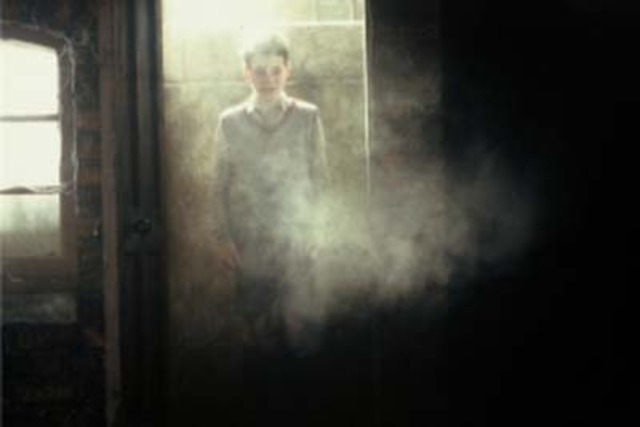
 Leigh McCormack. Courtesy of The Film Desk.
Terence Davies’ 1992 film The Long Day Closes, reissued to coincide with his new film The Deep Blue Sea, opens with an audio collage.
The lush, dramatic strings that play over the formal calligraphy of the opening credits gives way to a rainy night on a lonely Liverpool street. Against this romantic backdrop, the Twentieth Century Fox theme plays, followed by an audio clip of Alec Guiness from The Ladykillers, and Nat King Cole’s Stardust. Great stuff, undeniable classics all.
But for a collage to resonate it must transform its sources. Elements play off each other, become distorted, and generate something new by their juxtaposition. They’re given new life. But the effect of the litany of sounds that Davies assembles, however beautiful or historically significant, is flat: here are my memories.
The production values of The Long Day Closes are stunning. Michael Coulter’s cinematography practically caresses the screen with meticulously composed images of light, shadow, and fluid camera movements. The impressionistic narrative would like nothing more than to breathe into these sounds and images the epic memories Proust summoned from tea and a madeleine. But the end result is little more than a glorified scrapbook.
Leigh McCormack, in his sole acting credit, stars as eleven year old “Bud” Davies, a stand-in for the director as a dreamy child. We meet him sitting on his steps engaging with the camera, as if we are about to embark on the kind of imaginary play that children create in the privacy of their bedroom imagination. Bud is prone to staring out windows, at his mother (Marjorie Yates) hanging the laundry, at the shirtless bricklayer across the way. Bud is mad for imagery wherever he finds it, in the movies, in the street, and even in the way the sun casts a slow shadow across the carpet. Abusive teachers who cane their students’ hands are juxtaposed with the Catholic Bud’s vision of a living crucifix.
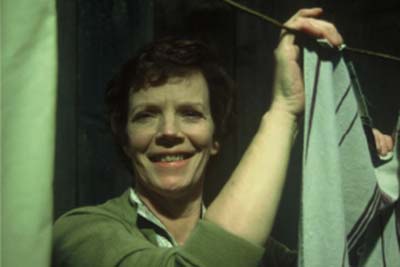 Marjorie Yates in The Long Day Closes. Courtesy of The Film Desk.
Popular songs and audio collage play a role throughout the film. Joseph Cotten’s narration from Orson Welles’ The Magnificent Ambersons recurs in what I imagine is supposed to be a running commentary on the passage of time. It just reminds us how much more evocative that film was in not only recreating a lost world but giving it a meaning beyond memory. Bud’s mum sings “Me and my shadow” to herself in a scene beautifully composed and lit—mostly in shadow. That’s an awfully literal image for a poetic sensibility. These are striking images, and there’s nothing inherent wrong with a non-narrative approach. But The Long Day Closes simply feels like an beautiful but tedious slideshow of unconnected episodes. Maybe that’s the way memory works. But conveying it in such a self-conscious manner is more navel-gazing than great art.
Moviegoers unfamiliar with Davies and coming to this film from his new narrative feature The Deep Blue Sea (now at E Street) will find familiar elements: a melodramatic score, pub sing-along’s, nostalgia, and windows and doorways, all wrapped up in gorgeous cinematography. The new film, based on the play by Terrence Rattigan, weaves a tense web of restrained emotion within a tight narrative. Rattigan’s sharp dialogue helps carry the film over Davies’ aesthetic affectations. In one of the script’s juiciest barbs, Hester Collyer (an inconsistent Rachel Weisz) listens to her mother in-law (Barbara Jefford) warn about the danger of passion. “What would you replace it with?” Hester asks. “Guarded enthusiasm,” the mother in law replies. “It’s safer.” The guarded enthusiasm of The Deep Blue Sea is a safer bet than the unshaped passion of this repertory title.
The Long Day Closes
Written and Directed by Terence Davies.
Starring Leigh McCormack and Marjorie Yates
Running time 85 minutes
Rated PG for mature themes
Opens today at West End Cinema.