Martin Austermuhle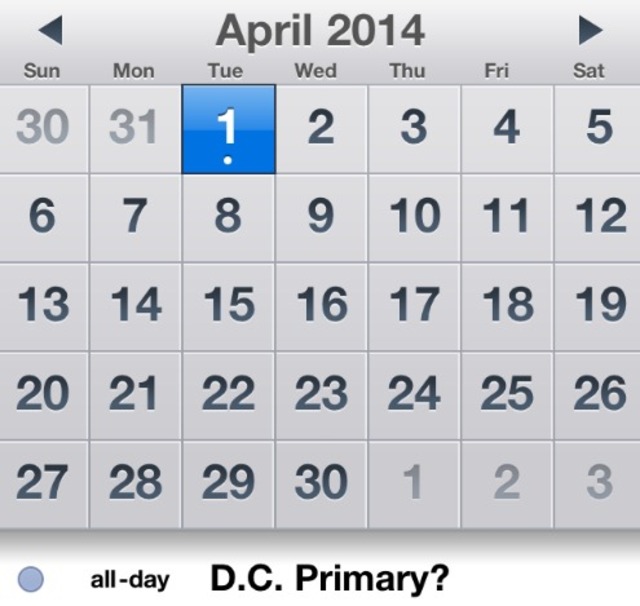
 For any number of years, candidates for elected office in D.C. became accustomed to a campaign schedule that saw them work for votes throughout the summer and face the electorate in a September primary. The schedule produced its own comfortable rhythm: candidates would knock on doors in the warming spring-time months, march in sweltering summer parades and take it easy during the August doldrums.
This year was different. Very different. Because of changes to the Military and Overseas Voter Empowerment (MOVE) Act, a law that enables servicemembers and U.S. citizens abroad to vote, D.C. was forced to abandon its traditional September primary. And while it got a waiver for the 2010 mayoral primary, no such flexibility was offered for 2012. The D.C. Council decided to merge the city’s presidential and local primaries in April, changing not only the date that residents would go to the polls, but also the rhythm that came along with campaigning. No more for those summer parades—candidates now had to contend with walking around in the winter.
In the lead-up to this week’s primary, plenty of people complained. Parents of D.C. public school students were concerned that it would coincide with their spring break, meaning that they might be out of town. Candidates and political analysts said that residents seemed blissfully unaware that an election was coming up, making it harder to attract their attention or raise money. (This, they said, gave incumbents an additional advantage.)
Others have complained that in a city where the Democratic primary is the de facto general election, the April primary could produce elected officials that will stay in office for eight months after losing. In a 2011 committee report on the legislation moving the D.C. primary up to April, Cheh commented that having lame ducks for that long might lead to “the current officeholder pursuing his or her duties with less zeal during the several months prior to the term’s expiration.”
More broadly, April just seems to be a bad time for elections—for last year’s April 26 special election, a rabbi sued over the fact that balloting coincided with the last day of Passover.
In the wake of Tuesday’s election, D.C. legislators have already started floating the idea of changing the election’s date. On “The Politics Hour” on WPFW 89.3 FM yesterday, councilmembers Marion Barry (D-Ward 8) and Tommy Wells (D-Ward 6) said that it should be moved to later in the year. “April is a crazy time to be voting,” said Barry.
Wells agreed. “I think that having it in April is not fair to the voters. I think that we got a very low turnout, I don’t think people fully knew who the opponents were…a lot of people didn’t know there was an election going on on April and I think we should change it back to June,” he said.
Councilmember Mary Cheh (D-Ward 3), who ushered through the bill that changed the date of the primary, doesn’t seem particularly keen on the idea, though she did hint that June might be a possibility. “We couldn’t have a September primary because of federal law. By the time we would have sent out absentee ballots and the like, the earliest the primary could have been was August. No Councilmembers wanted an election in August, and the same with July. I personally wanted a date in early June, but other members were adamant about having it as early as possible,” she said in a statement.
We reached out to Councilmember Muriel Bowser (D-Ward 4), who currently chairs the committee that would push any legislation making such a change, but she was unavailable for comment.
Chuck Thies, a political analyst and consultant who has worked on a number of local campaigns, seems to think a change would only be fair to challengers. “In all seriousness, the current schedule benefits incumbents. The 2014 date should be moved back such that petitioning and campaigning begins in the same year as the election. Challengers lose valuable weeks during the holidays,” he said.
Maybe so, but one thing seems unchanged from years past—turnout. While many assumed it would be low, possibly historically low, some 15 percent of voters came out to vote on April 3. (The September 2008 election with the same combination of ward and At-Large seats didn’t even hit 13 percent.) And had the Democratic presidential primary been contested, it likely would have been even higher. (The February 2008 presidential primary saw turnout of close to 40 percent.) If the primary were moved to June—the months in between April and June and likely no-go’s, seeing as they fall squarely during D.C. Council budget sessions—it would seem best to move the presidential primary alongside the local primary, both for cost-savings and turnout.
Cheh noted the benefit of joining the two. “Having the primary on April 3 allowed us to combine it with the Presidential preference primary, and aligned us with other states like our neighbors in Maryland and also Wisconsin. The other great thing about combining them is that we saved the city $800,000—1 million in election costs,” she said.
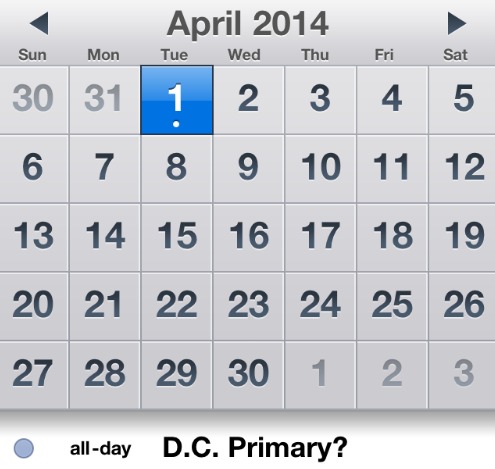
Whatever the council decides, Thies points to what may be a more practical reason for changing the date of the D.C. primary ahead of 2014—that year, it’s supposed to fall on April Fools Day.