
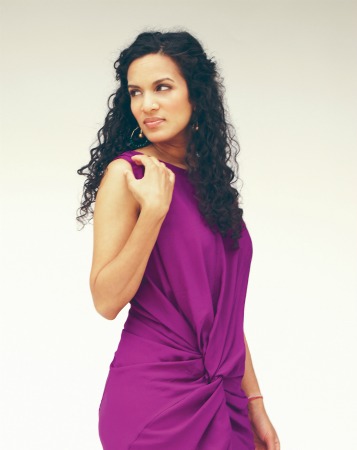
 Anoushka Shankar.
Though her music has always been rooted in the Hindustani classical tradition taught to her by her world-renowned father, Ravi Shankar, sitarist Anoushka Shankar has always sought to expand her sonic palette by infusing it with other influences. In the past, she has explored electronic and other international sounds that share a common space with the ancient forms at Shankar’s musical center. Shankar will be supporting her most recent release, 2011’s Traveller, on Friday with a performance at Lisner Auditorium. For this recording, she wanted to create an intersection between her Indian style and a genre for which she has a long-held affection, Spanish flamenco.
“The most important thing was the way flamenco music makes me feel,” said Shankar during a recent interview with DCist. “It’s completely transporting and hits the very deepest part of the listener.”
Shankar realized that in order for her project to maintain integrity and credibility, she would have to partner with someone steeped in flamenco. To that end, she tapped Javier Limón to co-produce Traveller. Limón is considered the top flamenco producer working today, and has worked with many of the genre’s best known artists. As with Shankar, Limón has also tried to incorporate more contemporary elements into what is a very well-defined and established art form.
“I was first given a lot of his crossover projects, then someone gave me his pure flamenco records and that’s when I realized he would be perfect,” Shankar said of her collaborator. “When I finally met him, there was a lot of chemistry.”
Shankar and Limón took several approaches to composing for the album. In some cases, the process would start with either of them bringing in a piece that would then be honed to fit in the space they were trying to create. In others, the two would compose together, and often with specific musicians in mind. As the process continued, they discovered connections between the Spanish and Indian conventions, not surprising given that gypsy culture has roots in the subcontinent, but not all of these connections were explored.
“With each similarity we also uncovered loads of differences,” Shankar explained. “Sometimes we would make the choices to exist between the differences. Sometimes I would ignore the Indian and stick with the flamenco, and sometimes we would ignore the flamenco and stick with the Indian.”
Traveller was recorded over a period of several months, a process which had to accommodate the Shankar’s pregnancy and the birth of her first child, with husband and filmmaker Joe Wright. As a result, instruments and the numerous guest musicians were often tracked separately, with sessions taking place in multiple countries. For this tour, Shankar has distilled the music down to a core ensemble of six people. In addition to Shankar on the sitar, the group is comprised of a Spanish vocalist, Spanish and Indian percussionists, flamenco guitar and the shehnai, an oboe-like woodwind instrument that is commonly used throughout North India and Pakistan. Though the instrumentation for certain songs has changed from recorded to live performance, Shankar feels that the material continues to evolve with each performance.
“I feel so happy with it live, I wish I was doing the record as a follow up,” she said. “It’s a really exciting show, but it’s also lyrical.”
The Washington Performing Arts Society presents Anoushka Shankar and the Traveller Ensemble on Friday, April 13, 2012 at Lisner Auditorium. 8 p.m. Tickets are $20-$40.