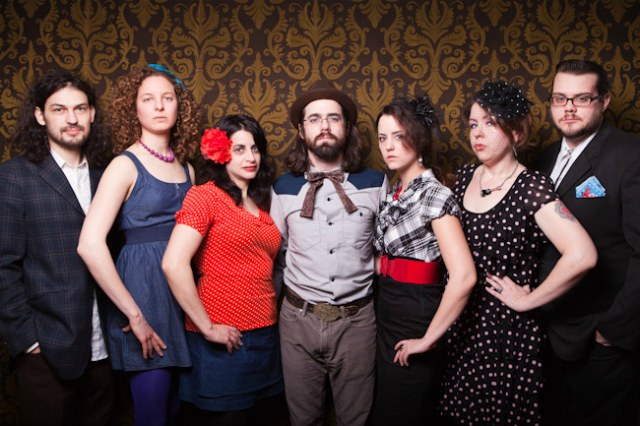
 Photo by Tara Welch
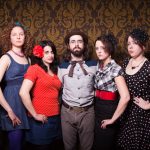
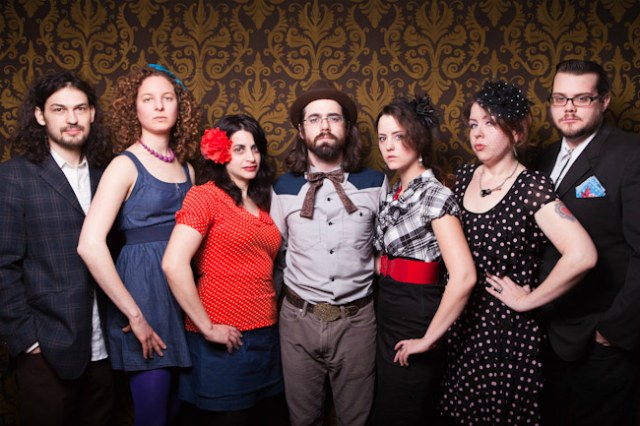
Seeing a collection of instruments that includes a banjo, a harmonica, a violin a cello and an oboe, but no guitars may immediately bring to mind bluegrass festivals or freak folk acts full of hippies and disciples of Neutral Milk Hotel. The Torches have a few bluegrass elements but their songs are decidedly darker, reminding listeners that violin and cello can be used for harrowing results. This is especially obvious on new single, “The Elephant in the Room.” Additionally, they have an infectious onstage energy that owes more to rock and roll than it does to Merlefest. At the heart of it all, Stephen J. Perron Guidry’s gravelly Tom Waits-esque vocals add a weight to the Torches’ gothic, melancholy songs. As such, The Torches sound like the band of gypsies ensuring that you’ll enjoy the lightning-fast train ride to hell.
We talked to Torches drummer (formerly their guitarist and bassist) Thomas Orgren about how the stabilization of the lineup, the difficulties of fitting seven people in a room and performing at the Smithsonian.
Find them online: thetorches.net
Buy their music: thetorches.bandcamp.com and lujorecords.com
See them next: Tonight at U Street Music Hall opening for Tim Fite.
On the website, The Torches talks about being a rotating lineup.
We’ve actually had a pretty steady lineup for almost the last two years now or at least a year and a half, it’s pretty much been the same. Our current bass player, Tina, started off in the band playing the fiddle and then our old bass player, Jill, moved to Richmond so Tina took over bass playing duties. Then, we brought in Claire to play the fiddle but other than that, that’s all that’s changed in awhile. It was more of a rotating cast thing in the beginning. I think we were still sort of settling on instrumentation and all that.
How many members are in the band now?
There are seven of us.
Does that ever get difficult as far as fitting all of you in the same stage or recording space at the same time?
Yeah, we generally don’t ever practice with all seven people there. I think the way it usually works out is that it’s more like six people but since there’s a big show coming up, then we’ll make room in our schedule. We actually played our first show without ever having all been in the same room at the same time.
Had you done that with any other band prior to this one?
No. I’d never been in a band that had more than five people. So, this is quite the expansive band in comparison.
I know you’ve played some small spaces as well, like the restaurants used for last year’s STPP festivals. Was it a squeeze at those spaces?
The first one was at Queen Makeda which was kind of bigger. That actually wasn’t a problem. Then, the second Sweet Tea Pumpkin Pie, I actually wasn’t there, but that was a challenge getting them onstage seeing the pictures of it. The old Red and the Black was a big challenge getting onstage. Galaxy Hut is always a challenge but we love playing there so we do it. Somebody just gets stuck by the door and we hope the weather is nice.
So, you’re drumming in the band now?
Yeah. I’ve been drumming in the band for over two years, now. I was one of the founding members and then I moved to California for a brief bit and when I came back, we had two guitar players, myself included, and no drummer. So, we had this show, I think it was a Nerd Nite show, and Stephen was just going to play the banjo and sing and kick the kick drum with his feet all at the same time. I was like, “No, no, no, no, no!” So, I sat there behind the drum set at practice one day and next thing I know, a week later, I’m sitting in front of a sold out DC9 for Nerd Nite and then I was the drummer.
Ah. I’d remembered seeing old videos of you playing the bass or guitar.
I think I was playing bass then. I’ve played bass, drums and guitar in the band, based on what’s needed at the moment.
Had you played drums before this band?
I’d played the bass drum in high school marching band but never really the drum kit. All my best friends in high school were drummers, so, I have learned a lot from them just about the theory behind it, but I had never actually played until a week before that Nerd Nite show.
That’s impressive that you picked up the drums that quickly.
I feel like I’m able to make music out of any instrument I pick up. I might not be the most technically skilled drummer out there, far from it, but the band doesn’t really call for a drummer who’s going to show off his chops. It’s more subdued and letting the other instruments sort of shine through. When there are seven people going on at the same time, you all have to be conscious of leaving space for everyone else. There’s not much space for pyrotechnics.
Well, the Torches does seem like more of an ensemble.
Yeah, I think we’re very aware of ensemble things. Often times, we’re not…We don’t play a lot of written out stuff. There’s not a whole lot of “here the cello and the oboe and the harmonica and the fiddle are all going to harmonize here.” It’s just sort of complementary minds that come together. But, I think one thing The Torches do really well is being more than the sum of its parts. I don’t think any of us are really going to light the world on fire with our technical abilities but I think it comes together in a very sort of interesting and creative and unique way that — well — there’s certainly no bands that I’ve ever heard that sound anything like it. That’s what’s really exciting about this band.
There’s definitely songs that I don’t expect to come from the instrumentation that you’re using.
Right. We’re very cognizant of the fact that there’s no guitar. That’s certainly one of the things that sets us apart. It was never really a conscious decision, “Hey, we’re not going to have any guitar,” it just so happened that when I started playing the drums, the show after that, our guitarist left. We were left with no guitars and it just stuck.
Can you speak a little more about your performance at the Smithsonian?
That was a really, really exciting opportunity for us to play in such a beautiful environment. It was also a fun challenge to do an unplugged set, although our instrumentation lends itself pretty well to that sort of setting. But, we were asked to pick out a piece of art that we felt like sort of reflected what our band does and we picked out Abraham Lincoln’s Death Mask, which was partially because it was around Lincoln’s birthday but also because it also really captures a sort of dark, weird, americana aspect of our band. We just recorded a few weeks ago, a version of a song of ours that will hopefully go on a compilation of this Luce Foundation’s Luce Unplugged series that will also play if you’re taking the audio tour of the Luce Center of Art which is pretty exciting that our music will be part of the museum now. We’re pretty excited to have the music preserved in perpetuity in a Smithsonian collection. It’s a big honor.
How does songwriting work with seven of you?
Usually it will start with an idea that Stephen will bring to the band. Sometimes, he’s got most of a song fleshed out, like a verse and chorus. Then, we’ll sit there and practice and usually me and Stephen and Tina often will just focus on arrangement and getting the bass and drums and banjo together. We tend to do arrangement stuff very collectively. People have ideas and a lot of times bridges will just be written on the fly. Someone will say, “What if we did this?” and then we’ll do it and sometimes it works, sometimes it doesn’t. We’re always bouncing ideas off each other. Then, the ensemble instruments: the violin, the harmonica, the cello and the oboe tend to write their own parts. Whatever sounds good and fits with what the others are playing.
You guys are recording a new album now, right?
That’s right. We are in the mixing phase now. We should be all ready to go by mid-May and then it’s off to the label. We don’t have a release date set yet but it should be in the label’s hands soon.
Had most of you known each other before you started playing together? I know that a lot of you came from other bands.
Yeah, Stephen sort of handpicked people. He’d been cognizant of picking people that aren’t just going to fit in instrumentally but also socially. There’s a good chemistry between us all. I knew Stephen back in 2005, 2006. My old band Cataract Camp did some touring with The Casettes. Joe was sort of a Casettes fan and is a North Arlington fixture, so Stephen asked him to play the harmonica. He was the only guy he knew who played the harmonica. Jocelyn, I think Stephen knew her from doing film stuff and Tina has been around D.C. for forever. I feel like I should push that The Torches just released a Valentine’s Day single.
Tell me about that.
They’re songs we recorded along with the record. We decided that they didn’t quite fit thematically with the record so we decided to release them as a single, together. One is sort of a ‘50s-style anti-love song called “My Former Baby Mine.” The other is a little darker, sort of more quintessentially Torch-y song called “Elephant in the Room” that takes a lot of strange twists and turns and gothic lyrics along with it. That single can be found at our bandcamp site, thetorches.bandcamp.com.
So, what is the new album going for thematically?
Thematically, I think we’re just trying to represent the Torches and to try to portray some of that live energy we have and try to put it onto a little piece of wax which is a pretty difficult thing. Recording process-wise we tried to do as much as we could together live as possible. It’s just going to sound like us in a room, hopefully.