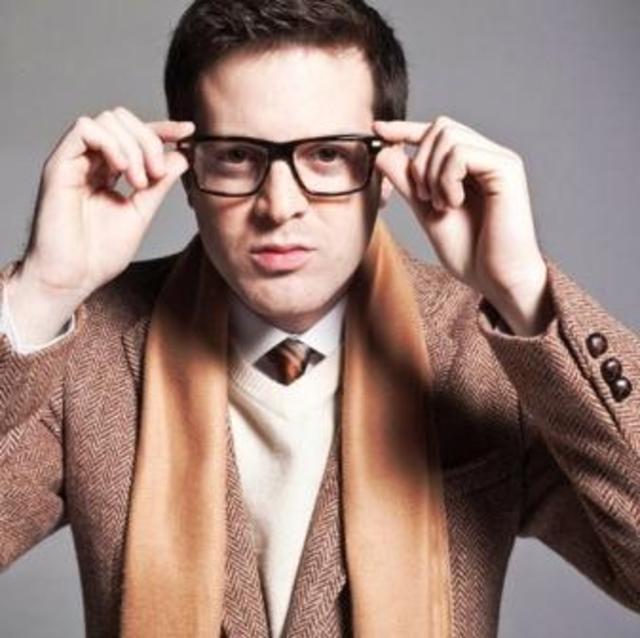
 Photo courtesy of Mayer Hawthorne
If you’ve spent enough years writing about artists and going to shows, there will be a few instances where you’ll have one of those “I remember when…” moments that’s simultaneously satisfying and frightening. On one hand, you remember when the nascent performer was just starting on their road to fame, but on the other, you’re reminded that that was about 15 years ago and now you’re old. Such is this writer’s case with this interview.
While going to college in Ann Arbor, Michigan in the late ’90s, I would frequent shows by a group called the Athletic Mic League. Athletic Mic League’s DJ went by the name Haircut. Haircut was not only the DJ, but also produced, performed musical instruments and, from time to time, rapped on tracks for the crew. Still, with six other guys in a group, it can be hard to stand out. A few years down the road, Haircut put out a mixtape of classic boogie tunes called Shoot The Duck, which would be one of his first forays into front-man territory.
So why do I bring up this DJ Haircut? Well, because DJ Haircut is also the internationally acclaimed soul singer Mayer Hawthorne (born Andrew Mayer Cohen). Hawthorne’s current musical path started to materialized after Stones Throw Records exec Peanut Butter Wolf got a hold of some tunes he’d put together. Wolf persuaded Hawthorne to create some more tracks and eventually it resulted in the album, A Strange Arrangement. The lead single, “Just Ain’t Gonna Work Out“, harkened back to 1960s Motown era pop songs of love lost and generated over 3 million views on YouTube. That success has led to appearances on the Late Show with David Letterman, collaborations with music legends and passive-aggressive disdain from a certain Canadian rocker.
Last week, the L.A.-based Ann Arbor native had just concluded the European leg of the tour supporting his latest album and first major label release, How Do You Do. As he prepped to head for the East Coast, the ever-so-cool crooner Mr. Hawthorne was kind enough to answer some questions:
I remember when you were the DJ for groups like Athletic Mic League and Now On. Then, around 2005, you released the first volume in the Shoot The Duck mix series. That was the first real instance where you stepped out from a team setting. At what point in time did you make the decision or see that you could be a stand-alone artist?
I don’t even know if I’ve made that decision yet. It’s been a wild transition. I’ve always been the DJ or the bass player or the drummer or someone in the background. Being the front man is definitely something I’m getting used to. It’s an everyday process. I’m learning every day and trying to get better and better every night.
So it’s a constant building process.
Yeah, I’m like a football coach. After every show, we review the footage, audio tape or whatever we’ve got, to try to make sure every night is better than the one before.
It seems that whenever an article gets written about you, terms like “retro” and “neo-soul” get used to describe your music. Do you think those labels are appropriate and are you comfortable with them being used to sum up your work?
It doesn’t bother me at all. I know everybody has to categorize you as something. So, I honestly don’t care what you call me. If you want to call me “acid jazz-baroque chamber music”, it does not matter at all to me just as long as you’re talking about me and listening (to the music).
But if you were given the opportunity to classify your music, what would you call it?
I’d just call it “fun”. The only rule I’ve had when making music is to have fun. The more you do (music), the more you realize (fun is) all that matters.
Listening to your debut, A Strange Arrangement, next to its follow-up, How Do You Do, it’s obvious you’re becoming more comfortable as a vocalist. What did you do to up your singing game?
Diving in to the deep-end, head-first, and doing 200 shows in a year makes a big difference. I’ve had a lot of opportunities to meet, talk to and perform with some of my favorite vocalists in the world like Bilal, Erykah Badu and even Bruno Mars, who I did a whole tour with. I learned a lot from him. Watching and talking to some of the best singers out there helps.
What are you picking up from these artists or what are they telling you?
The most important thing is to do is to do you. There is no magic formula. I can’t sing like Bruno Mars so I have to learn how to use my voice. Also, staying healthy is an insanely important part of what I do.
You had the opportunity to work with the Detroit guitar legend who’s behind one of hip-hop’s greatest breaks, Dennis Coffey. What was that like?
That was amazing. He’s one of the original Motown Funk Brothers. He was there for the whole Motown explosion. It was hard to get any work done with him in the studio. All I wanted to have him do was tell stories.
One of your big advocates is Snoop Dogg. How’d he get on the Mayer Hawthorne train?
He heard my music when one of his studio engineers played it for him. He actually called me on the phone the next day. He was like [imitating Snoop’s voice], “Yo, Nephew. I really appreciate what you’re doing there, cuz.” I do a very bad Snoop impression but he really, genuinely loves soul music. Every time I’ve ever hung out with him, he’s always singing The Delfonics, The Dramatics and The Chi-Lites. He’s never listening to rap music, he’s always listening to Willie Hutch and The Stylistics. I felt like if I was going to work with him, I should try to capture that side of him and I think we really knocked it out of the park (with “Can’t Stop“).
If you encountered someone who’d never heard of Mayer Hawthorne, what song of yours would you suggest to them as a good introduction to your music?
I’d probably play them “Get To Know You” because I think it’s the type of song that makes me different from other artists out there right now. I don’t know anyone else making music like (“Get To Know You”). For me, it’s about doing something different that moves the music forward and not backwards.
Given that I can remember back to your hip-hop days at little venues in Ann Arbor and now you’re doing shows all over the globe, I have to ask you this: Was there a point in time where you said to yourself, “I’ve arrived” or were just in awe of how far you’ve come?
Yeah. The lead singer from Nickelback (Chad Kroeger) went on this Canadian talk show and called me a douchebag on (Canadian) national television.
Was this related to the online effort to get you as the performer at the Detroit Lions’ Thanksgiving Day game halftime show?
Yeah, it was right after that. For the biggest douchebag in music to call me a douchebag on national TV, that’s when I realized I was doing something right. That was a big moment.
Looking forward, is there any new material you’re working on that you can discuss?
I’m always working on new music, constantly. It’s always about evolving and doing something new and different. Definitely don’t expect another A Strange Arrangement or How Do You Do. (The music) is going to keep evolving and changing and hopefully people can grow with me. It’s always going to be fun. I can guarantee that.
If you could tell a D.C. audience what to expect from your show, what would that be?
You can expect a show and not a concert. We don’t do concerts. Don’t come to play the wall. It’s a celebration.
Mayer Hawthorne will be at the 9:30 Club on Tuesday (April 17th) with his band, The County, and opening act, The Stepkids. $20. 7 p.m.