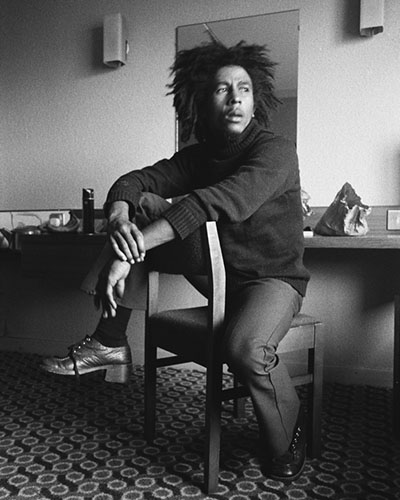
 Bob Marley in a scene from MARLEY, a Magnolia Pictures release. Photo courtesy of Magnolia Pictures.
 Is there a place for the hopeless sinner/ Who has hurt all mankind just to save his own? —
Bob Marley, “One Love”
Director Kevin Macdonald’s Marley is a compelling if uncritical story of the reggae legend. The documentary project was, at various times, to be made by Martin Scorsese and then Jonathan Demme, both directors of excellent music documentaries.
But the man who got the job has trained his lens on both music and politics, from the 2001 TV documentary Being Mick to One Day in September (1999), about the hostage crisis at the Munich Olympics. It’s possible that Macdonald introduces more politics into the story than other directors might have, but for better or worse his sense of showmanship combines the two: Led Zeppelin was prominently featured in One Day in September. Although Marley died at 36, his life and music were eventful enough to fill a 150 minutes feature without trying your patience. But the director’s political sensibility does not save Marley from the pitfalls of hagiography.
Robert Marley was the son of a white man whom he saw only a few times in his life, and a mother who left for America when he was a teenager. It is suggested that this early abandonment, as well as Marley’s mixed heritage, helped form the psyche of a man who longed to reach out to others and unify communities. It’s a story that has been told before, but Marley benefits from the cooperation of surviving family members, including wife Rita, son Ziggy and daughter Cedella. The director also tracked down talking heads to whom nobody had spoken to before, like a janitor at a recording studio where Marley made his early records.
Many of the Jamaicans interviewed are a pleasure simply to listen to, from stories about Marley’s impoverished childhood in Trench Town to demonstrations of the birth of the reggae rhythm. A touch of dissension comes when one musician calls Island Records producer Chris Blackwell, also featured, “Chris Whitewell.” Sometimes the interviewees make you wonder how reliable they are as narrators. A harmonica player claims to have been with Marley near the end of his life, while Rita Marley paints a picture of only women waiting at his deathbed. Are they both right?
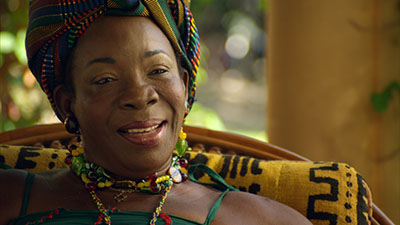 Rita Marley in a scene from MARLEY, a Magnolia Pictures release. Photo courtesy of Magnolia Pictures.
 Such conflicts in Marley are minimal, and that’s part of the problem. Marley’s surviving a gunshot wound fuels a kind of Messiah complex, and the director gives Marley credit for bringing together conflicting figures in Kingston politics. The closest Marley comes to cross-examining its subject is in the matter of his womanizing. Bob Marley fathered eleven children by seven women, and many of his affairs were conducted with the apparent cooperation of his wife Rita. It’s mostly shrugged off as “men will be men,” and only his daughter Cedella, who has inherited her father’s striking bone structure, acknowledges the pain it caused her mother. Great men are flawed and great musicians even more so, and Marley is another in a recent line of documentary subjects – from Elmo puppeteer Kevin Clash to sushi chef Jiro Ono – where excelling in one’s field comes at sacrifice to personal relationships. “One love,” indeed. We can get together and feel alright about the music, and the film indeed sent me running to my favorite streaming music service to listen to the classic Wailers albums. But a little more conflict and less beatification would have made for a more insightful film.
Marley
Directed by Kevin MacDonald
With Bob Marley, Rita Marley, Jimmy Cliff, Chris
Blackwell, Lee “Scratch” Perry
Running time 144 minutes
Rated PG-13 for drug content, thematic elements and some violent images
Opens tomorrow at E Street.