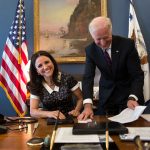
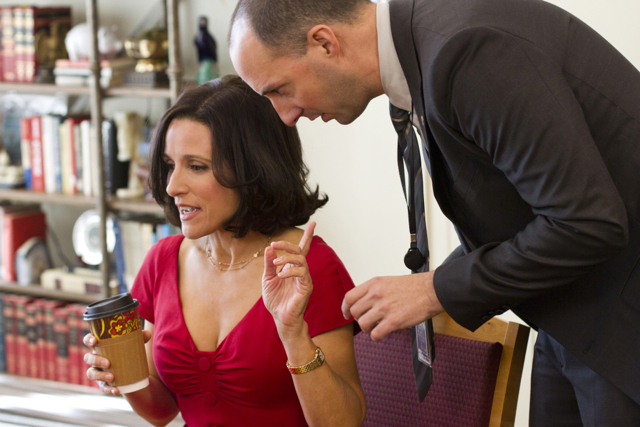
 Julia Louis-Dreyfus and Tony Hale in “Veep.” (Bill Gray/HBO)
There’s a scene early on in Veep in which a visitor to the vice president’s office requests an audience. An aide tells the visitor to wait. Why?
“She’s spinning.”
The scene cuts into a sprawling, oak-paneled office and we see Julia Louis-Dreyfus as Vice President Selina Meyer literally twirling in her chair, gazing at the ceiling and looking bored half to death. Such is the value this show places on what is supposedly the second-highest office in the land.
And why shouldn’t it? After all, even our most successful real-life vice presidents are often reduced to caricatures. Joe Biden is a well-meaning buffoon, Dick Cheney a mischievously smirking villain, Al Gore a stodgy bore. The vice presidency might be one faulty heartbeat away from the Oval Office, but it is that barrier that can make the seemingly powerful utterly powerless.
That’s what Veep creator Armando Iannucci, a Scotsman of Italian extraction, sees in the U.S. power structure, and that’s Selina Meyer’s station in the administration she serves.
Veep, which premieres Sunday at 10 p.m. on HBO, opens with Meyer entering what she hopes will be a ballroom full of Washington’s power elite. Instead, it’s nearly empty, an insult reinforced when one of the biodegradable spoons Meyer had championed turns flaccid in a mug of hot coffee.
Frankly, after so many years of the executive branch being portrayed on television as either a place of unlimited optimism (yes, Sorkin-philes, I’m talking to you) or the director’s chair of a bad action thriller, it’s a relief to see a depiction of Washington at its lamest. In the episodes I’ve seen, there are no debacles over the nuclear codes or impassioned defenses of a political party. In fact, we are not told of which party Meyer is. Not that it would make a difference—she’s championing environmentally friendly flatware in one episode and cozying up to Big Oil in the next.
Instead, Veep trades, rather successfully, on its characters’ suffering through this political cuckoldry, often in a flurry of well-timed expletives. This is Iannucci’s creation, after all, and anyone who’s seen either In the Thick of It, his sitcom set in the British cabinet or In the Loop, his 2009 film about Anglo-American foreign policy, will recognize the constant and clever deployment of the word “fuck.”
Both In the Thick of It and In the Loop starred a political aide named Malcolm Tucker, who spoke only in the meanest, bluest terms possible. There’s no true replacement in Veep, but Meyer’s chief of staff, played by Anna Chlumsky, comes closest. In that floppy spoon scene, she barks into the phone to castigate a subordinate for placing the vice president in a room with “three people and a fuckload of quiche.”
Only Gary, Meyer’s “body man” played by former Arrested Development star Tony Hale, seems have an unbroken spirit when it comes to his boss, but he’s all the stupider for it. Gary dotes on the vice president, she responds with vinegar.
Not that we would want Selina Meyer to behave in any other manner. As the vice president, Louis-Dreyfus excels—not for the first time in her career—as a frazzled professional woman beset by workplace, personal and, perhaps, sexual frustrations. It’s obvious Meyer once cut a powerful figure in Washington, but ascending from the Senate to vice presidency turned out to be hardly much of a promotion at all. There’s no power to be had in being a figurehead whose duties involve more ribbon cuttings than global summits.
And in that detail, perhaps the real-life vice president Meyer most resembles is Lyndon B. Johnson, plucked from his perch atop the Senate in order to help another man win an election, then stowed away until fate beckoned. Iannucci, not surprisingly, is a fan of Robert A. Caro’s ongoing biographies of Johnson, the newest of which (The Pasage of Power, set to be released May 1) studies Johnson’s time as understudy to John F. Kennedy.
For the Washington which we inhabit, it’s oddly fitting that Veep should be a show about the powerless. The District’s film office badly wanted this series to be shot here. But without the vigorous incentive program HBO desired, D.C. lost out to a soundstage in Baltimore. Sure, there are establishing shots here and there of the Eisenhower Executive Office Building or the drive up to the Naval Observatory, but something about Veep will always serve as a reminder of what happens when one has so few chips with which to bargain.
But let’s get past all this pouting over not playing host to yet another television show about the federal government, and relish that Iannucci has given us a series that permits us to indulge our true feelings about the people who run this country. Politics isn’t graceful and elegant; it’s crass, craven and vindictive. Selina Meyer and her just as emotionally stunted aides dwell in the space between utter inanity and legitimate power. It’s a pleasure to watch them squirm.