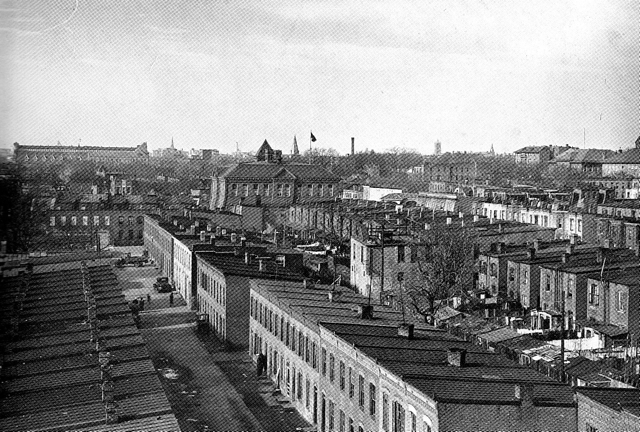
Decades ago, before it was a grid of brutalist brick apartment buildings and drab government warehouses, Southwest D.C. was perhaps the quadrant least changed since the drawing of the L’Enfant Plan. Not that it was the fairest of places though. A well-heeled waterfront where many of the cities wealthier black families lived stood in front of blocks of century-old rowhouses and crumbling tenements, divided into racially segregated neighborhoods on either side of what is now known as Fourth Street SW.
African-Americans lived to the east of what was then called 4 1/2 Street, Eastern European immigrants and their children to the west. Al Jolson’s family moved to the neighborhood when his family emigrated from Russia; Marvin Gaye was born in a tenement on First Street.
In 1943, intrigued by the poverty in Southwest, a social worker with a photography hobby named Godfrey Frankel took a collection of snapshots of life in the alleys between the tenements. His work was largely forgotten until 1992, when The Washington Post sent reporter Laura Goldstein to track him down and tell the stories he encountered. The resulting article landed Frankel a book deal 50 years after he took those photos. Frankel’s collection, In the Alleys, was published in 1995, the same year he died.
Through the website Alley Connoisseur, which collects images of life in the alleyways and hidden corridors of cities around the world, we’re able to show you some of Frankel’s gripping images. The site’s author, Raf Miastkowski, writes of Frankel’s findings:
Residents of Southwest, also known as “The Island,” were often called “alley rats” by outsiders. At the time, nearly 10,000 people called these alleys home, even though the conditions were not ideal. Dwellings faced alleys, as opposed to tree-lined streets with sidewalks, and were typically two stories high, dark, cramped, and built from wood or brick. Most had no electricity, central heating, or indoor plumbing. Wood stoves and outhouses were a common sight. Though the photos seem to depict urban blight, former residents talked with pride about a tight-knit community that resembled a small town. On Saturday nights the sounds of people drinking and blues music filled the alleys. It was a close neighborhood, and “no one” locked their doors. One resident noted that it was “because no one had anything to steal,” and another stated that they didn’t even know what a door key was until they were 16 years old.