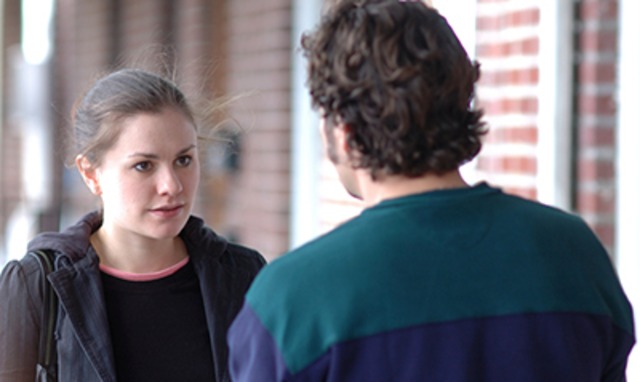
 Anna Paquin and Mark Ruffalo in Margaret. Courtesy of Fox Searchlight.
 “I think I just alienated one of your neighbors by smoking in the elevator.”
“What did they say?”
“They pretty much said you’re not supposed to smoke on the elevator.”
“Well that’s original!”
Most of the dialogue in Kenneth Lonergan’s long-delayed, two-and-a-half-hour drama Margaret is written at least somewhat better than that brief exchange between teenagers Lisa (Anna Paquin) and Paul (Kieran Culkin). But too much of the script sounds written, in ways that I’ve never heard people speak. By the time emotions finally come flooding in, they appropriately enough come from a lack of communication. This, among other things, is what the film is about. But Margaret is so contrived and ham-handed that its successes are mostly drowned in its failures.
High-school senior Lisa (Anna Paquin, who was 29 when she played the role) leads a privileged life on the Upper West Side. Her mother, Joan (Lonergan’s wife, J. Smith-Cameron) is a successful Broadway actress in something called Controversy, which looks as bad as it sounds. Lisa’s father Karl (played by Lonergan himself) has some unidentified career lucrative enough to earn him a beachfront home in Southern California. That the director plays a father who is distant both geographically and emotionally is apt for the feeling that the film is run by remote control.
The wheels of Margaret are set in motion when Lisa decides on a whim that she’d like a cowboy hat. She peers into shop windows in vein when she sees a bus driver (Mark Ruffalo) driving up Broadway with exactly the hat she’s looking for. She chases after the bus, trying to get the driver’s attention to ask where he got the hat, and while his attention is distracted by this young woman, the driver runs a red light and kills a woman (Alison Janney) trying to cross the street.
Much of the film is thus driven by blame. Does Lisa blame herself for distracting the driver? Is the driver to blame for not stopping at a red light? Lisa attempts to make peace with the dead woman’s friends and family, and frequently finds herself at odds with her own family. What she inevitably does reveals the film’s real theme.
 Matt Damon and Anna Paquin in Margaret. Courtesy of Fox Searchlight.
Lonergan’s debut feature, You Can Count on Me (2000), met with critical and commercial success, so his sophomore project was met with considerable hope and expectation. Margaret was shot in 2005, but post-production issues, detailed by the Los Angeles Times in 2009, left the movie in limbo for years. Fox Searchlight has released, without much enthusiasm, a 150-minute version. Those few who have seen the director’s three-hour cut claim it is the superior film but it’s hard to imagine the loose ends and forced nature of so much of the film being improved by an extra half hour. The director deserves some credit for getting his sprawling film to work emotionally at all. As the film moves along—and as frustrating as it is, it’s not boring—it reveals more and more breakdowns in communication, and if the situation set up is forced and the dialogue literary more than realistic, the raw emotions exposed seem real.
There is no character named Margaret in the film. The title comes from Gerard Manley Hopkins’ poem about grief. His Margaret grieves for her self and lost innocence. This is the crux of Lisa’s character flaw. Margaret appears to be a moralizing fable about the damage we cause to other people, but it slowly reveals itself to be about self-absorption—Lisa grieves not for the hurt she has caused someone but for the hurt it causes herself. Margaret‘s defenders, like co-star Ruffalo, call it “a love story to a post-9/11 America and New York City,” but that’s not the film’s pivotal romance. After all, the central tragedy unfolds because of Lisa’s vanity—she wanted a cowboy hat. Kenneth Lonergan wanted to make a three-hour movie about self-absorption. The two and a half hour movie we get is an occasionally compelling drama, as frustrating and self-centered as its grieving young woman.
—
Margaret
Written and directed by Kenneth Lonergan
With Anna Paquin, Mark Ruffalo, J. Smith Cameron, Matt Damon, Jean Reno.
Running time: 150 minutes
Rated R for strong language, sexuality, some drug use and disturbing images