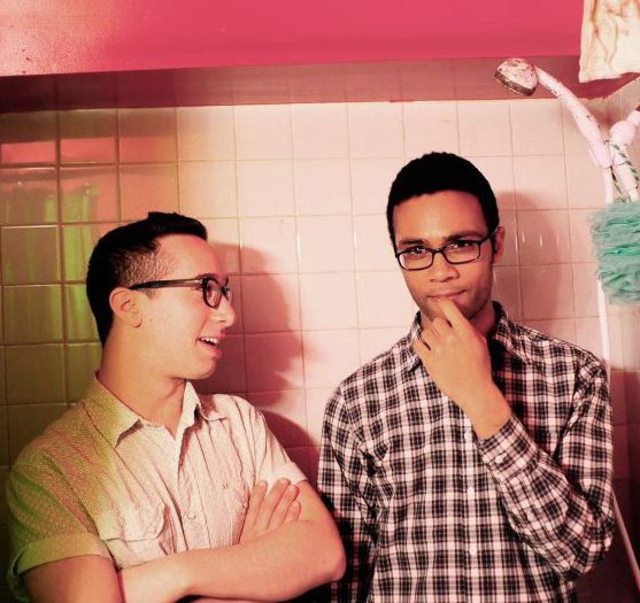
 Josh Gottesman and Daoud Tyler-Ameen of Art Sorority for Girls
Within a couple minutes of talking to Daoud Tyler-Ameen, the creative force behind the redundantly named Art Sorority for Girls, it was clear why we had found his songs so mesmerizing. Tyler-Ameen is a very engaging storyteller. He’s personable and self-effacing; both of these traits come across in his songwriting.
Art Sorority for Girls is unapologetically poppy. While Tyler-Ameen has occasionally played alone, his hooks have the bombast to reach the back of a very large room. If one was to speed up Death Cab For Cutie songs to the velocity of Voxtrot songs and combine the lyrical acuity of the two, you’d have a standard Art Sorority For Girls song. Besides, as anyone in this transient city can attest, leaving a former home may feel like cheating on that city with a new place, but Tyler-Ameen actually turned that sentiment into a likable and relatable pop song. Most of his songs play out similarly, taking some sour young adult experiences and sentiments and turning them into easily digestible fare.
We talked to Tyler-Ameen about getting comfortable with the band as a two-piece, drawing inspiration from hip-hop and keeping his awkwardly long moniker.
Find them online: http://artsorority.com/
Get their music: http://artsororityforgirls.bandcamp.com
See them next: Tonight at the Black Cat with Southern Problems and Mobius Strip.
So, you just moved down within the past year. That was for your job (at NPR), correct?
That’s right. At the end of 2010, I had been thinking pretty seriously about leaving New York for awhile because it is my hometown and I had been there forever and ever. I’d basically never lived anywhere else. I was working at my local public radio station but I was barely employed. I was a temp in on and off periods. So, someone sent me a link and I thought, “Oh, that’s interesting. I don’t know about D.C.” So, I put in for it and then didn’t really think about it for six weeks and then all of a sudden I had a job and I had to move and tell everybody I loved that I loved them and leave. I’m a production assistant. I do a lot of copy editing and web production and then write occasionally. I think the most recent creative thing that I did was a mini-oral history thing about Fugazi as a live entity which was for when the live archive went up in December and that was really fun.
Are you present for a lot of the musically related things that go on — the Tiny Desk concerts and whatnot?
Yeah, it’s all kind of one beast pretty much. Everyone’s in the same sort of triangle shaped room. That desk, the Tiny Desk is probably 12 feet away from me. We mostly like each other. We hang out outside of work occasionally. When it gets time to do best of the year, we all get in the same room and argue for days upon days and then we have beers together and mostly forget about it. It’s cool. I could be dominating and doing all kinds of cool stuff all the time. I think just I’m just balancing the creative stuff with the work and with the music and just doing music again because I kind of took last year off.
You did?
Yeah. I got to town. My first day of work was Valentine’s Day. I had gotten to town the night before. I was staying with a friend of a friend of a friend, didn’t know a single soul and I was pretty fragile. There was that and there was having a new job that I wanted to perform well at. I didn’t know anybody and certain things that I had taken for granted in New York like access to practice space and certain other things — I don’t know — in New York everybody you meet is in a band.
Where did you live in New York?
I grew up mostly in the East Village and then moved to Brooklyn briefly after college and then quit my publishing job that I had for two years because I decided that I appreciate what publishing is but I didn’t have any interest or passion for it so I quit and I moved back into my mom’s house and sought an unpaid internship at WNYC and that turned into paid production work and I did that for awhile until I got an actual job.
Since you took a year off, what was the impetus for playing again?
I never made a conscious decision to stop playing music but there were so many other things to worry about and when inertia gets its hooks in me, battling that off is an uphill battle. I’m not a great self-promoter and I’m constantly self conscious about being presumptuous or about being “That Guy” at work or “That Guy” in your group of friends who won’t stop talking about his awesome thing that he does that you really just have to hear everything about. But I thought about it and I would get honest to god shivers every once in awhile especially when I’d be walking along, listening to music, and something would come up on shuffle, like maybe a band that I used to be in that was part of my group of friends’ bands from back home and I remember thinking that it was like the tingle of a phantom limb. You really feel it, like it’s still there and you’re still part of it and it’s still part of you and I’d get really really miserable. But I didn’t really know what to do about it.
After awhile I started working on songs again. I had a lot of time to do it because I was starting from zero in terms of rebuilding a social circle. So, a lot of nights at home. I’ve been living in a basement bedroom where I can be as loud as I want to but there’s not a lot of light and you can sort of forget that there’s a world out there. I think it was October, I went to the D.C. Record Fair in Arlington and I was standing and flipping through the 99 cent hip-hop singles at this one vendor and there was this kid next to me and he pulled this Fresh Prince & Jazzy Jeff record from the stack which I don’t even care about but somehow we ended up in conversation and he explained that he was also from New York, had also moved to D.C. that year for work in the non-profit sector. He also wore glasses, was slightly unsure of himself but then if you engaged him on the right topic, was weirdly confident all of a sudden. And then he mentioned that he played drums. I was like, “We could probably get along, dude.”
He gave me his business card and even with such a positive windfall it took months before I actually acted on it. But we got together and we tried playing in my basement which sounds terrible and you can’t play very loud. Instantly, I could tell his instincts were totally on point. He would anticipate things that I would really want a drummer to do in that situation because, I’m primarily a drummer.
That surprises me.
I’m an amateur in all respects. I never took a music lesson in my life. But for a really long time that was what I did in a bunch of bands at home. If you live in a city and you are at least a competent drummer and you own your own kit and you’re a worthwhile human being and kind of a pushover, you end up in a lot of bands. That was me for a good while.
We got together and he tried his hand at songs having never heard them before and I was like, “That’s pretty okay.” But what it took for us to actually do it in public was…one of my roommates got a job in Africa. She was in a band here and decided she was going to throw herself a going away shindig. So she just said to me kind of idly one day, “I’m going to do this show before I leave town, can you guys play?” I said, “Sure” even though at the time, “You guys” wasn’t specific or official. We just got together and we played and it was like, “Well, that was fun but we don’t really know what’s going to become of it.” Up until a week and a half before the show happened, which was in early February, I thought I was going to play it by myself. I thought, “I have a handful of new songs. I’m feeling a little brave right now.”
Early February as in, three months ago?
Yeah. Like, a week and a half before it occurred to me that this is a going away party at a bar and it’s free to get into. Nobody’s going to listen to me. Nobody’s going to know who I am unless I put a little volume behind it. So, I wrote to Josh and went, “Hey, this is kind of crazy but do you want to play this show with me at a bar.” We managed to get two practices in. We managed to cobble together five songs. Two of them sound a lot like each other. But we did it and we had a great time. We were nervous. The sound system was terrible. My friend Dan who showed up said that when were sound checking, the vocals sounded a ziplock bag full of bees.
Wow.
But we had so much fun that we decided to do it again and weirdly enough, and this is a first for me, maybe a week after that we were offered a show. It had been so long since I had approache this project with anything resembling commitment and drive and the desire to make it more than what it already was. So, that’s it. This show we play on Sunday will be our fourth one in town. I should probably explain, Art Sorority for Girls as it stands right now is me and Josh and it’s new. Most of the songs are new and the ones that are old, by necessity, we’ve had to deconstruct and rearrange and make it playable by two people. I have been playing songs and writing songs under that name for the better part of ten years.
How many lineups have you gone through? I’ve seen you solo, I’ve seen videos of you with backup singers. How many more lineups have there been?
Up until two months ago it was me and whoever was around, basically. I think that worked for me because, for one thing, I’m not much of a guitar player. I don’t have a music theory background. So, jamming the way that bands do when they’re coming up with new songs or new arrangements was always really, really difficult for me. I could do it as a drummer but I couldn’t do it very well as a songwriter. Also, I was super-possessive and protective of the songs because the songs are very, very personal. So, the more people that I sort of brought into the fold, even though the vision up in here of what the song could sound like was really, really big, I never thought about it in a permanent way. It was very much a solo project. I think now I’ve found somebody that I trust to a) do what’s right with the songs and b) isn’t a songwriter, himself. That was the casualty of the scene I ran in. Everyone was a multi-instrumentalist. They had different talents but everyone was a songwriter so their own project was going to be the most important thing to them no matter how much they wanted to have fun and hang up.
But, I’ve been through a lot. I’ve probably been through half a dozen lineups. It was a boy-girl duo with my friend Sarah. That probably lasted a little under a year. It was a trio with a drummer and a baritone guitar and me. It was that thing which was kind of a tottering, six person collective wherein there were six, seven, eight people who had provisional membership and sort of drifted in and out. The last time that I tried to make it a band, it was a Weezer-style quartet. It was two electric guitars, bass and drums. That was fun, too, but I’ve got to tell you as someone who plays the guitar in a very functional way, I think not having another melodic instrument in the mix is awesome. To the extent that I’m able to improvise, just having a drummer to deal with means that you cannot play a wrong note.
That’s interesting that you described it to me as a Weezer-style quartet. Is that what you were going for?
No, but that’s just what I always come back to. People say to me now, every once in awhile, “I get kind of a Weezer vibe from you.” Or, “I get an emo vibe from you.” And I did listen to a fair amount of Weezer in high school and I did listen to a lot of second wave emo. I’m not sure what they’re talking about. I believe them but I don’t know. Everybody kind of has that moment in their adolescence when they realize they actually have an opinion about things. It could be music or it could be anything but I remember being 15, 16 and having my first girlfriend who came over to my house, looked at my CD collection and said, “We’ve got to do something about this,” and came over soon afterwards with a bag of forty CDs and basically said, “I need you to do your homework.” So, I think that was how I started to be not just a vessel who would listen to whatever the popular girls at school were listening to and would do it 6 to 12 months after it stopped being cool. So, it’s a reference point.
Other people hear emo and Weezer but what do you hear? What are the reference points for you?
So, I’m not great at this kind of self-analysis. Most of the time, if I’m doing something in a particular style or I’m trying to write about a particular thing, it doesn’t work. A lot of the time when I go for something specific, I can’t finish it. The times when I’m most successful and when I make something that I think is actually worth a goddamn afterwards are the times when I have an unusually high tolerance for not having any idea where something is going. So, I don’t know if any of the songs that I’m playing right now or have been committed to tape were — I never said, “I want to write a Weezer song,” or “I want to write a Mountain Goats song.”
This is a little bit more specific than what you’re asking for, but, I didn’t listen to hip-hop until 3 or 4 years ago. I was always curious about it, appreciative of it, never really related to it until then. Then there was a pretty turnaround in 2009 where all of a sudden it was a third of what I was listening to just because I managed to find a couple of gateway albums that I was really into. It was things like the first two Kanye West albums which are pop albums. It’s not really hip-hop. He’s got this middle class upbringing. A lot of the kind of signifiers of hip-hop especially in the area that I was growing up in, gangster rap and even certain kinds of conscious hip-hop, I had no idea what to do with it. But here was this dude that worked in a line from an Adam Sandler movie that I had actually seen when I was twelve. I was like, “Alright. I can see what this is about.” Certain other things, The Low End Theory by A Tribe Called Quest, Tha Carter III by Lil Wayne, a handful of Jay-Z albums — and I started listening to a lot of that stuff on repeat.
And what I found within a couple of months is that suddenly in the way I approach songwriting, melody is still important, but rhythm became just as important. Suddenly, I was in this space where the rhythm of how you sang a line was just as important as the melody and where I would try to cram more syllables or more words into a line than seemed possible and see if I could still make it work. Or, I would work in similes and I would bust off three or four similes in a row and occasionally they would be hip-hop references. I wouldn’t even realize it but there’s a song — it’s one of the songs that we perform now, “Spaceship” — there’s a line about kicking like a sensei which is from “Dr. Carter.” That’s something where I can say that this is something that I enjoy and I’ve absorbed it an through whatever recombinative process is behind songwriting, I’ve come up with this other thing that doesn’t really sound like this thing but you can trace the line and you can see how it happened. Apart from that, I just really love pop music. I realize that’s kind of a meaningless term at this point because it can refer to so many things. In college I thought of myself as an indie rock guy and I think I’ve given that up because everyone should give that up because that means even less.
You mentioned your lyrics being very personal and it seems that you take a lot of care with them. Do all of your songs come from personal experience?
Not all of them. I’d say they certainly all come from something personal. I think every once in awhile you’ll actually find something that’s a literal experience, something that really did happen to me, but that’s pretty rare and if it is there, I usually try to cloak it a little bit so that people won’t ask about it. I’m trying to get better about this, but I’ve had plenty of songs that have taken years to finish. That’s not to say that taking more time is necessarily good. I don’t think it is. I think sometimes I’ll get an idea for something and I won’t really know where it’s going. I don’t do lyrics first and I don’t necessarily do music first. It starts with a hook. It starts with the good part, basically. I’ll think of one thing, some lyrics and a phrase that fit well together and I’ll think, “That can work well on a song, but that’s not the beginning, it’s somewhere in the middle.” That begins a steady process of building outward from the middle and trying to teach myself in the process what the song is actually about. Sometimes that takes a long time. I’ve had one or two experiences where I’ve finished something in an evening but it takes a long time and that’s the reason why right now I’m trying to be proactive about trying to book as many shows as practically possible and making sure that by the time one show is over, we already have another one to look forward to because it’s the only way that I can meet songwriting deadlines. Otherwise this stuff just languishes forever.
But it’s nice to have one other person to be accountable to. That, I think I can manage. And, it’s nice to be in a place where I feel really excited about booking shows. I mean, on the one hand, I don’ t know anybody here and that’s a reason to be a little shy. On the other hand, I know everybody here. Every time that I get invited to something by one person, I see two people that I’ve already met. I say, “You guys know each other?” and they’re like, “Oh yeah.”
How did you come up with that rather unique stage moniker?
The summer that I graduated from high school, I went with my girlfriend at the time, Hannah, to a dinner party that was hosted by our mutual friend, Amy. We were all talking about the future and being adults and what college was going to be like. Amy had gotten into an art program at a school in the south somewhere that she was very excited about and was trying to explain to us all the cool stuff they have for the art students. She said, “They even have this art sorority…for girls.” And we laughed because that’s a silly sort of redundant thing to say. Then Hannah turned to me and said, “That should be the name of your band.” I said, “I don’t know about that.” But, Hannah was and is a really wonderful cartoonist and she made the flier for the first show and put Art Sorority for Girls on there without really asking. I ended up just rolling with it because for one thing, my name is impossible for people to say. Daoud Tyler-Ameen is a lot of variables for people to deal with. I used to hold it against them but I don’t anymore cause there are a lot of vowels and there’s a lot in there to trip you up. It’s gotten to the point where if I go to a coffee or sandwich place where they take your name and give you your order, I’m Tyler. I’m Tyler at Taylor. And it’s saved me a lot of time.
I did consider changing it. There was a moment right after college when I went, “Okay, this is easier to say than my name…but not by much.” People still get it wrong all the time. They say Art School for Girls or Art Society for Girls or Art for Sorority Girls which is almost better. So, I thought about changing it and the reason that I stopped is that, something that happened around the same time that I was starting to hear from other people. They would say, “Your music is about school” or “Your music is about young people.” I realized that that’s kind of it. Art Sorority for Girls, weird grammatical redundancy aside, sounds like young adult fiction. The songs are kind of young adult fiction. They’re all about the anxieties and desires that are specific to feeling young and feeling green and like you’re not as good and adult as you should be.