Review by Catherine Lewis
The opening act of a three-band bill isn’t supposed to upstage the other two groups, but that’s nearly what happened last night at the Fillmore Silver Spring.
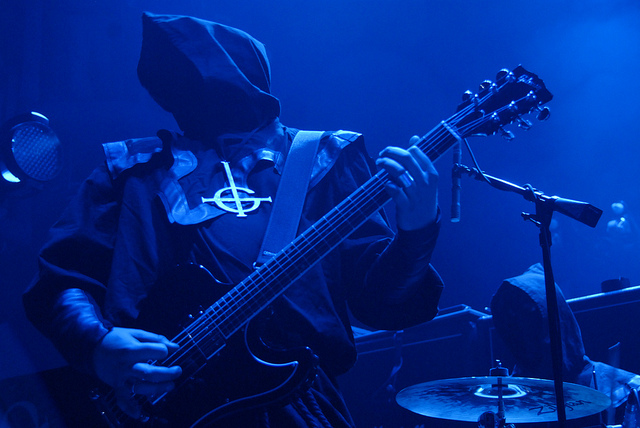
The first band of the night was Sweden’s mysterious Ghost. With heavy influences from Blue Öyster Cult and Mercyful Fate—and a generous helping of Satanic lyrics—the sextet was absolutely on point at this show. Gone were the vocal issues that plagued frontman Papa Emeritus at the group’s sold-out show at the Rock & Roll Hotel this past January: his soaring melodies sounded as good live as on the group’s debut album Opus Eponymous. The band basked in its anonymity, with Papa Emeritus dressed as an anti-Pope and the other five members—known collectively as “the nameless ones”—cloaked in black with their faces shielded. The backdrop glowed behind them like stained glass, adding a haunting atmosphere to the religious imagery in their songs “Con Clavi Con Dio” and “Ritual.”
After such an intense performance, Mastodon’s 70-minute set seemed tedious. The set list pulled heavily from the group’s latest album, The Hunter, featuring shorter, more succinct numbers instead of the sprawling, proggy compositions that the band has more traditionally been known for. Songs like “Octopus Has No Friends” and the sleepily sung “The Hunter” lacked energy, while the vocal effects on “Crack the Skye” didn’t seem nearly as effective as they did in the studio. Songs that raged live at the group’s show at the 9:30 Club last November—like “All the Heavy Lifting”—just seemed as though the band was holding back, and while they seemed to pick up intensity on “Spectrelight”, that might have just been the group’s overactive strobe light show talking.
Opeth very nearly brought the audience to Boringtown, too. The Swedish prog-metal band has grown mellower since its 1995 debut, and its latest album, Heritage, featured none of the growled vocals or lightning riffs that punctuated the band’s earlier work. More than half of the band’s set at the Fillmore came from the new LP, making Opeth sound more like a 70s progressive rock band than a metal circus. Frontman Mikael Akerfeldt even acknowledged the endurance required to listen to so many quiet numbers all in a row: “We’re going to test your patience a little bit more,” he said after the mellow number “Burden” before launching into the trippy, swirling “The Lines In My Head.”
It’s not that those mellower songs were bad. The lengthy, shapeshifting “Folklore” was one of the best songs of the night: while the song stayed soft-spoken throughout, it grew from Akerfeldt’s solo guitar introduction into a tenser, more dramatic climax. The problem was that too many sedate songs in a row drained the energy from such a large room. Akerfeldt’s between-song chatter certainly helped break up the songs (oddly, Opeth was the only band of the night to talk extensively between songs), but the best songs of the band’s 70-minute set were the final two. “Demon of the Fall” featured Akerfeldt’s growling vocals, and, after a random interjection of a riff from Metallica’s “The Eye of the Beholder” (and a joke about being influenced by the band’s crappy album Load), Opeth closed with the dark and brooding “The Grand Conjuration.”