Martin Austermuhle
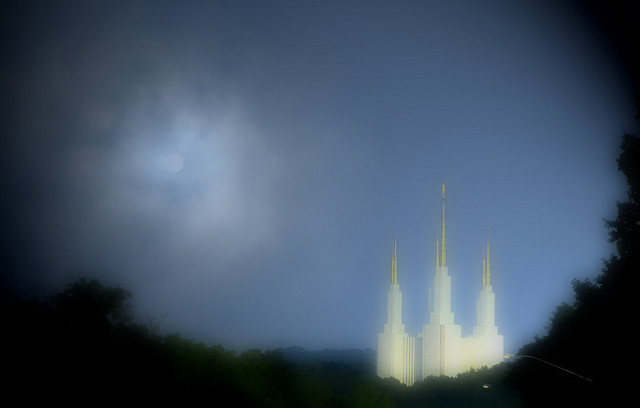 Photo by andertho
Even before the election that could see the first Mormon president in U.S. history, the Washington region is becoming something of a Mormon stronghold, CNN is reporting:
When [Bishop Lewis] Larsen arrived in Washington in the early ’80s, there were a just handful of Mormon meetinghouses in northern Virginia, where he lives. Today, there are more than 25, each housing three separate congregations, or wards, as they’re known in the LDS Church.
“There’s been an absolute explosion in Mormon growth inside the beltway,” Larsen says before slipping out of the pew to crank the air conditioning for the swelling crowd.
The LDS Church says there are 13,000 active members within a 10-mile radius of Washington, though the area’s Mormon temple serves a much larger population – 148,000 Latter-day Saints, stretching from parts of South Carolina to New Jersey.
There are 15 Mormon members of Congress, and Crystal City has become so popular with Mormons that it has become known as “Little Provo,” after the Utah town that hosts Brigham Young University. According to the article, many Mormons ended up in D.C. because of the religion’s emphasis on civic engagement.
Of course, the mere increasing presence of Mormons in the area doesn’t mean that their presence will be felt. Mormons are less overtly engaged in politics than other faiths, and even when they have played a role, it’s tough to measure how successful they have been locally. Take same-sex marriage, for one. Though the Church of Latter-day Saints was very active in pushing a same-sex marriage ban in California, it didn’t seem to engage much on the issue when D.C. legalized it two years ago.
That being said, for two years we did have a Mormon lording over us in the form of Rep. Jason Chaffetz (R-Utah), but his opposition to same-sex marriage, medical marijuana and D.C. voting rights seemed to stem more from his Republicanism than his religion.
Still, the CNN article does include a fun little factoid about Mormons in the region: the temple in Kensington, Md. that rises above the treeline when you’re coming around the Beltway was the first one of its kind built east of the Mississippi River since 1846.