Martin Austermuhle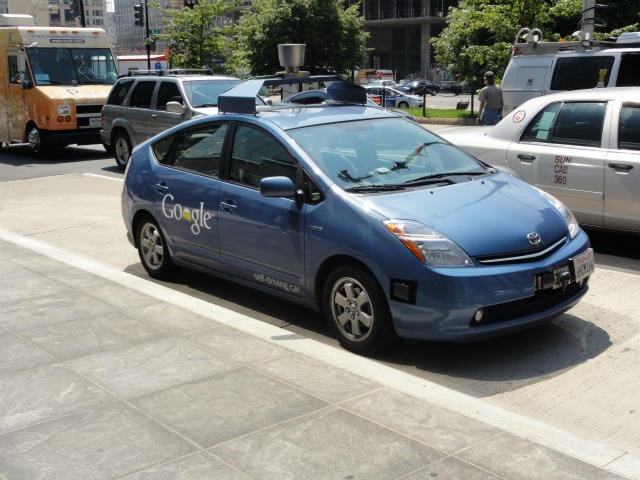
Google’s self-driving car has been a curiosity that until recently has been limited to the company’s Mountain View campus. But with Nevada’s recent decision to license the car for use in the state, one of Google’s self-driving cars was brought to D.C. last week. Today, two D.C. councilmembers got a chance to jump into one.
One of eight prototypes, the blue self-driving Toyota Prius Google brought to D.C.—no, it didn’t drive itself here from California; I asked—only really stood out because of the constantly-rotating laser mount that sits atop its roof. This laser—along with sensors on the front and rear fenders—constantly feeds information to the car’s computer, telling it when, say, a pedestrian crosses into the street or a Maryland driver is aggressively cutting into a lane. The car also relies on constantly updated maps that tell it what a particular speed limit is and how to drive itself from point A to point B.
After a morning briefing, Councilmembers Mary Cheh (D-Ward 3) and Tommy Wells (D-Ward 6) were invited for a drive around the block. After returning, Cheh said that while the car drove much like any other would, it was “uncanny” when she realized that it was driving itself. And how did she know? She said she asked the Google engineer behind the wheel to express himself with his hands and turn around to talk to them. He did—and the car continued driving itself without interruption.
OK, so it’s really cool, but what’s the point? Cheh and a Google engineer were peppered with questions as to why a self-driving car would be necessary or useful. First off, they said, was safety. In 250,000 miles worth of testing, said the Google engineer, none of the self-driving cars have gotten into accidents. For Cheh, the value of this is inestimable—not only in terms of lives saved, but also in a hopeful future where traffic isn’t backed up on I-66 because of early-morning fender-benders.
Second, said Cheh and Wells, was how the car could be better put to use by families, thus reducing the amount of cars each household would need. Wells conjured up a scenario in which your Google self-driving car drops you off at work and heads off to pick up a family member elsewhere; for Cheh, the advantages could be more immediate, as the car could simply go find itself parking after dropping its passengers off. (Wells joked that the city’s taxicab industry wouldn’t be happy with self-driving cars.)
Third, said Cheh, is the value for people who can’t drive currently—the blind, for one. Google seemed to be thinking the same thing, and an employee said that representatives from the Council for the Blind, the AARP and veterans’ groups would be taking part in test rides today.
None of this is to say that there aren’t quirks to be ironed out. The car might be able to sense its way around just about anything, but it certainly isn’t yet intuitive. Should a traffic control officer be directing traffic, for example, the car will only respond to whatever color the traffic lights are—no matter how vigorously it’s being yelled at to not do so. Also, engineers have been toying with how sensitive its sensors should be. While it’ll stop on a dime if a kid runs into the street, it might not do so if it’s a squirrel.
Obviously, we’re still a ways away from seeing this on the commercial market. (Optimistically, said Cheh, it could happen within two years.) And even if Google started mass-producing self-driving cars, Cheh noted that no regulatory structure yet exists to accommodate them. For today’s test-drive, for one, the DMV, MPD and the D.C. Department of Transportation had to coordinate to permit it. (One condition? The car couldn’t be empty.)
Still, Cheh called the car “mind-boggling” and seemed almost giddy at having had the chance to ride in it. “It’s incredible, and the potential seems almost unlimited for changing our lives in a positive way.”