
The email said “impromptu candlelight vigil.” But outside the Howard Theatre last night, the atmosphere was anything but dour. The man the burgeoning crowd came to honor wouldn’t have wanted it any other way, many people said.
Chuck Brown, the Godfather of Go-Go, died yesterday from complications due to sepsis after a long bout with pneumonia. He was 75.
In the hours after his death was announced, Washington was arrested in memories of what Brown meant—to the local music scene, to the black community, to giving D.C. residents something to be proud of. Statements poured in from the District’s elected officials; U Street seemed to be at a standstill.
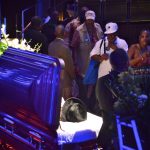
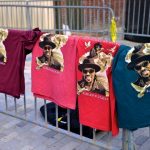
About 8 p.m., a makeshift sound system outside the Howard began emanating the bouncy, jazzy, percussive sounds of Brown’s oeuvre. People gathered to the restored plaza outside the theater Brown played so many times in the earlier stages of his 50-year career and, until falling ill, was scheduled to play again. It was a go-go to send off the man who invented the genre.
The crowd swelled as people grooved their bodies on the sidewalk just off Chuck Brown Way, the block of Seventh Street NW renamed for the late musician. “Get, get, get, get on down,” instructed the lyrics of Brown’s 1979 hit “Bustin’ Loose.” And that’s exactly happened.
“Chuck was beyond the music,” said Dre All Day, a DJ with the online radio station Blis.fm who said he helped organized the jam after learning of Brown’s death. “He spawned a whole culture.”
Alfred “Black Boo” Duncan, the lead vocalist for the go-go band Mambo Sauce, reflected on Brown’s appearance in the video for his group’s 2007 single “Welcome to D.C.”
In the video, Brown appears at the tail end seated in the back of a limousine, puffing on a fat cigar and dispensing orders in that distinctive gravelly voice. The caption is—what else?—”The Godfather.”
“Chuck is the epitome of creativity,” Duncan said. “He means to us what Elvis means to Memphis.”
A few feet away, Gregory Elliot, better known as Experience Unlimited frontman Sugar Bear, was holding court. E.U. scored as big a hit as any go-go band ever did, when “Da Butt,” their track contributed to the soundtrack of Spike Lee’s School Daze, hit No. 1 on the Billboard R&B chart in 1988, just as “Bustin’ Loose” had done nine years before.
None of E.U.’s successes would have been possible without Brown’s work or mentorship, Elliot said last night.
“Chuck Brown is the reason Sugar Bear is here,” Elliot said. “He opened up a door for me.”
The music stopped for Brown’s daughter, KK, to address the crowd. Her words were muffled by the mobile sound system provided by WKYS, but a DJ from the radio station—one of many yesterday to switch their programming to Chuck Brown’s discography—put the evening’s vibe succinctly: “Chuck would not want it any other way.”
The crowd chanted “Wind me up, Chuck” several times, and the party resumed with the sweaty, clickety-clack beats of “Feel Like Moving That Body.”
Cheri Johnson was dancing with her sister, Tina Kirkland, a few feet from the door of the Howard. A lifelong D.C. resident, Johnson said she started going regularly to go-go shows when she was 14, but the first time she saw Chuck Brown play was at a “back-to-school” jam at the now-demolished Capital Centre in 1981 when she was 12. Johnson was at work yesterday when she received a text message telling her Brown was dead.
At a show last year, Johnson said she won an audience raffle and was invited to join Brown’s band on stage. “I was crying,” she said. “I was in awe.”
To Johnson, Brown meant one thing above all else—home. “No matter where I go—Texas, California—if I hear Chuck,” she said, “that’s home.”
Johnson rifled through a few titles when asked her favorite Brown song.
“‘Hoochie Coochie Man’!” Kirkland said with a hearty laugh.
“That’s your favorite,” Johnson told her sister.
They kept dancing, along with the rest of the hundreds-strong crowd. Though he was absent, Chuck had indeed wound them up.