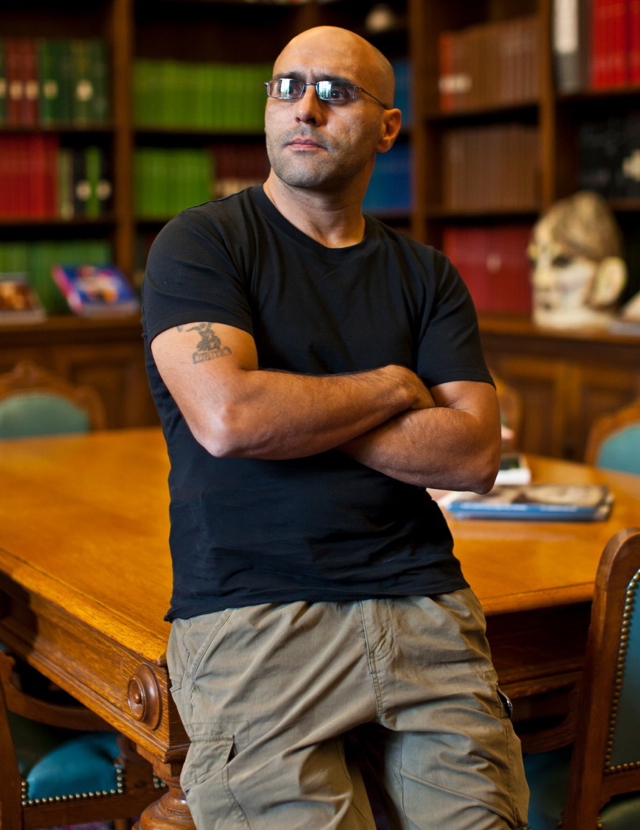
 Samuel Corum/Corcoran College of Art and Design
João Silva has been around the most dangerous spots in the world for most of his adult life. Since making his name as one of the most adventurous chroniclers of the clashes between the African National Congress and Inkatha Freedom Party that ripped apart his country of South Africa in the early 1990s. From there, Silva became one of the most widely seen combat photographers in journalism, with his shots of frontline carnage from war zones around the world seen by newspaper readers everywhere.
With the outbreak of the war in Afghanistan, Silva was one of The New York Times’ lead shooters in what would become the United States’ longest war. Though a treacherous country, Afghanistan had long captured Silva’s eye; he started going there in the 1990s, before the Taliban arrived. But on October 23, 2010, Silva, traveling with a U.S. Army brigade, stepped on a land mine. He lost both his legs below the knees, and became a resident of Walter Reed Army Medical Center for many months.
Silva finally got home to South Africa late last year. Recently, he’s been back in D.C., spending time at the Corcoran College of Art and Design, where he delivered the commencement address last Saturday. He’s also been back at Walter Reed—though he’s been recovering for 19 months, there’s still a long way to go.
We spoke Saturday at the Corcoran Gallery of Art.
How is your recovery at this stage?
Well, it’s been mostly prosthetics and then healing whatever arises. For instance, I’ve spent the last week at Walter Reed with a couple complications. One of them being a partial bowel obstruction which developed into a bleeding ulcer and finally an abscess in the abdomen that had to be cut and drained. So that was the past week. It kind of comes in waves. Mostly it’s prosthetics.
You’ve had some opportunities to get some pictures published. There was the White House photo last year.
That was pretty much it. That and doing the marathon. That’s the last time I shot anything.
What was the New York Marathon like?
It was good. It was fun. I’m glad I did it. It was a challenge a year and a few weeks after I’d been injured and it was something I wanted to try doing. Definitely fun and hard work. I don’t know if I’d do it any time soon again, but as a one-off I’m glad I did it.
Can you tell me about Afghanistan?
Sure. Whatever you need.
Leading up to when you were injured, what was that experience?
I was there as part of the regular rotation and I was on my fourth rotation. I’d been at that point in the country for almost a month and during that particular time I was embedded with a unit in the Fourth Infantry Division, Task Force 166. And we were moving between bases and dismounted and I stepped on a land mine. That’s basically it.
About a year ago I interviewed Greg Marinovich and he had actually just come from visiting you at Walter Reed so we talked about you for a bit. He told me that you would eventually like to get back to those theaters.
Well, yeah. The combat aspect is probably not possible because I don’t have that mobility anymore. But in terms of going back to countries in conflict, countries in flux, society changing—most definitely, yeah. As a photographer there’s so much more to do than the conflict. The combat is something I’ve always been fixated on, but the bottom line, there’s the impact on society, the human drama, all that kind of stuff which is equally important. I guess those would be the things I’d focus on when I eventually get back to it.
I also think about the photographers who were not as lucky as you to survive.
Chris [Hondros], Tim [Hetherington].
Yeah. Do you think in the last year or so the world has become more dangerous for photographers?
I don’t think so. Go far back as Vietnam, there’s a huge number of journalist casualties. If you just look at Iraq alone, it’s in the 40s. A majority of that actually being Iraqi journalists which doesn’t get the media attention that it warrants. As long as there’s photographers, journalists, cameramen going into these situations, there’s always the potential for people getting hurt or killed. I think what’s happening right now is that it’s been a lot in a very short period of time and a lot of those people being pretty high-profile, pretty experienced. And that I think has caused the industry to step back and just reassess. There’s nothing wrong with reassessing. I don’t think we should stop doing this work. We are the eyes and the ears and the witness. So we need to continue. It’s just how we go about doing it. It’s always been risky.
What got you into it in the first place?
I picked up photography quite by luck. It wasn’t something I aspired to as if I was a young kid at school with photo clubs and stuff. Quite the opposite, in fact. A friend of mine was studying graphic design and one of his subjects was photography, and on a particular day he had to photograph motion. So, he went with us to a racetrack where he was going to photograph cars and motorcycles going around, that kind of stuff. And that was it. I shot a few pictures with his camera and it was like someone had turned on a light switch. I knew exactly what I wanted to do. It was also very clear what kind of photography I wanted to do, and I wanted to be on the edge of history. I wanted to bear witness. I wanted to photograph society as it changed.
When I go out with a photographer, he or she is always two or three steps ahead of me. You really have to be out there, certainly in front of the reporters. What’s the mindset when you’re out there?
Ultimately you want to document the situation as best you can and as close to reality as you can. That’s basically what you’re trying to do. At the same time you’re assessing risks. There’s various things going on simultaneously and you make a risk assessment as you go forward. But certainly, being a photographer, if you’re not seeing it, you’re not capturing it. And that’s just the way things are, so that automatically makes it necessary to be as close as possible to whatever’s happening, be it a demonstration, be it actual combat. It’s not one single thing. It’s a variety of things you try to process simultaneously in order to be able to do justice to your subject matter and to the situation. But it depends on the situation. Sometimes you can, sometimes you can’t. There’s always the matter of access. Everything being equal, for the most part we will tread as close as we can.
So what do you impart to these graduates then?
I’m not going to be preaching. They’ve all heard me speak for the most part. Just motivate them and know what they’re getting themselves into. It’s certainly an honorable profession. For those who are going to pursue this career path, it’s important to understand that there’s a price tag that gets attached to this, be it psychological, emotional and at the same time it’s a very rewarding career.
Of the many conflicts that you’ve covered, which ones stay with you?
Obviously Afghanistan. Not only because I was injured there, but I’ve had this longstanding love affair with the country. I first went to Afghanistan in the early 1990s during the civil war after the Soviets were there, way before it became a mainstream story with the U.S. and NATO involvement post-9/11. And I’d been going there periodically ever since. But it’s also the country that cost me my legs and pretty much my career. But there’s many. Each country has its own uniqueness that keeps pulling you back in.
Having been there even before the arrival of the Taliban, what was it about that country?
It’s just a fascinating place. Borderline biblical, with people who still live a way of life which goes back hundreds of years. At the same time, there are tanks going by and all these artillery explosions around you. This mix of medieval culture blending with all this modern technology. And also just the resilience of the people, the whole warrior concept, the mujahadeen thing. It was fascinating as a young journalist. Of course it’s a country steeped in deep history going back to Alexander the Great. Those people have never been conquered. When not fighting foreign forces they’ll be fighting among themselves. You’ve got Pashtuns, Uzbeks, Tajiks, it’s endless. I guess another product of western powers drawing a line across the map and deciding that’s a country.
If you got a chance to go back to telling that story, do you know what part of that story you would want to tell?
Going back to Afghanistan?
Yeah.
I think if I could I’d certainly want to see the end of this chapter. I’d like to be there around the period of the drawdown and just document how that’s going to have an impact on Afghan society. Is it going to slide back into civil war? Is the Taliban going to gain power overnight? These are all unknowns. Can the Afghan army hold it together without NATO support? These are all questions that need answering at some point.
How do you feel generally these days? Do you feel optimistic you’ll have a chance to go back?
Yeah, it’s just a matter of when. I just spent the last week in hospital. My body is still very much going through a recovery process. Once I’m fully healed then I’ll be able to immerse myself in work again. Right now it’s very much keeping it together.
Greg Marinovich actually told me that he hoped you’d stay away from the dangerous places in the future.
I think to a certain extent I will do so. I don’t think I would exclude it entirely. It’s the part of journalism I enjoy most. But as I’ve mentioned, the combat aspect is gone. Running around on front lines and getting shot at, that’s gone. That automatically eliminates a huge amount of danger. You can spend time in war zones without being shot at, as do many journalists, because there’s so much more to document. My focus has always been that, but now that I can’t do it anymore, I’ll just have to focus on other aspects. So there will still be a certain element of danger inherent to being in those places alone, but I think not doing the frontline stuff buys you a certain cushion of moderate safety.
Do you miss it?
Oh, yeah. I want to go back to it. I want to do what I’ve always done, but there are certain realities one has to confront and accept and move on.