Memorial Day is an American tradition started in 1868, three years after the close of the Civil War, to honor those killed in combat. But in 1942, with the United States thrust into World War II after the attack on Pearl Harbor, the Memorial Day parade and tributes took on more meaning.
The War Production Board urged those working at war factories to forgo the holiday and “continue production to defend America.” At Arlington National Cemetery, Undersecretary of the state Sumner Wellles said the following:
Today, as our nation faces the gravest danger it has ever confronted since it gained its independence, the American people are once more meeting together in every state of the union to commemorate the observance of Memorial Day. … We must utterly and finally crush the evil men, and the iniquitous systems which they have devised, that are today menacing our existence, and that of free men and women throughout the earth. There can be no compromise. There can be no respite until the victory is won.
For the American soldiers and sailors deploying around the world, Memorial Day 1942 came at a fulcrum for the war in the Pacific. In the months following the raide on Pearl Harbor, Japanese forces continued their push against U.S. naval power. From May 4 to 8, U.S. and Australian ships and planes met their Japanese counterparts in the Battle of the Coral Sea, the first engagement of the war in which aircraft carriers fired directly on each other. The Allies lost more ships in the five-day engagement, although they were able to secure a strategic victory in bottling the Japanese advance through the Pacific.
But the Allies still needed a decisive victory in the Pacific. Memorial Day observations came in the final days before the Battle of Midway. Under the command of Admiral Isokoru Yamamoto, the Japanese fleet designed a trap to ensnare the American fleet at the atoll and use the expected victory as a launchpad for further attacks on Fiji and other island chains.
The Japanese fleet, though, did not expect every wave of U.S. sorties dive-bombing and strafing their sea and fleets. In total, Japan lost four aircraft carriers and more than 300 planes in the battle, which scholars quickly called “the first irreversible Allied victory of the Second World War.”
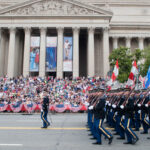
On Monday, the National Memorial Day Parade starts at 2 p.m., stepping off at the corner of Constitution Avenue and Seventh Street NW, and then proceeding west past the White House before ending at 17th Street.