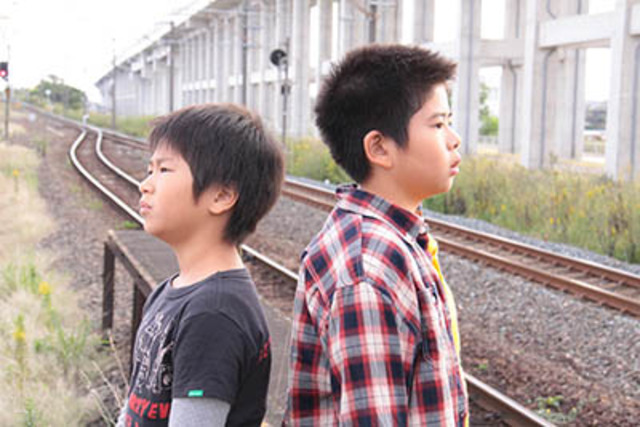
 Ohshiro Maeda and Koki Maeda. (Magnolia Pictures)
Twelve-year old Koichi (Koki Maeda) lives with his mother under the shadow of a volcano that regularly coats his high-rise bedroom with a fine layer of ash. His little brother Ryu (Ohshirô Maeda) lives a hundred miles away with their father, a struggling indie rocker. Hirokazu Kore-eda’s film I Wish, whose Japanese title can also be translated as “Miracle,” follows the boys and their wishes, which of course include their parents getting back together. In the wrong hands this could come off as maudlin and sentimental, but the director’s gentle touch finds a good balance, grounding whimsy in reality, dreams with resignation.
Koichi and Ryu, played by real-life brothers, have names that may ring a bell with fans of Japanese director Yasujiro Ozu. Actor Chishu Ryu is one of Ozu’s signature performers, and Koichi is the character he plays in Ozu’s Early Summer. You see Kore-eda’s debt to Ozu all over this film, from its delicate tone and patient rhythm to variations on Ozu’s famed compositional style. But there are telling differences. Ozu mostly depicted an old-fashioned Japan, but towards the end of his career, the tension between the old and the new worlds threw fuel on relationships between parents and their children. Kore-eda uses what he learned from Ozu to deal with subjects the master would never have touched — just take his previous film, Air Doll. This is a director who lives in the present but appreciates the past, as do his characters. Inflatable love dolls aside, Kore-eda’s themes of alienation and abandonment are often seen through children, and I Wish is a gentle return to form that depicts a culture where children are both empowered and as helpless as adults.
Despite the broken family dynamic and the volcanic ash gives even children a sense of mortality, I Wish is light on its cinematic feet. It’s a vision of children who act like adults and adults who have never lost childlike desires. Three generations of Koichi’s family are observed in the film, and they all look forward or backward to some other age. Kids wield power over adults, threatening to get a teacher fired or a food vendor written up. Thirty-some things lament the chances they had when they were younger, or hang on to a young person’s dream of rock and roll. The elderly try in vain to recapture the taste of a favored dessert of their youth. The children are not the only ones with a wish, but they are the ones with the plan — or so they think.
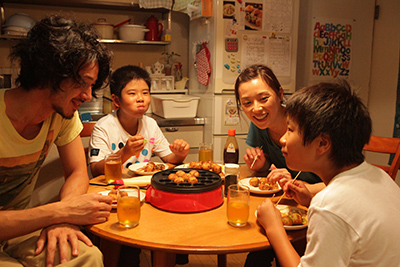 From left: Joe Odagiri, Koki Maeda, Nene Ohtsuka, and Ohshiro Maeda. (Magnolia Pictures)
Koichi and his classmates get an idea about the new bullet train coming to town. They believe that when two trains pass each other from different directions, the pressure will create so much energy that whoever witnesses this meeting can make a wish and it will come true. Worldly and naive at the same time, the kids plot a journey that in this country would result in frantic tweets and half a dozen Amber alerts.
I Wish departs from the bleak alienation of Kore-eda’s earlier films like Maborosi or Nobody Knows. That doesn’t mean this is just another quirky coming of age movie. The kids are never really in danger, but are not particularly happy. Koichi’s brooding is obvious, but it becomes clear that his little brother puts on a happy face as a defense mechanism. There is no conventionally happy ending, but the movie is still quietly cheerful. The somewhat incongruous alt-country/indie pop soundtrack by Japanese rock band Quruli helps, but the movie’s wistful pleasures lie mostly in the wishes of characters young and old. I Wish suggests that they don’t have to come true – that wishing itself is an affirmation of life.
—
I Wish
Written and directed by Hirokazu Kore-eda.
With Koki Maeda, Ohshirô Maeda, Ryôga Hayashi, Cara Uchida.
Running time 128 minutes.
Rated PG for mild thematic elements, language and smoking.
Opens today at E Street.