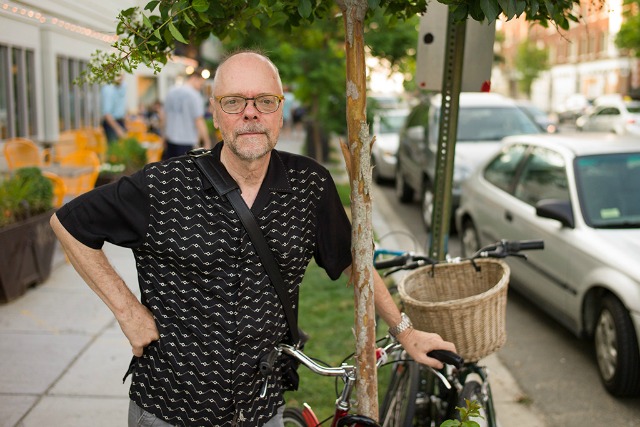
 Photo by John Ulaszek
Leica just announced the winner of its prestigious Oskar Barnack Prize, named for the Leica engineer who is considered the father of 35mm photography—and it’s Mt. Pleasant resident Frank Hallam Day. A former State Department employee, Day won for his series called “Alumascapes,” a meditation on man vs. nature that marries a fine art sensibility to a Florida landscape dotted by recreational vehicles. Day’s images of RVs are portraits, not only of mobile homes but of man’s sometimes contentious relationship with nature. I spoke with Day about his career and recent work
First of all, congratulations! How does it feel to win the Leica Award?
This award has a long history and it’s been a pretty important award since the beginning. I think I’m only the ninth American to win it since 1979 when it started. There were thousands of entries from 89 countries. It’s a big deal!
You’ve used a range of film formats in your work but do you have a favorite Leica combo?
Back in the 70s and 80s I had a Leica M3 but all my current work is shot on a Canon DSLR. They’re giving me a Leica of course. And they’ve also promised to get my bar tab. You don’t have to use Leica to compete.
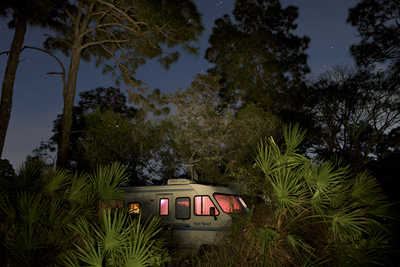 From “Alumascapes.” Courtesy of Frank Hallam Day/Addison Ripley
You’ve said that your RV series is inspired by painter Henri Rousseau, and you are yourself a painter as well. Can you tell me a bit about the relationship between painting and photography in your own work and how you see the world through these different eyes?
I think it’s really helpful to have been a painter before going to photography. You really think fundamentally differently. You feel more comfortable about adding and subtracting and seeing the photographic image as a process you can tweak and work on. As opposed to point and shoot and that’s it, which is what a lot of photographers think like. I think the RV series is interesting in that it owes nothing to William Eggleston, and it’s very hard for contemporary photography to escape his influence.
Tell me about it! [Ed. Note – Eggleston is one of my favorite photographers]
William Eggleston is sort of the first color photographer. He ‘s still alive. He created a particular kind of photographic vision that’s very vernacular and democratic. Seeing everything and having a particular style of framing
The iconic tricycle.
That’s the iconic look in contemporary photography. “Just look around you and see what you see!” But the RV pictures owe much more to the history of painting. They owe a lot to late medieval/early Renaissance painting. I was very influenced by Jan van Eyck altarpiece called The Adoration of the Mystical Lamb. Obviously there’s nothing lamb like about RVs! But the treatment of the light in the foliage, the kind of glow it has, comes from Northern European painting in the late med/early Renaissance periods. And it also comes form late nineteenth century landscape painting, both German and American. I’m very influenced by that. When I’m looking at the LCD on the back of the camera after I make an image I say wow, that looks just like David Caspar Friedrich or George Inness.
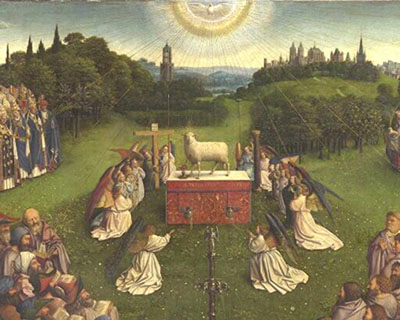 Detail from Jan van Eyck, The Adoration of the Mysitcal Lamb
Your RV work, as well as your series of mannequins in Africa and the Middle East seem to comment on man vs. nature in a specifically commercial aspect.
My series called American Waterscape is very much about man and nature. Those are enormous black and white prints shot on black and white film with a great big mahogany camera. They are about man and nature – not commercialism per se, more about our thoughtlessness. As far as the mannequins go, I see them more about the status of women in some third world countries, Arab countries. Very commoditized, damaged, for sale, patched up, banged up – but still presentable. That’s what I see the mannequins as being not about nature, but the Waterscapes, that’s definitely spot on.
This is a big can of worms, but can you speak to the advantages of digital vs. analogue photography? Can you give a sense of what draws you to use film in one project and digital on another?
I’m mostly digital. The RV images were all shot with a digital camera. It’s not really possible to do them with film because you have to see what you’re doing. You’re applying light at the scene and you need to know if it’s looking right. You shoot, you look at it, do it again, you look at it. And this can go on for 20 shots. What I use film for only is giant view cameras like 8 x10 and above. Digital is so good that you don’t really need to use large format cameras as much as you used to.
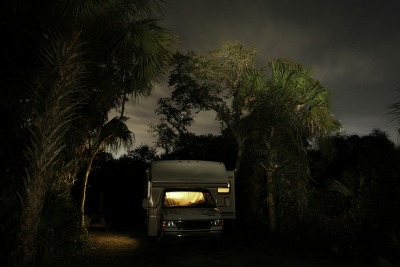 From “Alumascapes.” Courtesy of Frank Hallam Day/Addison Ripley
What’s next for you?
Leica is giving me a rangefinder digital camera and I’m looking forward to learning how to use that. It’s going to be a big departure. And I’m trying to think of another project – it could be Jerusalem. I’ve worked in Jerusalem before and have an extensive body of film-based work. And I would like to go back and wrap that up.
Is there anything else you’d like to mention?
You might note that the Leica prize is a single prize; it’s not a group of people. It’s worldwide, 89 countries. An early version of this work was shown at Addison Ripley in 2010.
Do you have any other exhibits coming up?
I have shows coming to the Orlando Museum of Art and the Artisphere in September. I have a piece in the RV series that’s up right now at the Corcoran in the Deep Element show. And then I have a lovely diptych up at Addison Ripley right now from a different series in Coney Island. The RV series has done better in Europe than America for some reason. Maybe it’s more exotic to them? Less baggage?
Will you be showing them in Orlando?
Yes – I showed two of them, 24 x 36 images at the Snap Festival in Orlando in May and they were pretty well received.
One more thing. You may wonder why Leica uses the title Alumascapes and I use the title RV Night. Europeans have no idea what an RV is. So I had to think of something. They call them caravans and Americans have no clue what that means.