Martin Austermuhle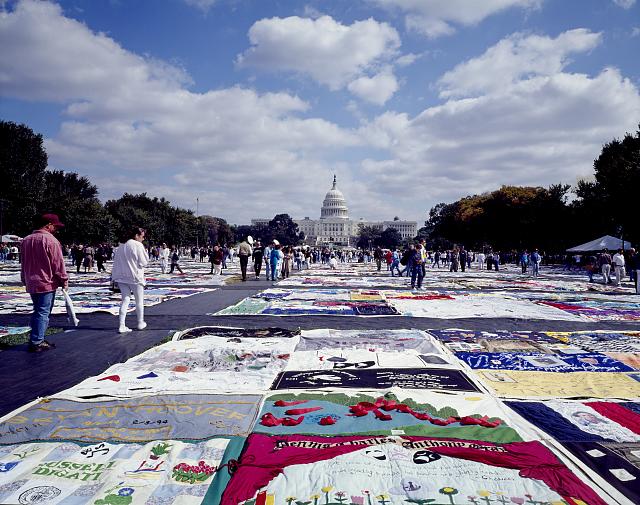
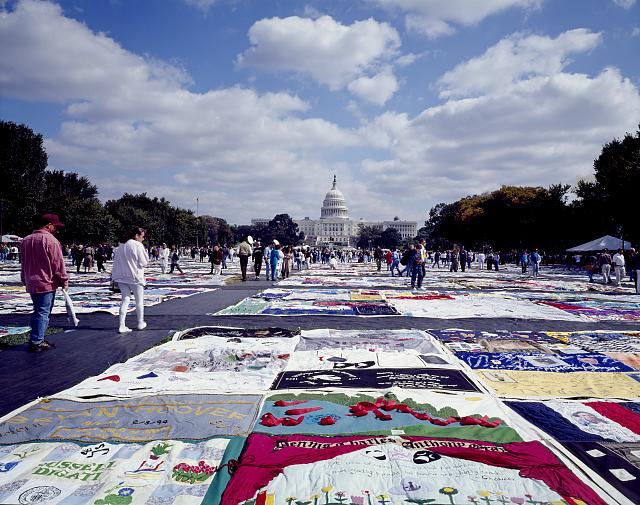 The AIDS Memorial Quilt. Photo courtesy of the Library of Congress.
While D.C.’s HIV/AIDS rate is far higher than most places in the U.S. and even some developing countries, the city’s focus on combating the disease seems to be slowly paying dividends.
A new report on HIV/AIDS released by the D.C. Department of Health yesterday found that while 14,465 residents are living with HIV—2.7 percent of the city’s population, far above the one percent the World Health Organization qualifies as a “generalized epidemic”—the number of new HIV/AIDS infections and death have decreased over the past four years. Additionally, more residents that test positive are receiving the necessary medical care more quickly—between 2005 and 2009, 60 percent of those residents diagnosed with HIV had achieved viral suppression.
The good news comes only weeks before D.C. will play host to the International AIDS Conference, the first time the gathering has been held in the U.S. in over two decades. “Next month, when the District will welcome thousands of HIV/AIDS advocates, leaders and researchers to the AIDS 2012 conference, we will be able to say proudly that the District of Columbia is leading the way in HIV prevention and treatment,” said Mayor Vince Gray in a statement.
The gains have come in the wake of aggressive programs to test residents and offer means of protection. In late October 2010, the DMV started offering free HIV/AIDS tests at its Penn Branch location; 5,000 tests were conducted over the course of a year. All told, in 2011 the city conducted 122,000 HIV tests, up from the 110,000 in 2010. The city also distributed five million male and female condoms and removed 340,000 dirty needles from circulation, despite having lost one of the main needle-exchange providers in early 2011. (For years Congress prohibited D.C. from spending its own money on the programs.)
“The strength of the District’s response is a direct result of the quality and quantity of data we now regularly collect,” said Councilmember David Catania (I-At Large), who chairs the D.C. Council’s Committee on Health. “Our policy and program decisions are driven by our data and, as a result, are reaching and benefiting at-risk and infected individuals. People are making better, safer decisions about their health because we have focused on expanding knowledge about the disease in order to combat its spread.”
Despite the move in the right direction, HIV/AIDS cases still largely target the city’s black residents. According to the report, 4.3 percent of the city’s black adults are HIV-positive (when broken down by gender, it’s 6.3 percent of black men), compared to 1.8 percent of Hispanics and 1.2 percent of whites. Additionally, HIV seems to be hitting older adults more than anyone else—almost 12 percent of the reported infections are in adults between the ages of 40 and 60.
In terms of geographic distribution, Ward 8 leads in infections with 3.1 percent, followed by a two-way tie at second in ward 1 and 5 (2.7 percent) and a two-way tie at third in wards 6 and 7 (2.6 percent.) Ward 3 has the fewest number of cases, at 0.3 percent.
As in the past, men having sex with men leads all other modes of transmission. Through the end of 2009, 38.8 percent of all HIV cases were attributed to this mode, while heterosexual sex accounted for 27.2 percent and injection drug use for 16.4 percent. White men were much more likely to contract the disease from having sex with other men, while black men were more likely to get it via heterosexual sex.