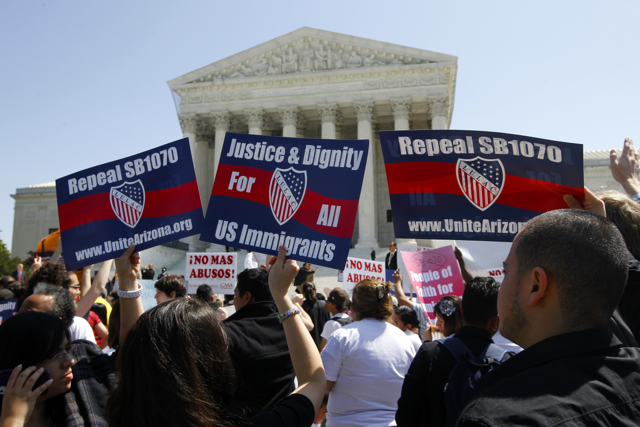
 Opponents of Arizona’s controversial immigration law outside the Supreme Court during arguments in April. (AP Photo/Charles Dharapak)
In a split decision, the U.S. Supreme Court rejected several key provisions of a controversial immigration law in Arizona. In the 5-3 ruling, the court struck down sections of the law that make it illegal for immigrants without work permits to look for jobs, command police officers to arrest anyone whom they believe has committed a deportable crime and make it a crime for immigrants to not carry their documentation.
But the court left intact the most hotly contested portion of the Support Our Law Enforcement and Safe Neighborhoods Act, also known as SB 1070, that authorizes police to review all detainees’ and arrestees’ immigration status with the federal government’s registry.
The ruling in Arizona v. United States was the second-hottest ticket in the Supreme Court’s current term, which will conclude Thursday with the even-more-anticipated decision in the case determining the fate of the Obama Administration’s 2010 health care overhaul.
In the Arizona case, Justice Anthony Kennedy, writing for the majority, called immigration policy the bailiwick of the federal government. “The Federal Government’s broad, undoubted power over immigration and alien status rests, in part, on its constitutional power to ‘establish an uniform Rule of Naturalization,’ ” Kennedy wrote.
Joining Kennedy were Stephen Breyer, Sonia Sotomayor, Ruth Bader Ginsberg and, in a split from the remainder of the court’s conservative wing, Chief Justice John Roberts. Justice Elena Kagan recused herself from the case, citing her work on the matter in 2010 while serving as solicitor general.
Justices Antonin Scalia, Clarence Thomas and Samuel Alito wrote in their dissent that they would have upheld the entirety of SB 1070.
“Immigration is a federal matter” David Cole, a professor at the Georgetown University Law Center, told CNN shortly after the decision was announced. That that was the court’s leading sentiment is being seen as a crucial victory for the Obama administration, which challenged the Arizona law as soon as it was signed by Gov. Jan Brewer.
“On net, the SB 1070 decision is a significant win for the Obama Administration,” wrote Scotusblog’s Tom Goldstein. “It got almost everything it wanted.”
But, with the section instructing police to check the immigration status of anyone they stop for any reason remaining intact, Brewer claimed victory, too. In a statement released after the decision, Brewer said that enforcement of the surviving pieces of SB 1070, which had been suspended in the wake of rulings by lower courts, will begin almost immediately.
“After more than two years of legal challenges, the heart of SB 1070 can now be implemented in accordance with the U.S. Constitution,” Brewer said. “In recent days, in anticipation of this decision, I issued a new Executive Order asking that this training be made available once again to all of Arizona’s law enforcement officers.”
Update, 12:45 p.m.: President Obama responded to the Supreme Court’s ruling, claiming victory in the justices’ finding that immigration is a matter of federal concern. But he was disappointed with the preservation of the facet of the Arizona law that authorizes police to check the immigration status of all detainees.
“I am pleased that the Supreme Court has struck down key provisions of Arizona’s immigration law. What this decision makes unmistakably clear is that Congress must act on comprehensive immigration reform,” Obama said. “At the same time, I remain concerned about the practical impact of the remaining provision of the Arizona law that requires local law enforcement officials to check the immigration status of anyone they even suspect to be here illegally.”