It’s hot out there. Damned hot. With the temperature set to push past 100 degrees today and this weekend, tacked on with punishing humidity that will make it feel as though it is close to 110 degrees outside, we should all be mindful of ways to stay cool.
The National Weather Service announced a heat advisory for the D.C. area today, advising people to stay in air-conditioned places, drink lots and lots of water and avoid direct sunlight. Smart advice that’s relatively simple to adopt. (And remember, if you don’t have air conditioning at home, you should consider spending some time at one of the District’s cooling centers.)
But imagine dealing with this heat wave if you were covered in thick fur and weighed 600 pounds or more. That’s what a lot of the large mammals at the National Zoo are facing this weekend. Fortunately for them, the zoo’s staff employ a variety of methods to keep their specimens as cool and comfortable as possible during these hot spells.
The pandas have it pretty easy, enjoying air-conditioned and radiant water-chilled grottos, according to the zoo. They also spend most of their days inside, not being fans of the heat. Pandas, along with many of the zoo’s other mammalian residents, are given popsicles made of frozen fruit juice and chunks of fruit, usually pears or apples.
Even the scaly, furless creatures get hot-weather treats. Cuban crocodiles also spend the summer days indoors, but nosh on frozen cocktails made of water, beef blood, beet juice, gelatin, white rats and black mice.
Zoo visitors might also spot a porcupine snacking on a watermelon wedge, a white-faced saki splashing in a wading pool or an elephant dousing herself with water collected in her trunk.
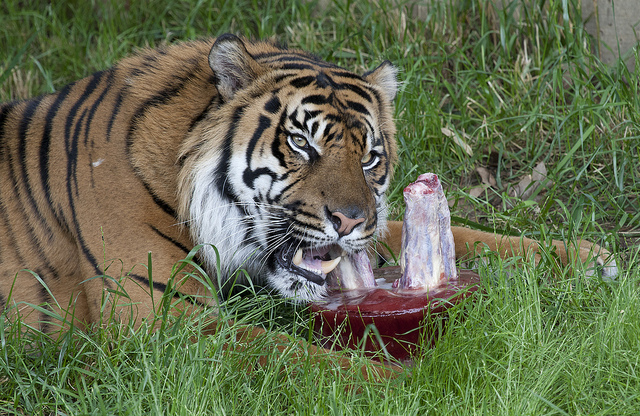
And then there are the tigers. Weighing more than 500 pounds and carpeted with fur, tigers must get very steamy during this kind of weather. So the zoo’s resident nutritionists supply the big cats with bloodsicles—a blend of frozen ichor and chipped meat mounted on a sawed-off bone. And should you ever be in the mood to make your own bloodsicle, the National Zoo passed along the recipe.
Bloodsicle
Water
One cow’s femur, cut in half
A couple pounds of shaved beef
One quart cow’s blood
1. In a medium-sized bucket, combine water, shaved beef and cow’s blood. Stir until mixture is viscous and beef is equally distributed.
2. Drop cow’s femur into bucket, with a few inches of bone sticking above the top of the bloodsicle mixture.
3. Place bucket in freezer unit until frozen. (Cow’s blood, according to a 1921 article in the Journal of Industrial and Engineering Chemistry, solidifies at slightly below 0 degrees Celsius.)
4. Remove bucket from freezer. Gently slide frozen bloodsicle from the bucket and feed to the nearest tiger.