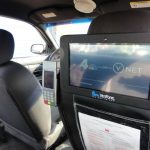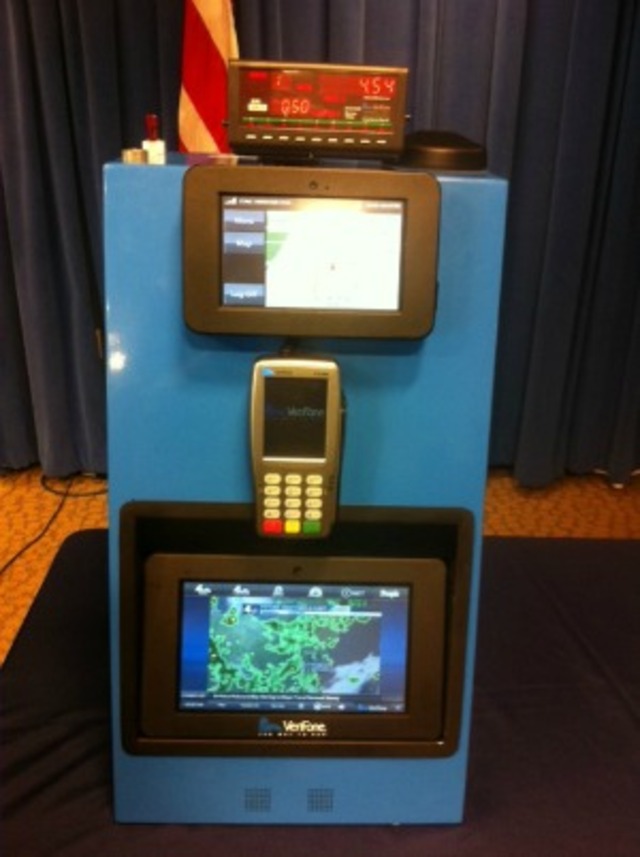
 The components of D.C.’s new smart meter for taxicabs, including the meter, GPS, credit card payment option, and TV.
A group representing 3,000 D.C. taxicab drivers says that the District’s planned adoption of new “smart” meters for the District’s taxi fleet could lead to an invasion of their privacy and that of passengers.
In a press release, the Small Business Association of D.C. Taxicab Drivers argues that introducing the new-fangled devices, which feature credit-card readers and global positioning system devices, “unnecessarily expands government in a way that threatens personal privacy.”
Under a taxi oversight bill set to be voted on next week by the D.C. Council, the D.C. Taxicab Commission would collect all fare and GPS data transmitted by the new smart meters. Drivers have long opposed the implementation of the new meters as a financial hardship—the association has said installing the new devices will cost $4,100 per cab—and last week threatened to strike over the matter.
But with Mayor Vince Gray’s announcement yesterday of a $35 million contract with VeriFone, which manufactures the smart meters, implementation seems all but guaranteed.
The drivers’ group says that it does not oppose adding the option for passengers to pay with credit cards or GPS devices for “navigational purposes,” but the data collection is making it wary.
“There is no legitimate public purpose for a government agency to monitor the minute-by-minute movements of individual taxidrivers. DC taxicabs are private businesses licensed by the city government,” the press release states.
But backers of the smart meters say that installing the devices are a much-needed step in modernizing the District’s fleet of more than 6,000 taxis, which, under current regulations, are cash-only enterprises. Smart meters have been a part of New York City’s taxis for several years now, featuring credit-card access, GPS monitoring and television content provided by NBC.
Data collection is also the norm in New York; the Taxi and Limousine Commission there keeps track of cabs’ GPS movements and fares, just as the D.C. Council’s bill would authorize. New York cab drivers have argued that the U.S. Supreme Court’s decision in January that GPS tracking requires a warrant (based on a case that began with a Metropolitan Police Department operation). In February, a group of New York cabbies cited the verdict in a class-action lawsuit against the TLC that claims the constant stream of data led to unjustified prosecutions against drivers.
Ron Linton, the chairman of the D.C. Taxicab Commission, says that the D.C. drivers’ association isn’t seeing the entire picture.
“They don’t listen carefully,” Linton says in a phone interview. There are two groups of data that the DCTC intends to collect from the smart meters, he says. The first is the distance, time and cost of rides that is already printed on passenger receipts.
“There’s no invasion of any privacy there because that information is going to the passenger,” he says.” Right now, Linton says, that information is not relayed to the commission until at least 24 hours later when it is deposited into a data drop.
As for the GPS tracking, Linton says the drivers are being paranoid there, too. GPS data collection will only occur when a cab picks up a passenger, he insists. “They think that from the time they get in their car and start the ignition” that the smart meters will transmit a taxi’s location back to the DCTC, Linton says.
Instead, Linton says that the GPS tracking will kick in only when a driver has a fare, and that the data will be sent in a real-time feed to the District’s Unified Communications Center.