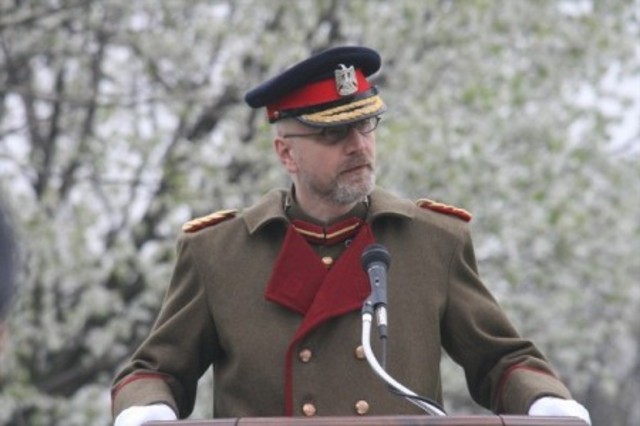
 Albrecht Muth, courtesy of Georgetown Patch
Inside Sunday’s edition of The New York Times Magazine, the tale of murdered Georgetown socialite Viola Drath and her husband, Albrecht Muth, gets a long look from New Republic editor Franklin Foer.
Calling Drath and Muth “The Worst Couple in Georgetown,” Foer’s account is an unflinching look into their bizarre tale, one that ropes in the likes of former Secretary of State Henry Kissinger, Newsweek columnist Eleanor Clift, Supreme Court Justice Antonin Scalia, Kennedy consigliere Pierre Salinger and even the Iraqi militant Moqtada al-Sadr. Of course, it begins and ends with Drath’s death last August, for which Muth, 47, is charged with first degree murder, though he has been consistently ruled incompetent to stand trial. Muth is a well-known fabulist, who has claimed, among other dignities, that he is a general in the Iraqi army.
Foer’s story mines the correspondence and unpublished memoirs of Drath, who died at age 91. The article is a good, long Sunday read, but here are a few highlights that might be new to you:
Drath and Muth’s party guests had wild guesses about Muth’s background:
According to one tale, he once planted a bug in Madeleine Albright’s master bathroom on behalf of German intelligence, although the device managed to pick up only the sound of running water. Another placed him in Baghdad, working a furtive U.N. mission for Kofi Annan, or Uncle Kofi, as Muth called him.
Their first date, in the 80s when Muth was a teenage intern, was at Kissinger’s favorite haunt:
The schnitzel joint he picked was said to be Henry Kissinger’s favorite restaurant in town. Muth ordered a bottle of expensive wine and, over the course of dinner, recounted the details of great battles, quoted Oscar Wilde and spoke of landing a top job in the United Nations.
Muth claimed he was a double agent embedded in Sadr’s insurgent militia:
Several months later, the dateline on Albrecht Muth’s e-mails began to read “Villa Zarathustra, Sadr City, Iraq.”
…
The focus of his efforts was the insurgent Moqtada al-Sadr, whom he referred to either as Mookie or with the honorific Hojatoleslam. He said that he had implanted himself as an aide in Sadr’s camp so that he could act as a double agent: while he advised Sadr, he would try to steer him and his Mahdi Army away from violence.
Muth considered himself a modern-era Lawrence of Arabia:
In his missives Muth assumed the persona of a world-weary freelance operator, comparing himself with T.E. Lawrence. He enjoyed angering the inept Americans, who couldn’t appreciate all the ways he saved their bacon. There were others who shared this assessment. The former Pakistani ambassador to Iraq, a recipient of Muth’s e-mails, wrote a column in The Dawn newspaper that credited Muth with restraining Sadr: “Perhaps [Muth] had been inspired by the sterling example of the Iron Chancellor, Otto von Bismarck, who welded modern Germany.” When Muth forwarded this article to his friends, Eleanor Clift replied: “This is an excellent piece with a perspective that is right on target and gives credit where it’s due.”