 Photo by Dan Macy
When the D.C. Council votes tomorrow on a bill overhauling the regulation and operation of the District’s 6,500 taxicabs, Councilmember Mary Cheh intends to offer an amendment intended to ease things for a company that has been nagging at the side of D.C.’s livery industry for several months.
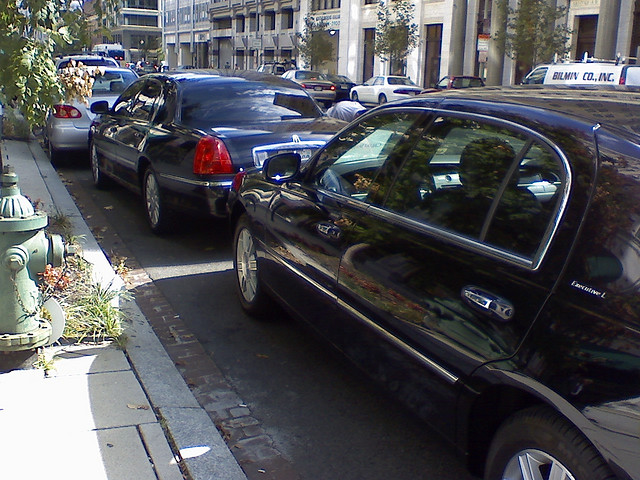
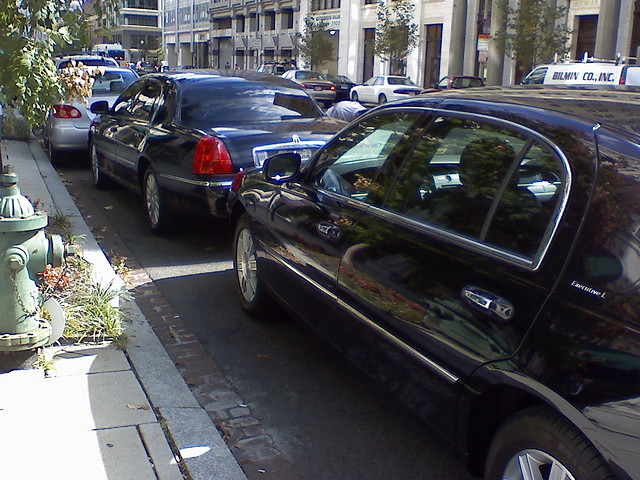
Part of Cheh’s amendment bill addresses the governance of “sedan-class” vehicles—livery operations that are more than a taxi, but less than a full-service limousine. Specifically, the amendment would smooth things out between the D.C. Taxicab Commission and Uber, the smartphone app that hires upscale black cars for passengers looking for something more luxurious than a cab to get around town in a pinch.
But Uber’s pricing model—a $7 base fare plus $3.25 for each mile traveled and 75 cents for each minute a car is hired—is out-of-sync with the DCTC’s approved meter rates, a point of contention that erupted in January when the commission’s chairman, Ron Linton, conducted a “sting” on an unwitting Uber driver. And its arbitrary nature has sparked worries that Uber, in setting its own rates, could potentially undercut the District’s metered cabs.
The text of Cheh’s amendment, which was shared with DCist by a Council aide, offers several rule changes that would stabilize livery sedan operations. In the draft amendment, Uber is mentioned once in a heading.
The most important part of the Uber amendment states that the minimum fare in a sedan-class vehicle be five times the $3 drop rate charged by metered cabs. As it happens, Uber’s minimum fare is $15. The amendment also pushes livery sedan companies, especially those that book passengers through mobile applications, to offer an estimated fare before a passenger enters the vehicle. Uber has also been flagged for only sending its customers receipts after a ride is finished.
If Cheh’s amendment passes, companies that comply with its provisions would be exempted from the DCTC’s oversight. In a brief phone interview, Linton said he did not view this amendment as an issue specific to Uber. “From our standpoint the bill is dealing with a certain class called ‘sedan class,’ ” he said. “We’re working out appropriate language that makes it possible and protects the consumer.”
While Uber is mentioned only once in the draft amendment as a section header, a memorandum Cheh—who chairs the Council’s Environment, Public Works and Transportation Committee—circulated with her Council colleagues explains in details concerns presented by Uber. Among those concerns are the ability to operate without regulation from the DCTC and to charge substantially higher prices than regular cabs while still operating on a fare schedule based on time and distance.
Like the amendment, Cheh’s memo seems to put Uber in a larger class of sedan services. But for practical matters, Uber is in a league by itself. Limos.com, a competing company that plans to roll out a D.C.-specific service later this summer, presents its customers with estimated fares before rides are booked.
But Uber CEO Travis Kalanick wrote in an email to his customers today that the company does not want to see a pricing floor implemented. Kalanick argues that the amendment would block Uber’s latest announced product, a discounted service that hails less luxurious cars. In his email, Kalanick calls the amendment a giveaway to the District’s cab industry.
[T]hey are handicapping a reliable, high quality transportation alternative so that Uber cannot offer a high quality service at the best possible price. It was hard for us to believe that an elected body would choose to keep prices of a transportation service artificially high—but the goal is essentially to protect a taxi industry that has significant experience in influencing local politicians.
Through a spokesman, Cheh said the amendment was hammered out by every interested stakeholder: “We worked with Uber and all the parties. Our intention was to make it so that Uber could continue to operate and we think we have that in this amendment.”
Besides Uber, Cheh’s amendment also focuses on cabs’ fuel emissions, passenger complaints and the distribution or taxicabs across the city.
Cheh’s amendment:
2012.07.10 Taxi Amendments
Cheh’s memo:
Memo to Members July 9
Additional reporting by Martin Austermuhle