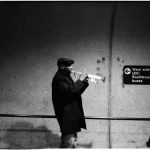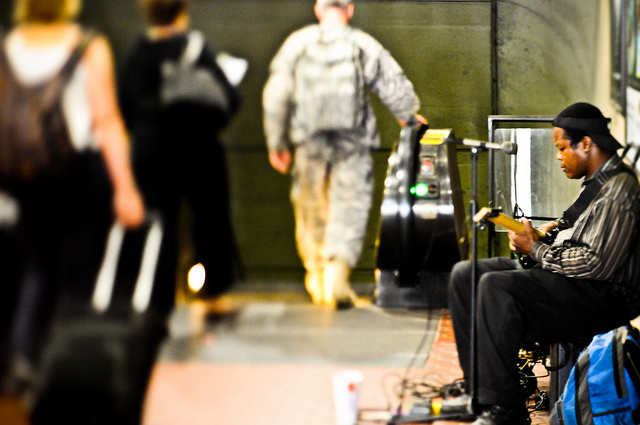
 Photo by Chris Reif
That the Washington Metropolitan Area Transit Authority only gave musicians four days to prepare themselves for hastily announced auditions to perform outside Metrorail stations is one of many complaints that a coalition of local performers has with the transit agency.
Yesterday, Listen Local First, a group that promotes homegrown singers and bands, lodged its concerns with MetroPerforms!, a series of musical performances outside various stations along the rail system. The program’s 2012 edition was announced only last Friday, with auditions being scheduled for yesterday evening.
According to Chris Naoum, who runs Listen Local First, the abrupt scheduling led to Metro’s review panel seeing only about 50 performers, half of whom appeared to be WMATA employees. “So that really means 25 artists showed up,” Naoum writes in an email. And almost none, Naoum said, were professional musicians.
But the hasty planning is the least of Naoum’s worries. More important, he writes, is the way the setup of MetroPerforms! marginalizes D.C.’s hardworking musical talent by preventing them from earning tips or selling merchandise during their performances. Noting that transit agencies in other cities—New York, Boston, Chicago—have more developed systems for licensing buskers to perform at subway stations, Naoum says Metro is behind the curve.
“Why are these guys incompetent?” Naoum asks. “Why does D.C. need to be the exception when we have incredibly talented music being made right here in our backyard?”
For its part, Metro is holding fast to its line from yesterday, referring all questions about busking to the agency’s longstanding prohibition on panhandling.
“It’s part of a longstanding policy against solicitation,” says WMATA spokeswoman Cathy Asato. “And those are rules that we need to abide by.”
But couching tips and record sales as begging only sets off Naoum further. “Panhandling?” he says. “They are treating musicians like a bunch of beggars.”
Asato says that from Metro’s perspective, the musicians who wind up being tapped are getting an opportunity to perform and show off their skills to commuters and passersby. But Naoum argues that all the benefits, in fact, go to WMATA. “They think they are promoting the arts when in fact they are killing them,” he says.
With musicians not being permitted to pass a hat or, more appropriately, sell EPs, he’s not entirely wrong. Listen Local First, while perhaps a bit too eager about some musicians simply because of their geographic origins, works to persuade businesses and other organizations to invest in local artistry. But if WMATA refuses to pay for music, Naoum fears that could lead to more agencies and companies expecting artists to perform for free.
“How can Listen Local First convince local businesses to set aside budgets to pay musicians when the government and WMATA are not prioritizing paying musicians?” he says.