The superhero blockbuster promises catharsis in a crowd-pleasing package. Depending on the fanboy you talk to, The Avengers and The Amazing Spider-Man may or may not have delivered on that promise. But there’s a new masked man in town. The most anticipated and in some ways most successful of the summer blockbusters towers above the others in a category that doesn’t seem like a sure-fire box office strategy: anxiety. A feeling of dread and helplessness pervades much of Christopher Nolan’s The Dark Knight Rises, the final installment of his Batman trilogy. The lost souls that protect and terrorize Nolan’s world are nearly all motivated by economic disparity, a collapse of the moral authority of our leaders, and old-fashioned revenge. Maybe future audiences living in a more stable and egalitarian society will find Gotham City an unrecognizable dystopian fantasy. But it seems all too plausible and real today.
Unlike many other superheroes, Batman was not born of the bomb, but nukes are an irresistible symbol of energy and power in all their connotations, and new Gotham City is threatened by that old demon, Nuclear Anxiety. A scientist with the expertise to solve the world’s fuel problems or send it to a fiery end is kidnapped from a private jet in a daring mid-air attack. Science and technology has brought us to these heights, but as smoothly as the laws of aerodynamics keep us aloft, a determined evildoer with a voice like an omniscient metal narrator can just as easily take it down. This is where much of the movie takes place, in depths—geographical and emotional—from which characters hope to rise.
Against this dark scenario we meet Bruce Wayne (Christian Bale), still recovering from crippling injuries sustained the last time he fought crime, eight years ago. How should we feel when the world is at risk and our heroes have fallen? Worried! One by one those who serve and protect the metropolis are injured, and if they survive at all you fear they lack the strength to overcome the evil in their midst. Must they enlist those they don’t quite trust (Anne Hathaway’s morally ambiguous Catwoman) to have any shot at conquering evil?
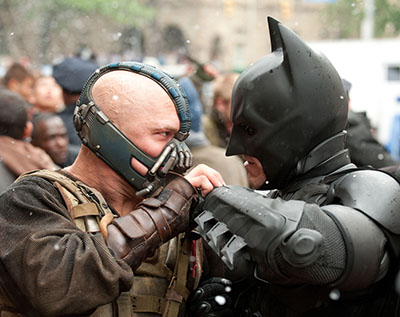 Tom Hardy and Christan Bale (Ron Phillips/Warner Bros.)
About that moral ambiguity and evil. Bane (Tom Hardy) is introduced by his jarring metallic voice which seems to be coming from inside the house. (A request for retro-futurist action filmmakers: a robotic villain who communicates only in loops from Lou Reed’s Metal Machine Music). He is obviously a monster, but he and Batman happen to share a few distinctive character traits: a mask and an altered voice. Aren’t good and evil two sides of the same human coin? I’m a sucker for movies about finding your voice, which is one of the reasons I enjoyed Andrew Garfield’s Spider-Man immensely, but what if that voice is artificial? This goes for both Bane and the “I’m always really angry” voice of Christian Bale’s caped crusader. As evil and unstoppable as Bane is, this connection suggests that our moral compass can depend on circumstances beyond our control. Who’s to say that, given each other’s back stories, they would flip their visions of good and evil? It recalls a line from John Huston’s Noah Cross in Chinatown: “most people never have to face the fact that at the right time and the right place, they’re capable of anything.”
We are capable of anything, but if Cross had his mind on the dark end of that street, there’s another option. This is what drives the failing body of Bruce Wayne to overcome pain and fear. Batman may be a hero; Bruce Wayne is a man who experiences fear and pain just like anybody else, so even though he doesn’t have what anyone would call social graces, you root for him anyway. At a key moment, I was hoping for a cameo by Rob Schneider, who has been absent from the last few Adam Sandler movies but would have provided a welcome bit of levity with his signature line, “You can do it!”
Still, there is little uplifting in this hero’s journey, and despite the inevitable resurrection of Wayne’s Christ-like hero, there is little rejoicing. Was there even a blockbuster that reminded us more of our imperfection? We look up to the big screen for what Hollywood tells us are superhuman specimens, but in this movie bones ache and skin blemishes. Bale’s Bruce Wayne begins the movie as a wealthy but disheveled recluse, and even when he first dons his suit, the mouth exposed by his mask reminds me a little of that scarred icon, Tommy Wiseau. The facial disfigurement of Tom Hardy’s Bane is only hinted at, but his body has obvious signs of suffering. Hardy is required to act mainly with his eyes, and he doesn’t quite have the chops to carry it off — compare to Charles Laughton’s Quasimodo, whose disfigurement left him to act with one eye, and weep at what might have been. Still, hero and villain alike bear physical and emotional marks of pain, and even the beautiful Marion Cotillard has scars.
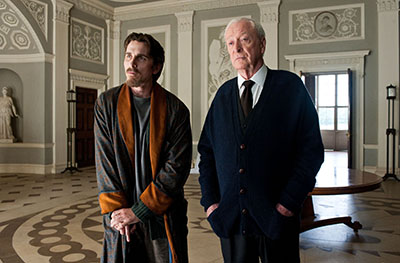 Christian Bale and Michael Caine (Ron Phillips/Warner Bros.)
Cotillard is one of a handful of cast members who also appeared in Nolan’s last movie, the smash thriller Inception, and a few set pieces ring a bell here as well. Thankfully Ellen Page isn’t around to explain every scene that just happened. Inception was the ambitious work of an art house director given the reins of an action movie, but TDKR, while not lacking in the self-importance of an ambitious motion picture artiste, is if anything more relentless in its tension — if you could tell yourself that the action in Inception mostly occurred in the mind, the frail bodies of The Dark Knight Rises keep reminding you it isn’t a dream.
There’s no summer escapism to be found in The Dark Knight Rises. It plays on public fear like a politician, and fuels anxieties that will resonate beyond the fanboy base that has clamored for death sentences for critics who dare to write a negative review. As blockbuster spectacles go it’s pretty awesome, but at the same time it’s an awesomely negative movie. I admired Frank Miller’s The Dark Knight, the bleak graphic novel that preceded Tim Burton’s uneven crack at the popular franchise, and at the time I hoped for a movie vision as bleak as Miller’s. Nolan’s series delivers such a vision, but it’s an inferno with no convincing paradise at the end.
—
The Dark Knight Rises
Directed by Christopher Nolan
Written by Jonathan Nolan, Christopher Nolan and David S. Goyer.
With Christian Bale, Anne Hathaway, Marion Cotillard, Tom Hardy, Joseph Gordon-Levitt, Morgan Freeman, Michael Caine, Gary Oldman
Rated PG-13 for intense sequences of violence and action, some sensuality and language, and enough muscular complaints to painfully remind older audiences of their mortality.