Martin Austermuhle
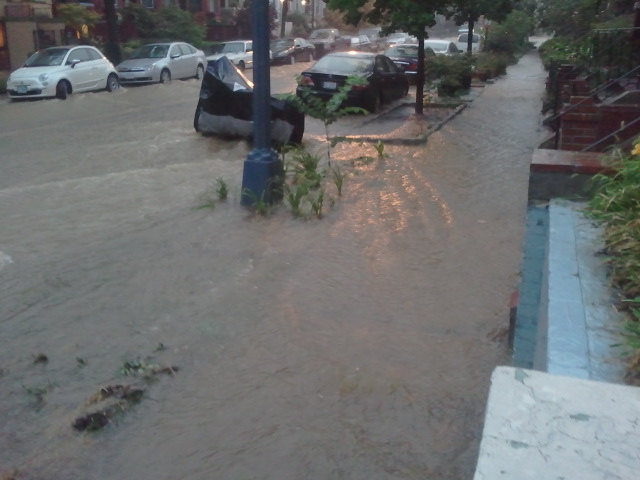 Flooding in Bloomingdale last week. Photo by @kgaines
Rhode Island Avenue through Bloomingdale again became the Rhode Island River last night, causing flooding in the neighborhood for the third time in two weeks and provoking fears of what could result after the heavy rains that are expected today. Residents—many of whom have seen flooding in their basements—are expressing frustration that D.C. agencies haven’t responded quickly enough and that the principal solution to the flooding is over a decade off.
Teri Janine Quinn, president of the Bloomingdale Civic Association, said that residents were at “their wits’ end” with the flooding that has struck in the last two weeks. “To go into someone’s house and trudge through sewage…it’s just an overwhelming feeling,” she said. Quinn, a four-year resident of the neighborhood, also asked why city agencies were so slow to respond. “Why didn’t they hustle and get things together for Thursday?”
Bloomingdale resident Derrick Jones puts the blame squarely at the feet of the D.C. Department of Public Works, which he says has been unresponsive to neighborhood pleas that sandbags be distributed ahead of storms.
“After last week’s storm (which happened very quick and with little warning) DC DPW had to be aware that the Bloomingdale neighborhood was at high risk for flooding during similar storms in the future,” wrote Jones in an impassioned blog post about yesterday’s flooding. “They had to be well aware that the city’s antiquated drain system simply cannot handle the amount of water we’ve been receiving. And one has to believe they saw that Bloomingdale residents were very quick to request sandbags – or any kind of assistance – from DC DPW.”
That assistance is on its way, said Councilmember Kenyan McDuffie (D-Ward 5), who told us that DPW will be distributing 1,500 sandbags to select locations throughout Bloomingdale, LeDroit Park and other affected neighborhoods today. (Sandbags will be available at RFK Stadium between 2-11 p.m.) He also called for an “all hands on deck” approach to stem the flooding and respond to the damage it leaves behind, and said that he had been in constant contact with city agencies and the mayor’s office.
Quinn has started a petition to gather information on damage to homes for future insurance claims. Residents have expressed concern that their insurance companies won’t cover damage caused by the floods; one even floated the idea of a class action lawsuit against D.C. for its part in allowing the floods to happen. Also, the D.C. Department of Transportation today encouraged residents to move their cars out of flood-prone areas.
On a longer term, D.C. Water is working at increasing the area’s sewer capacity. According to Alan Heymann, a spokesman for D.C. Water, flooding has happened in Bloomingdale because it sits in something of a geographic bowl and is served by some of the city’s oldest sewer lines, dating back to 1879.
In 2001, the neighborhood was hit by some of the worst flooding in D.C. in a half-century, with an estimated billion gallons of rain water overwhelming a combined sewer line that could handle only a fraction of that. (Some 3,000 properties were damaged by the flooding.) Flooding also occurred in 2006, after which the then-D.C. Water and Sewer Authority published a report explaining why the flooding happened. (The report is here in .PDF format.)
A $2.6 billion infrastructure project that will see a massive tunnel under the Anacostia River serve as a repository for stormwater runoff will remedy that with a 13-mile line running up towards Bloomingdale. Still, the project isn’t set to be completed for 13 years.
“We realize a solution that’s 13 years away is of little consolation to someone whose basement has flooded three times in the last nine days, or even once for that matter,” said Heymann in an email. “We’re in the process of investigating why this seems to be happening more often than usual. We’ve heard a lot from the community on Twitter, in the press, by email, and by phone. We understand the frustration, anxiety and fear that comes along with flooding and sewer backups, and we are going to help.”
For Quinn, though, the explanation about the neighborhood’s pipes isn’t enough. She said that flooding didn’t occur during last years hurricane or the June 29 derecho storm, even though both those storms saw heavy rains. “Something has to be wrong in the system,” she said.
D.C. Water has published a website this afternoon propose a number of short-term solutions. In a press release, D.C. Water stated:
“We have already begun implementing what I call our Bloomingdale Action Agenda,” commented DC Water General Manager George S. Hawkins. “This is a list of specific steps DC Water, residents and businesses, and other parts of the government are taking and can take to reduce the effects of runoff and flooding.”
In addition, DC Water and Councilmember Kenyan McDuffie are in communication about coordinating a multi-entity examination of this problem. District and federal agencies with jurisdiction over streets and alleys, stormwater management, plumbing codes, insurance and flood plains, and residents, all have a part in this discussion.
“I am pleased that DC Water is taking these steps to help our community in the short term,” said Councilmember McDuffie. “I will continue to work with General Manager Hawkins and the staffs of other agencies to resolve the problem in the long term, and my team is exploring any legislative or regulatory changes that might help.”
McDuffie remains concerned, though, saying that the storms seem more intense and seem to be coming with more frequency than before.