Martin Austermuhle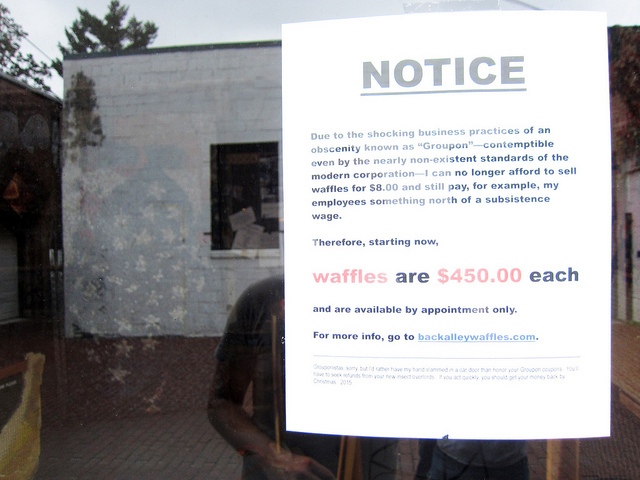
 Photo by thisisbossi
D.C. recently gave LivingSocial a $32 million tax break, but now one local restaurateur is claiming that a competing online coupon service drove it out of business.
Over the weekend, Shaw’s Back Alley Waffles—named because its located in an alley between Ninth and 10th Streets NW—closed its doors, claiming on its website and on a posted flyer that the “shocking business practices of an obscenity known as ‘Groupon'” made it impossible to stay open. (Major hat tip to Flickr user thisisbossi for noticing the closure and snapping the picture above.)
Last week, Groupon offered one of its usual deals on the waffles: 50 percent off on waffles for two or four. Over 670 coupons were bought, but Craig Nelson explained what took place behind the scenes:
Grouponistas, sorry, but I’d rather have my hand slammed in a car door than honor your Groupon coupons. You’ll have to seek refunds from your new insect overlords. If you act quickly, you should get your money back by Christmas. 2015.
Here’s our Groupon story:
Groupon promises to send you lots of new customers. The customers buy 50% off coupons (two waffles for the price of one, for example). They send the money to Groupon, which issues them a code. The customer brings the code into the shop. The shop gives the customer the two waffles, collects the code, and then “redeems”, or verifies, the code with Groupon.
Does Groupon then electronically deposit the money that the customer paid them for the coupon into the business’ bank account overnight like credit card companies do? No. After taking a big chunk of the money as its share, Groupon holds on to the business’ share, using it while the business waits. And waits. And waits. And waits.
After about a month, Groupon issues the first of three payments to the business. By check. Then it has to “process” the check, which can take up to ten days. Then it snail mails the check. A month later, the process is repeated for your next installment. Then, a month later, the process is repeated again for your final installment.
Now, keep in mind, the bulk of the Groupon activity (i.e., the big surge in customers) occurs at the outset of the Groupon campaign. That means the business has to lay out all the money (in our case food and labor) up front to service this expensive campaign, but it takes roughly a month for Groupon to send the (deeply discounted) payment for the waffles those customers ate. And even then its only half or less of what is owed. The business has to wait for most of the remainder of its money until two months after laying out the cost of the food and labor. And for some of the money, it will be three months after honoring the customer’s Groupon coupon in the shop before the business is paid for that customer.
That’s the part that I didn’t expect and the part that put our new business out of business.
On the restaurant’s website, Nelson, who’s also an artist, hints that while he’s closed for now, he’s still open to selling waffles, albeit at a much higher price—$450. For the price, he says, you’ll not only get the waffles, but also a “4′ x 4′ mosaic…of the subject matter of your choice,” the materials to make the mosaic and the “unparalleled experience of creating your own piece of art.” Waffles (and art) will be available by appointment only.
This certainly isn’t the first time that a small business had groused about Groupon or LivingSocial. In fact, many businesses have decided that it’s not worth it—for a number of reasons. Others argue that it’s simply a matter of reading the fine print: “I hate to say it of a neighbor and purveyor of tasty fare, but unfortunately with this information I would best place blame on him,” says Bossi.
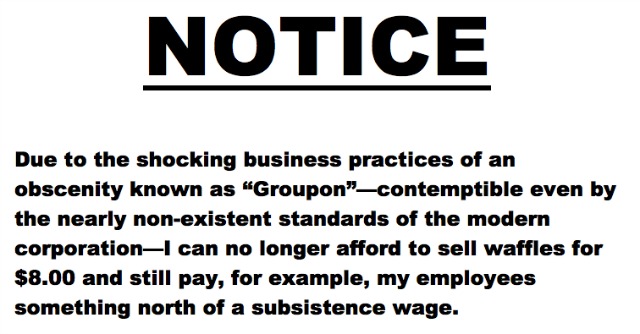 The notice posted by Nelson.