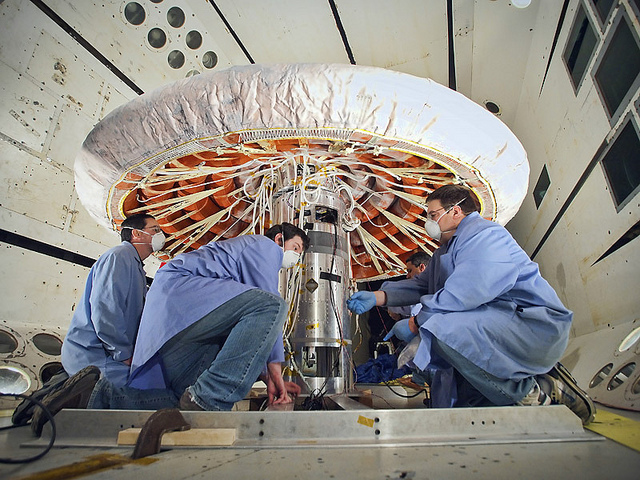
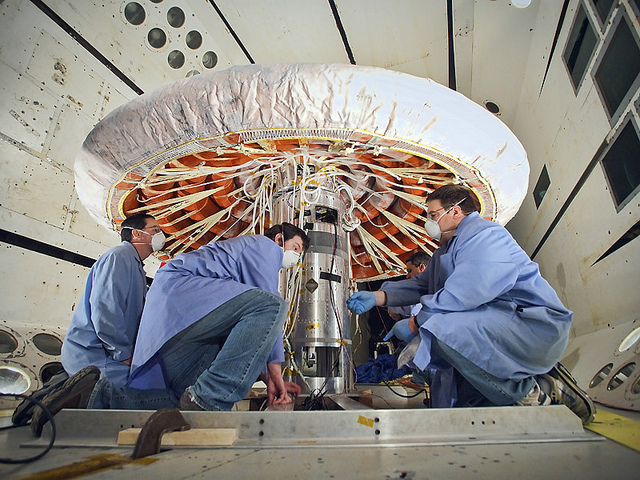
 Technicians prepare the IRVE-3 for its test flight. (Photo via NASA)
Earlier today, NASA’s facility in Wallops Island, Va. launched a rocket carrying an experimental heat shield that, if functional, could play a role in the space agency’s future missions to Mars and elsewhere in the solar system.
The Inflatable Re-entry Vehicle Experiment, or IRVE-3, took off about 7 a.m. today, after its originally scheduled launch on Saturday was scrapped due to inclement weather. The shield is designed to be a lightweight, yet sturdy device capable of protecting spacecraft when crossing atmospheres.
A NASA press release described the appearance of the 680-pound IRVE-3 as akin to “a large, uninflated cone of inner tubes” packed inside the nose of a Black Brant XI, a Canadian-manufactured sounding rocket.
Once detached from the rocket, the IRVE-3 is designed to expand to a diamater of nearly 10 feet through a system of nitrogen pumps.
After ignition, NASA expected the rocket climbed to an altitude of about 280 miles over the Atlantic Ocean. Once the shield deployed, IRVE-3 was designed to descend to the surface about 350 miles south of Wallops Island, somewhere off the coast of North Carolina. The flight was scheduled to take all of 20 minutes. A U.S. Navy vessel is currently looking for the device, WTOP reports.
NASA designed the IRVE-3 specifically with the Red Planet in mind.
“We originally came up with this concept because we’d like to be able to land more mass and access higher altitudes on Mars,” Neil Cheatwood, the project’s lead investigator, said in a NASA press release. “To do so you need more drag. We’re seeking to maximize the drag area of the entry system. We want to make it as big as we can.” Current heat-shield technology has been limited by the size of launch vehicles, he added.
Watch video of the launch: