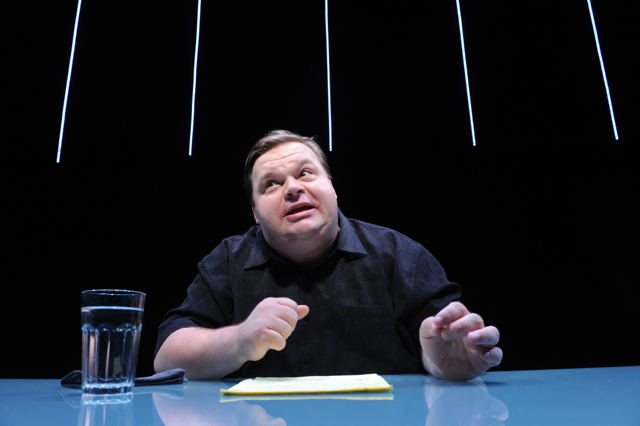
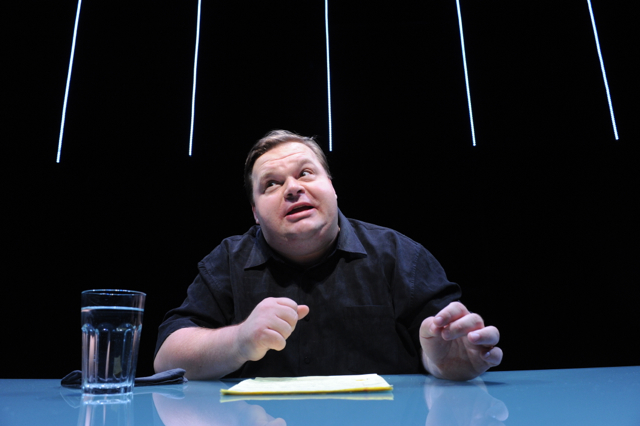
 Daisey (Stan Barouh/Woolly Mammoth Theatre Company)
I’m sitting in an auditorium at Georgetown University. Days earlier, a man named Mike Daisey admitted to the world that a monologue he had been performing for more than a year about the iniquities at the Chinese manufacturing plants where Apple products are cranked out contained several fabrications. I’m sitting in this auditorium at Georgetown University watching Mike Daisey squirm around the truth, and I get very angry.
Take two: Nearly four months later, Daisey is back at Woolly Mammoth Theatre Company performing a re-engineered version of his hit one-man show, The Agony and the Ecstasy of Steve Jobs. You might have heard that in March, two months after the show took over an episode of This American Life, that a public-radio reporter fact-checked Daisey’s account of his time in Shenzhen, China, only to discover that several elements of Daisey’s story were cooked up.
In the new version—call it Agony and Ecstasy 2.0—Daisey’s most flagrant strays from veracity have been excised. Gone are the teenage assembly-line workers, the assault-rifle-toting security guards and, perhaps most memorably, the former Foxconn employee with the deformed hands who marvels at the wonder of the iPad. All these elements of Daisey’s story are gone. The storyteller has, since being caught in his web of lies, strained to make amends to the journalists whose legitimate investigations illuminated far darker truths about Apple than Daisey could conjure from thin air.
But this is not some TED Talk. It’s theater. And zapped of its most gripping facets, Agony and Ecstasy is a dull corporate history peppered with whiffs, not blasts, of workplace horror. Instead, Daisey is once again relying on his best assets—his charisma and humor—such as moments in which he is describing his fascination with technology or his recreations of conversations between Steve Jobs and Steve Wozniak.
Unfortunately, where Agony and Ecstasy is concerned, watching Mike Daisey be Mike Daisey is now a chore and a two-hour exercise in vanity. He is still consumed by his own role as messenger of Apple’s corporate misdeeds, acknowledging but not rectifying the fact that his message was flawed. Daisey has long been a fixture of summers at Woolly Mammoth, but ideally, he would use these weeks to workshop a new project, not wring the last bits of life from a irreparably damaged monologue.
In March, I wrote that I agreed with Daisey’s “urgency of the broad strokes.” Does Apple contract with Foxconn to manufacture its products? Are the labor conditions at Foxconn grueling, unsafe and otherwise deplorable? Was Steve Jobs practically unmatched in creating public adoration for his company and its inventions?
The answer to those questions then was yes, and the answers are the same today. Daisey’s message remains compelling, but he is an infuriating messenger. He might no longer insist on programs being printed with the statement “This is a work of nonfiction,” but the cult of Daisey continues, at least in Daisey’s mind.
“Tonight we are jailbroken,” he says near the end, comparing the audience to locked-down iPhones. But Daisey shouldn’t be our re-programmer. We could continue to debate the agony and ecstasy of Mike Daisey, but it’s probably time to move on.
The Agony and the Ecstasy of Steve Jobs, at Woolly Mammoth Theatre Company (641 D Street NW) through August 5. Tickets begin at $45.