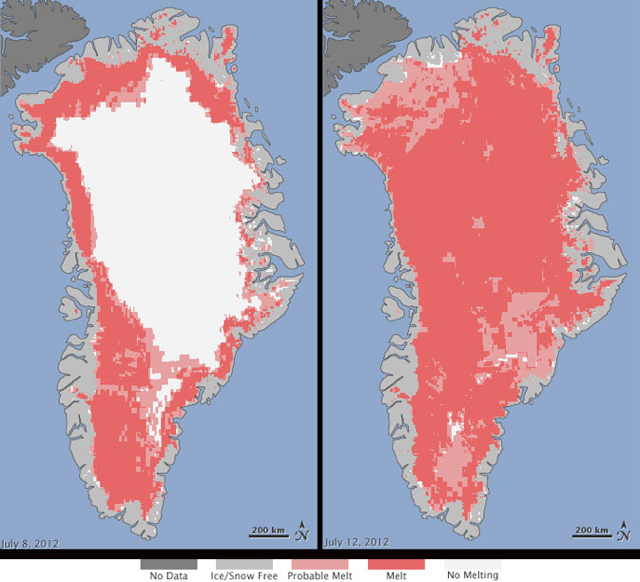
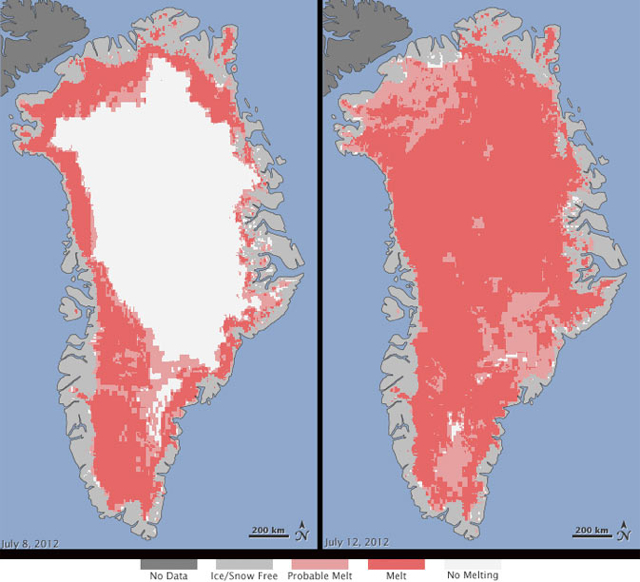
 Image via NASA
This is kind of scary. According to a NASA analysis of recent satellite readings, it took just four days for nearly all of Greenland’s surface ice to melt amid an oppressive heat wave a couple weeks ago.
On July 8, 40 percent of the landmass was covered in ice. That’s a normal figure for summertime on the Arctic island, where the ice sheet usually shrinks by about half during the hottest months of the year.
But four days later, three independent satellites passing overhead recorded the same startling finding—almost all the ice was gonesurface ice had started to melt. On July 12, 97 percent of Greenland’s icy blanket was thawing out, a record amount of melting in a record amount of time.
The discovery was so severe, researchers at NASA’s Jet Propulsion Laboratory in California analyzing the satellite data thought it was a mistake. The space agency has monitored Greenland’s annual ice melt for 30 years, and has never recorded anything like this before.
“This was so extraordinary that at first I questioned the result: was this real or was it due to a data error?” Son Nghiem, who first analyzed the satellite imagery, said in a NASA release. But it was no error, he quickly found:
Nghiem consulted with Dorothy Hall at NASA’s Goddard Space Flight Center in Greenbelt, Md. Hall studies the surface temperature of Greenland using the Moderate-resolution Imaging Spectroradiometer (MODIS) on NASA’s Terra and Aqua satellites. She confirmed that MODIS showed unusually high temperatures and that melt was extensive over the ice sheet surface.
Thomas Mote, a climatologist at the University of Georgia, Athens, Ga; and Marco Tedesco of City University of New York also confirmed the melt seen by Oceansat-2 and MODIS with passive-microwave satellite data from the Special Sensor Microwave Imager/Sounder on a U.S. Air Force meteorological satellite.
Two weeks ago, much of North America, especially the East Coast, experienced waves of record-breaking heat. While we were experiencing consecutive days of triple-digit temperatures and hyperthermia alerts, Greenland was also in the middle of its own heat wave. On July 11 and 12, temperatures recorded at Summit Camp hovered a degree or two above the freezing point for several hours.
That might seem chilly and inviting for U.S. residents who are enduring one of the hottest summers on record, but the average temperature in July at Summit Camp, located 10,551 feet above sea level, is 14 degrees.
Ice cores analyzed be researchers in Greenland show that a melting event this severe last occurred in 1889. Lora Koenig, a NASA scientist, says this happens about once every 150 years, so it could be a regular event. Then again, Koenig and other researchers want to be sure this isn’t the new normal.
“But if we continue to observe melting events like this in upcoming years, it will be worrisome,” she says in NASA’s article.