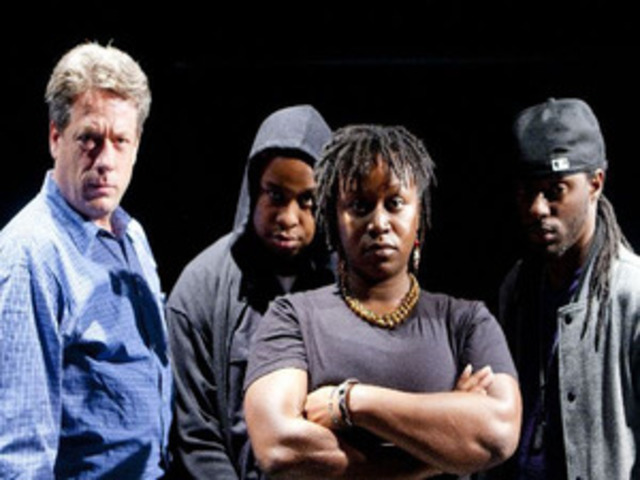
 If the name of the performance wasn’t indicative of Gil Scott-Heron’s influence over the play, then other aspects of The Revolution Will Not Be Televised should give it away. The rolling set pieces mirror the title: the brightly painted sides are covered with pictures of televisions and Scott-Heron’s compositions played in between each of the seven vignettes. One of the seven vignettes in Revolution even portrays an awkward high school class discussion of his poem, “Whitey on the Moon.”
The awkward race relations discussion with a seemingly unaware teacher played by Todd Clark (and its hilariously dark surprise ending) offers one of the few moments of levity in an hour of portrayals of serious social issues. This is appropriate, of course, considering the content of Scott-Heron’s work, but the scenes range from powerful to preachy. Louis E. Davis and Marlon Anthony Russ offer an electrically charged scene of a father and son who even over their matriarch’s deathbed, still struggle to come to grips with the son’s sexuality. Davis also shines as the drug-addled personification of a soon-to-be-aborted fetus haunting his would be mother.
Those scenes inspired by “Home Is Where the Hatred Is” and “Who Will Pay Reparations on My Soul?” are extremely intense, but playwright Faruq Hussein-Bey demonstrates that not all life decisions are necessarily that heavy. Hussein-Bey lightens the mood slightly with vignettes where a stay-at-home mother does a voiceover where she debates and rationalizes her decision to give up her career and another where a seemingly happy couple delves into their dynamics. While these scenes involving more mundane decisions are less successful than the heavier fare—even after the argument we have very little character development and the voice-over sounds more recitation than stream-of-consciousness. Still, if all of the vignettes were as dark as the first two mentioned in this paragraph, the effect would not be as strong and the play would drag.
That said, it’s worth staying until the end as the final vignette, the briefest of the seven actually shows the most scathing but perhaps the most original social commentary shown within the hour. Unsurprisingly, it’s a modern update of “The Revolution Will Not Be Televised.”
Remaining Performance: June 29, 3 p.m.
Mountain at Mount Vernon United Methodist Church, 900 Massachusetts Avenue NW