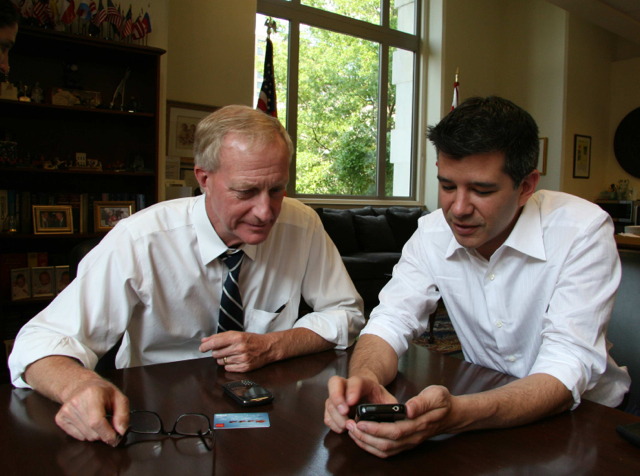
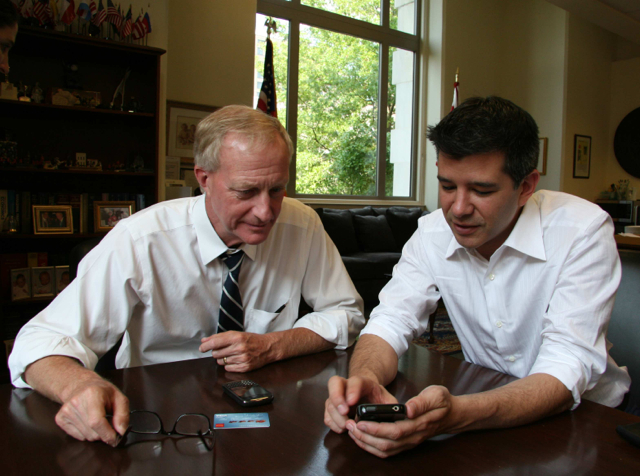
 Uber CEO Travis Kalanick, right, shows his company’s smartphone application to Councilmember Jack Evans (D-Ward 2). (Photo by @JackEvansWard2
Despite its furious insistence otherwise, Uber, the on-demand black-car service, did attempt to hammer out a deal that would have exempted it from regulation in exchange for its accepting a minimum fare, correspondence from the company’s lobbyist reveals.
Earlier this month, Councilmember Mary Cheh (D-Ward 3), an admitted fan of Uber, was all set to “legalize” the controversial livery company. Cheh planned to amend the D.C. Council’s comprehensive taxicab overhaul bill to create a new class of regulated sedans using Uber’s price structure as a benchmark. By setting the minimum fare at no less than five times the flag drop of a standard taxi—a $3 charge—Cheh would have codified Uber’s $15 minimum into law, effectively freeing the company from drawing the continuous ire of the D.C. Taxicab Commission.
But in a flash on July 10, Uber went nuclear over Cheh’s amendment, with CEO Travis Kalanick marshaling his customers to bombard councilmembers with phone calls, emails and online petitions demanding the amendment not be ratified. Rather than risk her amendment tanking a comprehensive taxi bill that was the product of nine months of legislative grinding, Cheh pulled it. In its place, Councilmember Jack Evans (D-Ward 2) introduced an amendment barring the DCTC from regulating “a business that uses a mobile phone application to connect its users to sedan service.” (If not identifying Uber by name, the text of Evans’ amendment defined it by business model.)
Kalanick and his customers loudly objected to the notion of a price floor, which Cheh’s amendment would have implemented. Throughout the lobbying effort to nix the measure, Kalanick said Uber has “always been opposed to price fixing,” despite statements from Cheh and her staff saying that Uber “negotiated in good faith” an agreement that would make its business street-legal in a city with a heavily entrenched taxi industry.
This week, Kalanick finally met with several members of the D.C. Council. Though Kalanick did not replied to multiple interview requests with DCist, he did sit down for a lengthy conversation with the Post’s Mike DeBonis. In the Post interview, Kalanick said he would like to see Evans’ amendment, which freed Uber from regulation through December 31, be made permanent. “That should just be the law we operate under,” he told DeBonis. “It’s just that simple.”
In an email, Evans’ spokesman said Kalanick’s visit to the John A. Wilson Building was “just a check-in.”
Kalanick also applauded Evans and the other councilmembers who backed Uber’s free pass—David Catania (I-At Large), Michael A. Brown (I-At Large) and Tommy Wells (D-Ward 6). But when it came to Cheh’s proposed price floor, Kalanick repeated to DeBonis his insistence that Uber never considered negotiating a price floor.
However, an email between Cheh’s and Uber’s D.C. lobbyist argues the contrary, that the company did have conversations about a mandated minimum fare. Earlier this year, Uber hired Claude Bailey, a partner Venable LLP, to be its representative before the D.C. Council.
Although there was disagreement on where a price floor should have been set, the tone of Bailey’s email to Cheh suggests that Uber was willing to accept such a compromise in exchange for not being regulated by the D.C. Taxicab Commission.
“As promised, Rachel [Holt, Uber’s D.C. manager] did consult with her superiors about your idea to create a mandatory minimum fare for Uber that would be five (5) times the current “flag drop” rate for taxicabs, i.e., $15, the current Uber minimum fare,” Bailey wrote. “Ideally, Uber management would prefer a $10 minimum fare. Is there room for a possible compromise of a minimum fare somewhere between the two?”
Reached by phone, Bailey declined to comment without the authorization of his client.
UPDATE, 5:25 p.m.: In an email to DCist, Kalanick accuses Cheh of helping to “gouge” people by attempting to regulate his company in a “back-room deal.”
“It amazes me that in response to calls that Cheh is protecting the taxi industry and price gouging her own constituents, that Mary Cheh responds saying she somehow had a back-room deal that makes it OK,” Kalanick writes. “When a private company wants to charge consumers less for a product and the elected representative for those same consumers is trying to force their own constituents, something’s really wrong.”
Kalanick repeats his assertion that Cheh is helping the taxi industry gouge D.C. residents and not acting in her constituents’ interests. “The fact that she still doesn’t seem to get this is troubling,” Kalanick says.